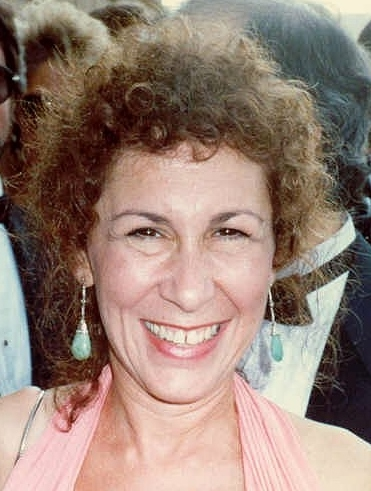
Rhea Perlman has a Jewish background and has publicly expressed reservations about organized religion. She has also spoken about family traditions without presenting them as a fixed religious identity for her children. That combination gives a more useful answer than assuming that her Cheers character, Carla Tortelli, reflects the actress’s own faith.
Rhea Perlman’s own words about religion
In a 1998 Los Angeles Times interview, Perlman said, “I truly don’t have a great feeling about any particular organized religion.” The original interview is an older source, so it should be understood as a statement made at that time.
Her Jewish identity also appears in a 2010 Jewish Journal interview. She recalled her 1982 wedding to Danny DeVito, who came from a Catholic background. The report explains that neither a rabbi nor a priest officiated. This is a specific detail about that event, not a reason to guess how either spouse practiced religion throughout the marriage. Read the interview with Perlman and her daughter.
These sources let us distinguish heritage, personal views, and family life. Someone can cherish a Jewish background while remaining cautious about religious institutions. Someone can share holiday traditions without giving a complete statement about God. Those differences deserve to be reported carefully instead of flattened into a yes-or-no label.
A career built on sharp timing
Perlman was born in Brooklyn in 1948. She became best known as Carla on Cheers, a role that earned four Emmy Awards. Her career also includes Matilda, in which she appeared with Danny DeVito, and Barbie, in which she played Ruth Handler. She has worked in theater and written children’s books as well as acting on television and in films. Her biography provides a career overview.
Comedy often depends on what happens between the lines. A pause, a glance, or a quick response can change a whole scene. Perlman’s familiar performances show why a supporting actor can become essential to an ensemble. Carla’s sharp tongue was one piece of a fictional world written by many people. It cannot tell readers whether Perlman prays, attends services, or agrees with a religious teaching.
That boundary is especially helpful here because Carla’s religion is part of the show’s storytelling. This article concerns the actress’s public background and comments. It does not transfer a character’s Catholic identity to the performer.
Is Rhea Perlman a Christian?
The material reviewed describes Perlman as Jewish and includes her criticism of organized religion. It did not provide a verified public profession of Christian faith. That is a limit on the available evidence, not a claim about every private thought she has had. Her older statements also should not be presented as if she gave a new interview today.
Tradition, institutions, and the Bible
Many readers understand the distinction between valuing family traditions and feeling uneasy about religion. Institutions can do real good, but people within them can also fail others. The Bible itself takes religious hypocrisy seriously. In Matthew 23, Jesus rebukes leaders who use religion to lift themselves up while neglecting justice, mercy, and faithfulness.
Christians should hear that warning before using it against anyone else. A church label does not make cruelty holy. Faith should lead to honesty, care for neighbors, and humility. James 1:27 points toward practical care for people in need, not empty religious display. It is reasonable to ask whether our lives match our words.
At the same time, the Bible does not stop with disappointment in institutions. It points to God Himself. Christianity grew from the Jewish Scriptures, and Jesus and His earliest disciples were Jewish. Christians therefore have no reason to speak with contempt about Jewish people or heritage. The central disagreement concerns who Jesus is and whether He is the promised Messiah, not whether another person deserves respect.
From the Christian perspective, Jesus fulfills God’s promises and opens the way for people of every nation to be reconciled to God. The comparison here concerns that claim. It does not suggest that Perlman has publicly debated it or that we know her full response to it.
The gospel for anyone looking for hope
Perhaps you came here only to learn what a favorite actress believes. Her story may also raise questions about your own relationship with religion. The gospel invites you to look beyond a celebrity, a family label, and even a disappointing experience with a church. It asks you to consider Jesus Christ.
God created us for a life of love and truth. All of us have sinned and fallen short of His glory (Romans 3:23). The problem is not limited to religious leaders or famous people. It includes us. We cannot undo our guilt simply by being more open-minded, more generous, or more attached to a tradition.
Jesus, the Son of God, lived without sin. He died on the cross for sinners and rose from the dead. His death deals with sin, and His resurrection grounds Christian hope in a living Savior (First Corinthians 15:3–4). God’s justice is real, but His mercy is real too.
Salvation is a gift received through faith, not a reward earned through good works (Ephesians 2:8–9). Repentance means turning from sin toward God. Faith means trusting Jesus to save you. You can begin by reading Luke’s Gospel and asking honest questions in a Bible-teaching church. The invitation is offered respectfully, but clearly: forgiveness and eternal life are found in Christ.
Photo credit: Alan Light, via Wikimedia Commons, CC BY 2.0. Existing Commons portrait crop. No endorsement implied.
_-_cropped.jpg)