People · Beliefs
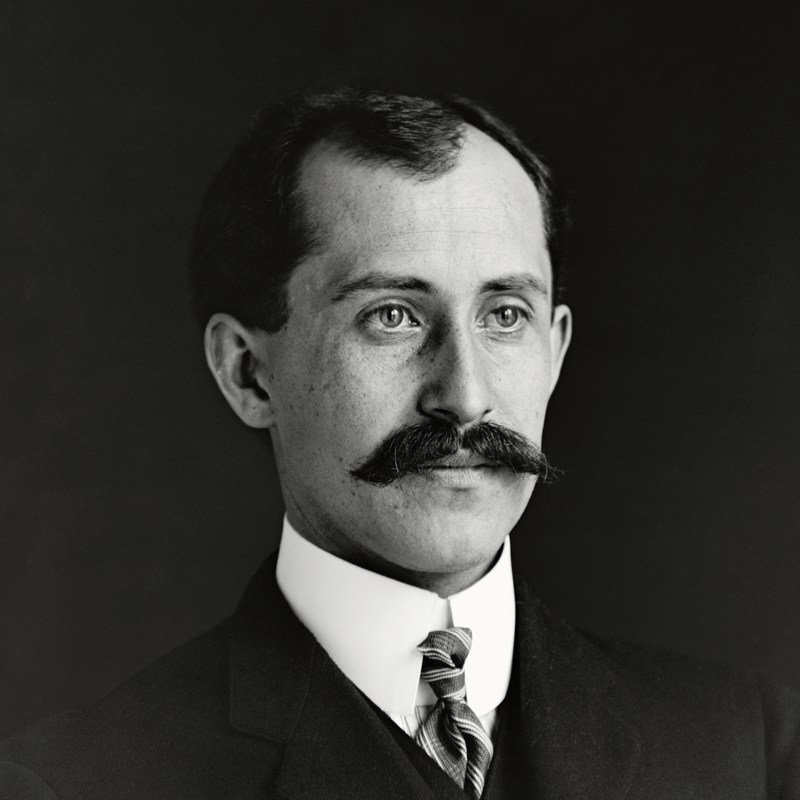
Orville Wright
Bishop Milton Wright brought his boys a little flying toy from one of his travels. Orville remembered it long after he and Wilbur had built a machine big enough to carry a man.
- Born
- August 19, 1871 · Dayton, Ohio
- First powered flight
- December 17, 1903 · 12 seconds
- Family tradition
- Church of the United Brethren in Christ
- Died
- January 30, 1948 · Dayton, Ohio
What a bishop brought home
When Orville Wright was a boy, his father came home with a toy that could fly. It had a rubber band and a rotor. When released, it climbed toward the ceiling. Orville and his older brother Wilbur played with it until it broke, then built versions of their own. Orville later traced their early interest in flight to that toy. Their first attempts to make it larger also gave them an early puzzle. A bigger version did not fly as well as the little one.
Travel was a regular part of Milton Wright’s work as a minister and bishop in the Church of the United Brethren in Christ. Books filled the family home. The children could ask questions and try things out. Their mother, Susan, had learned to use tools growing up in a wagon maker’s family. The two boys who would one day build an airplane had a mother to turn to when they wanted help making something.
Was Orville Wright a Christian?
Orville grew up in a Protestant Christian household. His father’s church, his mother’s convictions and the family habit of keeping Sunday free from ordinary work all belonged to that upbringing. Milton even named Orville for a clergyman he admired. Yet the question of what Orville himself believed in adulthood has a less clear answer.
In his biography of the brothers, historian David McCullough noted how rarely religion came up in the family’s surviving correspondence. A friend in North Carolina remembered the brothers as Christian gentlemen. That recollection tells us how they treated people who knew them, and how those people understood their conduct. The sources here do not give us a comparable account in Orville’s own words of what he believed about Jesus. His father’s denomination is clear. Orville’s personal profession of faith remains uncertain.
Twelve seconds, then another turn
In Dayton, Orville and Wilbur worked as printers and bicycle makers. When they took up the problem of flight, they had a practical question that an engine alone could never answer. If one wing rose or the machine began to turn, how would a pilot bring it back under control? The brothers built and flew gliders, tested wing shapes in a small wind tunnel, and changed their designs in response to what they saw. They did much of that work in Ohio before they brought their powered Flyer to the North Carolina coast.
On December 17, 1903, at Kill Devil Hills, Orville lay at the controls while Wilbur ran alongside. Orville stayed aloft for 12 seconds and covered 120 feet. Local lifesaver John T. Daniels tripped the shutter on the camera the brothers had set up. His photograph caught the Flyer just after it left its launching rail. The brothers took turns for three more flights that morning. By the fourth, Wilbur stayed up for 59 seconds.
The Flyer had one more astonishing journey ahead of it, in pieces. In July 1969, Neil Armstrong carried wood from its left propeller and fabric from its upper left wing aboard the lunar module Eagle. They reached the surface of the Moon with Armstrong and Buzz Aldrin. The fragments returned to Earth with the Apollo 11 crew.
Beyond the Spotlight
How much of a parent’s faith can a child inherit? A child can inherit stories, a Bible with notes in the margin, or the habit of setting aside Sunday. In John 1:12–13, the apostle describes becoming a child of God as a gift to people who receive Christ. A parent can introduce a son or daughter to Jesus. Each person can answer that invitation for themselves.
Christianity takes seriously the wrong we do even when other people think well of us. The Ten Commandments reach into ordinary life, from the way we speak about a neighbor to our desire for what belongs to someone else. Jesus spoke of judgment and hell, and he also went to the cross out of love for sinners. Christians believe he bore our sin there and rose bodily from the dead. To repent is to face the truth about our sin and turn toward him. Forgiveness comes freely to those who trust him. That invitation is open both to the person raised in church and to the one who has never set foot inside.
Sources
- Library of Congress, the Wright brothers’ boyhood and their flying toy
- National Park Service, Orville Wright’s life and family
- National Park Service, the Wright family and the flight experiments
- David McCullough, The Wright Brothers (2015)
- Baptist Press, historians and contemporaries on the brothers’ beliefs
- Wright Brothers National Memorial, the first flight and its photograph
- NASA, the 1903 flights and the Wright Flyer pieces carried aboard Apollo 11
Photograph: Orville and Wilbur Wright, 1905. Library of Congress, Wright Brothers Negatives, reproduction ppprs.00680. Public-domain portrait via Wikimedia Commons, restored by Scewing and cropped for this profile.
