People · Beliefs
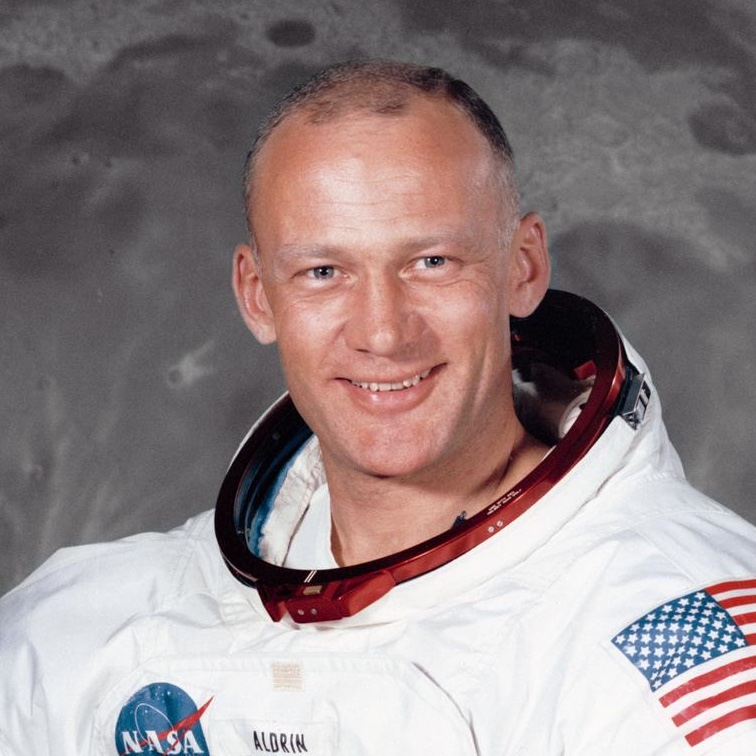
Buzz Aldrin
Before he stepped onto the Moon, Buzz Aldrin poured wine into a silver cup from his church. Decades later, he explained why he might choose a different gesture if he could make that journey again.
- Born
- January 20, 1930
- Doctorate
- Astronautics, MIT, 1963
- Spaceflights
- Gemini XII and Apollo 11
- Apollo 11 role
- Lunar module pilot
Buzz Aldrin had a practical question for his pastor before Apollo 11 flew. Could they find a chalice light enough to take to the Moon? Dean Woodruff brought him a small silver cup. Aldrin held it in his hand and decided he could spare the weight. It traveled aboard Eagle, along with a piece of bread, a little wine, and a Bible verse he wanted to read.
Aldrin was a Presbyterian elder when he made that flight in 1969. His account of Communion is an explicit expression of Christian faith. Asked about his beliefs in 2016, he spoke of a broader sense of a power behind the universe. He gave a different answer at that point in his life than a reader might expect from the story of the chalice alone.
When the rendezvous radar failed
Three years before the Moon landing, Aldrin had occasion to be grateful for a different small instrument. He and Jim Lovell were closing in on an unmanned Agena target during Gemini XII when their radar lost its lock. At MIT, Aldrin had written his doctoral thesis on how a pilot could use what he saw out the window to bring two spacecraft together. Now he had to put that work to use.
With a sextant, Aldrin measured the angle between the target and the horizon. He checked his observations against a rendezvous chart and worked out corrections with the onboard computer. Lovell brought the vehicles together. For his spacewalks on that same mission, Aldrin had practiced underwater, learning where to brace his feet so that turning a tool would move the tool instead of turning him. Both problems called for a pilot who understood what his own hands could do.
What listeners heard from the Moon
On July 20, 1969, Neil Armstrong and Aldrin landed on the Moon while Michael Collins orbited above them. Before either man climbed down the ladder, Aldrin called Houston. NASA’s transcript records his invitation to anyone listening, wherever they were, “to give thanks in his or her own way.” The people listening on Earth heard that invitation. The next part took place quietly inside the cabin.
In his October 1970 account for Guideposts, Aldrin explained that Woodruff had checked whether a layman could serve himself Communion. His church, Webster Presbyterian near Houston, had also arranged a Communion service on Earth. Aboard Eagle, Aldrin poured the wine and watched it curl up the side of the cup in the Moon’s weak gravity. Before eating and drinking, he read John 15:5, where Jesus describes himself as the vine and his disciples as its branches. Aldrin recalled feeling close to the people worshiping back home.
How Aldrin described his faith later
In his 2009 memoir Magnificent Desolation, Aldrin returned to a question about the people listening that day. Communion had meant a great deal to him. Yet people of many faiths, and people with no religion, had a share in the landing. Looking back, he wondered whether he would choose a specifically Christian sacrament to mark a mission undertaken on behalf of everyone.
When National Geographic asked about Communion in 2016, Aldrin called it a way to express his Christian background. For his philosophy at the time of the interview, he reached for Einstein’s language about a cosmic sense of a greater power behind creation. He described that understanding as “very nonspecific.” The distinction comes from Aldrin himself. He identified the church tradition behind his lunar observance and spoke more broadly when asked what he believed decades later.
Aldrin’s Masonic membership
The Scottish Rite Masonic Museum & Library records Aldrin’s initiation at Oak Park Lodge in Alabama in 1955 and his advancement to Master Mason at a Colorado lodge in 1956. Those records document a fraternal commitment that predates his astronaut career. His own account traces the Communion he took on Apollo 11 to his Presbyterian congregation.
Famous Faith urges Christians considering membership to pause over the difference between an obligation that people of many faiths can share and a Christian’s confession of Jesus as Lord. We regard the spiritual obligations of Freemasonry as a serious danger to that confession. Our biblical examination of Freemasonry explains that judgment.
Beyond the Spotlight
The verse Aldrin carried puts a surprising question to anyone used to being capable. What can a branch do once it has been cut from its vine? In John 15, Jesus tells his friends that their ability to bear fruit depends on remaining in him. People who earn their living solving difficult problems can find dependence uncomfortable. The Christian invitation begins there, with what we need to receive.
God is holy and loves the people we live alongside. His Ten Commandments ask something of us as ordinary as telling the truth about a neighbor. A lie can injure someone long after the words are spoken. We who write here have our own sins to answer for. Jesus warned of judgment and hell, and he took our need for mercy seriously enough to give his life for sinners.
Christians share bread and wine to remember that the sinless Son of God died for us. The good news continues with his bodily resurrection. As Paul explains in Ephesians 2:8–10, salvation comes by grace through faith, and good works follow as part of the life God gives. You can turn from sin and entrust yourself to Jesus. His forgiveness is a gift, open to the person who has never achieved anything the world will remember.
Sources
- NASA, Buzz Aldrin’s astronaut biography and Apollo 11 portrait
- MIT Libraries, Aldrin’s 1963 doctoral thesis on orbital rendezvous
- NASA, Gemini XII crew masters the challenges of spacewalks
- NASA, Apollo 11 Lunar Surface Journal, Aldrin’s message at 105:25:38
- Buzz Aldrin, his firsthand account of lunar Communion, Guideposts, October 1970
- Presbyterian Historical Society, Lunar Communion, Heritage Sunday 2016
- Buzz Aldrin with Ken Abraham, Magnificent Desolation (2009), pp. 26–27
- National Geographic, Simon Worrall interviews Buzz Aldrin on Communion and his later beliefs, 2016
- Scottish Rite Masonic Museum & Library, “Astronaut Buzz Aldrin in Action,” on his lodge membership
Photograph by NASA. Official Apollo 11 portrait of Buzz Aldrin, S69-31743, 1969. Cropped for this profile.