People · Beliefs
Neil Armstrong
Neil Armstrong once made paper airplanes with his engineering students. Years earlier, just home from the Moon, he had answered an unusually personal question about his belief in God.
- Born
- August 5, 1930, near Wapakoneta, Ohio
- Died
- August 25, 2012
- Spaceflights
- Gemini VIII and Apollo 11
- After NASA
- Engineering professor, University of Cincinnati
Ralph Spitzen remembered making paper airplanes with a man who had landed a spacecraft on the Moon. To the world, Neil Armstrong was the voice from Tranquility Base. To Spitzen and his classmates at the University of Cincinnati, he was the professor who showed up to teach them how things fly. Armstrong taught there from 1971 to 1979. When NASA interviewers later asked about his time in the classroom, he told them how much he had enjoyed teaching engineering.
Was Neil Armstrong a Christian? He grew up in a Protestant church, and his biographer says that as an adult he used the word “deist” for his belief in a creator. Armstrong spoke publicly about his lack of a church affiliation. His surviving remarks leave his personal view of Jesus an open question.
From the Gemini spin to Tranquility Base
As a boy, Armstrong wanted to design airplanes. He explained in his NASA oral history that a designer ought to know what an airplane felt like to the person flying it. He became a naval aviator and a research pilot. Years before the lunar landing, one flight with David Scott demanded nearly everything he had learned about controlling a machine.
In March 1966, Armstrong and Scott guided Gemini VIII into the first docking of two vehicles in space. Then the joined vehicles began to roll. The crew separated from the Agena target, and the spin got faster. A thruster on Gemini itself had stuck on. The astronauts stopped the tumble with the separate controls reserved for reentry. Using that system meant ending their mission early. Getting home safely was the achievement few people had expected them to need that day.
On July 20, 1969, Armstrong again had a decision to make with someone beside him. As the Apollo 11 lunar module Eagle descended, he saw boulders where it was headed. Buzz Aldrin called out their altitude and speed while Armstrong flew on to a clearer patch of ground. Michael Collins waited in lunar orbit. Hours after touchdown, Armstrong stepped onto the surface, the first human being to do so.
What did Neil Armstrong say about God?
On August 17, 1969, Walter Cronkite asked Armstrong about a public claim that he was an atheist. Armstrong answered, “I am certainly not an atheist.” He explained that the entry on his NASA paperwork about religious preference reflected his lack of an affiliation with a particular church at the time. He was willing to correct the record without offering a creed for the television audience.
Armstrong grew up with a church connection. Robert Sherrod’s notes from a 1971 interview record that Armstrong had been confirmed in the Evangelical and Reformed Church. At the time of that interview he no longer belonged to a church, though he sometimes attended services, usually Protestant ones.
James R. Hansen, Armstrong’s authorized biographer, supplied a detail from his test-pilot years. When Armstrong filled out a form to help with a Boy Scout troop, he gave his religious affiliation as “deist.” Hansen later said he discussed deism with Armstrong himself. Broadly, deism understands belief in a creator as something a person can reach through reason and observation of nature. The word alone tells us little about what Armstrong believed about Jesus.
Who took Communion on Apollo 11?
Aldrin brought bread, wine, and a small chalice aboard Eagle. In the account he wrote for Guideposts in 1970, he remembered pouring the wine after landing and watching it rise up the side of the cup in lunar gravity. He then took Communion. It is a striking Christian moment in the story of Apollo 11, and Aldrin was the astronaut who described it as his own.
Another story circulated years later claiming that Armstrong had converted to Islam after hearing the Muslim call to prayer on the Moon. The Armstrong Air & Space Museum records that Armstrong denied the story. Neither that rumor nor a crewmate’s sacrament gives a better answer about his beliefs than the account he gave himself.
Beyond the Spotlight
People who saw the same Moon landing drew different conclusions about God. Psalm 19 begins with a thought that a reader can consider under an ordinary night sky. The heavens tell of God’s glory. Then the psalm turns toward the person looking up. Its writer asks for help seeing his own faults. In Famous Faith’s Christian understanding, the God who made what we see also knows the parts of our lives we would rather keep hidden.
The Ten Commandments bring that thought close to home. We can tell a lie that costs a neighbor their good name or quietly resent someone for having what we want. We who write here need mercy for such sins, too. God is holy and loves the people our actions hurt. Jesus spoke plainly about judgment and hell. The Christian hope rests on what he did for people who have broken God’s law.
Jesus Christ, God’s sinless Son, died on the cross for sinners and rose bodily from the dead. Paul put those events at the center of the good news in 1 Corinthians 15:3–4. Forgiveness comes by grace through faith in Christ. You can tell God the truth about your sin, turn from it, and trust Jesus with your life. There is room to bring your questions as you do. Even the most memorable achievement of a lifetime could never buy the mercy he offers as a gift.
Sources
- NASA Johnson Space Center oral history interview with Neil Armstrong, September 19, 2001
- University of Cincinnati Libraries, former students and colleagues remember Professor Armstrong
- NASA, Gemini VIII and the first docking in space
- NASA, Apollo 11 Lunar Surface Journal mission summary
- CBS News archive, the Apollo 11 crew on Face the Nation, August 17, 1969
- James R. Hansen, A Reluctant Icon, chapter 1, on Armstrong’s interview with Walter Cronkite
- Robert Sherrod, 1971 interview notes, page 5, NASA History Office
- James R. Hansen, author of First Man, on Armstrong’s account of deism, Talks at Google
- Buzz Aldrin, his firsthand account of Communion on the Moon, Guideposts, October 1970
- Armstrong Air & Space Museum, 10 Myths About Neil Armstrong
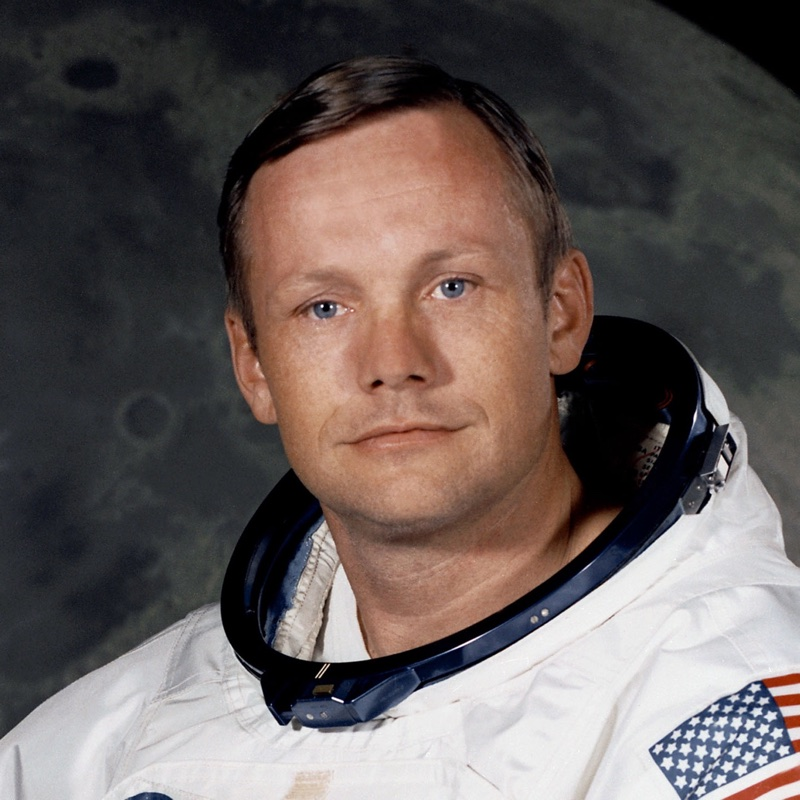
Photograph by NASA. Official Apollo 11 portrait of Neil Armstrong, S69-31741, 1969. Cropped for this profile.