People · Beliefs
Nat King Cole
Before Nat King Cole became a voice heard in homes every Christmas, he was a gifted pianist learning in a preacher’s household. His mother’s music and his father’s Baptist ministry helped shape the world from which his remarkable career emerged.
- Full name
- Nathaniel Adams Coles
- Life
- 1919–1965
- Profession
- Jazz pianist and singer
- Family religious background
- Baptist; father was a minister
Nat King Cole’s singing can make a familiar song feel almost conversational. His Christmas recordings remain a doorway into a much wider career, one that began with serious piano ability and grew into a place in American music history.
Church was part of that beginning. His father was a Baptist minister, and his mother taught him piano and worked with church music. That is firm evidence of a Christian upbringing. It should not be stretched into a complete description of every belief he held as an adult.
A pianist before the famous voice
The Encyclopedia of Alabama biography traces Cole’s early years from Montgomery to Chicago, where his family moved in 1923. The city offered a lively musical world. He listened to jazz, learned piano from his mother, and eventually built a professional career with the instrument.
After moving west, he formed a trio with guitarist Oscar Moore and bassist Wesley Prince. That small group’s sound gave his piano room to speak. Remembering Cole only as a smooth-voiced singer misses this important part of the musician he was.
The Songwriters Hall of Fame profile records his long association with Capitol Records. Successive recordings carried him from an admired jazz performer toward a broad popular audience. Songs such as Mona Lisa and Unforgettable became part of the legacy many listeners know today.
Success did not remove the barriers
As the National Park Service biography explains, Cole’s career unfolded amid severe racism. In 1956, he made television history with a variety program bearing his name. The program’s difficulty obtaining national sponsorship showed how commercial opportunity and racial prejudice could collide, even for an acclaimed performer.
Those pressures belong in the story alongside the beautifully controlled voice. Fame did not make Cole immune to hostility. His accomplishments came within a culture that could welcome his music while denying him equal treatment.
Cole died of lung cancer on February 15, 1965, aged 45. His recordings outlived him, and the next generation encountered his voice in another way when Natalie Cole’s 1991 version of Unforgettable combined her performance with her father’s recording. A career cut short continued to connect families and listeners.
What the Baptist background establishes
The National Park Service and Songwriters Hall of Fame both identify Cole’s father as a Baptist minister and his mother as a church musician. The Alabama biography also explains that the story behind Straighten Up and Fly Right came from a fable he heard from his father.
These details show that church life contributed to his childhood and artistic imagination. They do not establish a full adult statement of doctrine, the regularity of his worship, or his standing before God. The careful answer is that Cole had a documented Baptist Christian background; the sources used here do not provide a detailed personal Christian testimony.
Likewise, performing a Christmas carol is not by itself a declaration of faith. We can listen with appreciation while being precise about what the historical evidence actually tells us.
Beyond the Spotlight
The thought of a musical gift developing in an ordinary family can prompt gratitude. From Famous Faith’s Christian perspective, every gift comes with a deeper truth: the person who possesses it is loved by God and accountable to him. Talent cannot carry the weight of our need for forgiveness.
God is holy, good, and loving. His Ten Commandments show a standard we have broken through lies, theft, coveting, and giving other things the place that belongs to him. The Bible calls this sin. The writer belongs in that confession, not above it. Comparing our best moments with someone else’s failures cannot clear our guilt.
Scripture teaches that God judges sin and that hell is real punishment. Yet the gospel announces mercy, not a demand that we somehow sing, serve, or behave our way into acceptance. Jesus Christ, God’s sinless Son, was crucified for sinners and rose bodily from the dead. His finished work provides what we cannot achieve.
We receive salvation by grace through faith rather than earning it through good works or religious identity (Ephesians 2:8–9). Repentance is turning from sin and rebellion toward God with a changed mind and heart, learning to trust his character and the love he has shown in Jesus. It normally reshapes our conduct, but improved conduct is not the purchase price of forgiveness.
Whether your family sang hymns or never entered a church, you can bring your need and honest questions to Christ. He offers forgiveness and a changed life to those who trust him. This is Famous Faith’s Christian invitation, not a claim to know Cole’s eternal destiny. For additional reflection, read the Good Person Test.
Sources
- National Park Service — Nat King Cole
- Encyclopedia of Alabama — Nat “King” Cole
- Songwriters Hall of Fame — Nat King Cole
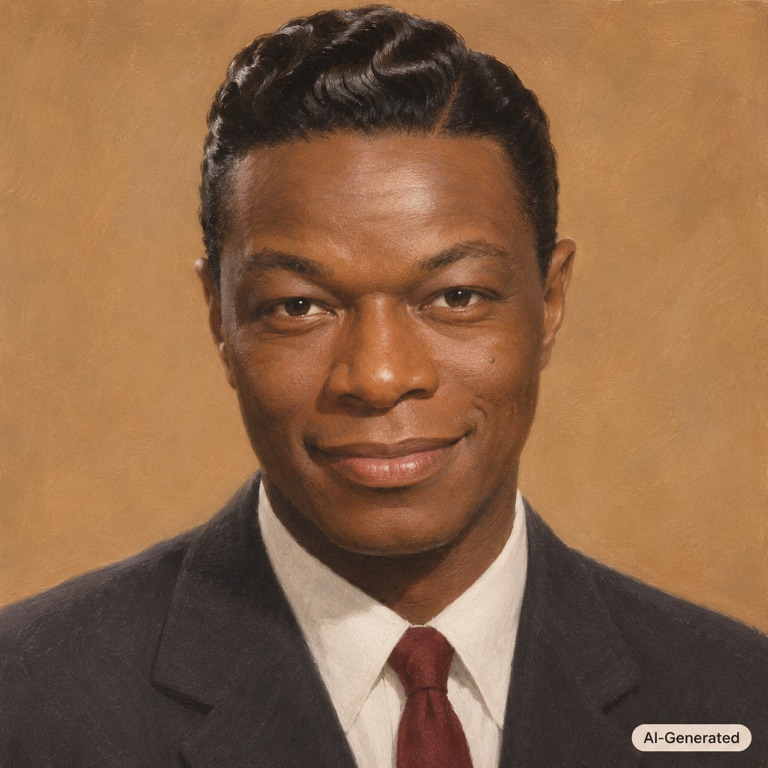
Artwork: Original AI-generated portrait created for Famous Faith; not a photograph. No endorsement is implied.