People · Beliefs
John Goodman
John Goodman’s route to acting began with a change of plans after a football injury. His familiar screen presence has crossed family comedy, unsettling drama, and animation—and his own remarks about religion are more conflicted than a simple childhood label suggests.
- Profession
- Film, television, stage, and voice actor
- Known for
- Roseanne, The Big Lebowski, Monsters, Inc.
- Education
- Theater degree, Southwest Missouri State
- Religious background
- Raised Southern Baptist; later described a more personal spirituality
John Goodman can be instantly familiar without repeating the same character. Dan Conner in Roseanne, Walter in The Big Lebowski, and the voice of Sulley in Monsters, Inc. call for very different kinds of performance. The warmth or force audiences recognize is held within a surprisingly broad range.
His religious story also needs more than a quick label. Goodman has said he was raised Southern Baptist. In a later interview, however, he described feeling conflicted about religion and giving greater importance to spirituality. Childhood background and an adult’s own words are related, but they are not interchangeable.
An injury and a different direction
The Hollywood Walk of Fame biography describes Goodman entering Southwest Missouri State with football in mind. An injury helped redirect him toward drama. He graduated with a theater degree and moved from St. Louis to New York in 1975 to pursue acting.
That beginning is easy to overlook once someone becomes a household name. The familiar performer first had to make the rounds, work other jobs, and see whether a hoped-for career could become real. His 2017 Walk of Fame ceremony marked years of work rather than an overnight arrival.
There is no need to turn a career change into a claim about God’s private plan for a stranger. It is interesting enough as a human story: one path closed, another developed, and the talent audiences now recognize had room to grow.
The voice and the person behind it
The Television Academy’s biography places Goodman’s role as Dan Conner alongside film work such as Raising Arizona, O Brother, Where Art Thou?, and The Big Lebowski. It also records his Emmy-winning guest performance in Studio 60 on the Sunset Strip.
For younger viewers, his voice as Sulley may be the first connection. For others, it is the ordinary family life of a television comedy or a much stranger film character. Those different introductions help explain why audiences from several generations feel that they know him.
Knowing a performance is not the same as knowing the person. Actors enter imagined lives, and the emotional truth of a role does not make every line an autobiography. That distinction is particularly useful when a character talks about God, morality, or religion.
What he said about religion
In a 2018 Men’s Journal interview, Goodman was asked what role religion should play in someone’s life. He spoke of a Southern Baptist upbringing that could feel like being scolded, acknowledged that religion can cause damage, and said, Spirituality has become more important than religion to me
.
That is an adult’s direct description, not just a family-history detail. It supports a careful answer: he has Christian roots, but the interview does not present a clear current denominational affiliation or a personal Christian testimony.
It would also be too strong to turn his conflicted response into a declaration of atheism. Respecting the limits of his statement is fairer than choosing a neat label for him. His questions and reservations can be reported without either dismissing them or adding beliefs he did not express.
Beyond the Spotlight
A childhood experience of religion can leave lasting impressions. Famous Faith’s Christian invitation is to consider Jesus himself as well as the people who have spoken about him. God’s holiness and love belong together. His law is not permission for pride or cruelty, and his mercy does not pretend that wrongdoing is harmless.
The Ten Commandments show our shared need: lies, theft, coveting, and putting other things above God break his law. The Bible calls this sin. The writer has no superior place from which to judge everyone else. We need forgiveness rather than a convincing role or an improved reputation.
Scripture teaches that God will judge sin and that hell is real punishment. That is a serious warning for us to hear humbly, not a tool for guessing where a celebrity will spend eternity. The gospel gives hope precisely because our need is serious.
Jesus Christ, the sinless Son of God, died on the cross for sinners and rose bodily from the dead. His death and resurrection are central to the Christian message (1 Corinthians 15:3–4). He offers a salvation we cannot earn through good deeds, religious performance, or membership in a particular family.
Forgiveness comes by grace through faith (Ephesians 2:8–9). Repentance means turning from sin and rebellion toward God with a changed mind and heart, learning to trust his character and his love shown in Christ. That trust normally affects our actions, but our actions do not pay for pardon.
Honest questions, painful memories, and doubts can be brought to Jesus. The invitation is to trust him for forgiveness and a changed life. This is Famous Faith’s perspective, not a belief attributed to Goodman. The Good Person Test offers another place to reflect.
Sources
- Hollywood Walk of Fame — John Goodman
- Television Academy — John Goodman biography and awards
- Men’s Journal — John Goodman on Getting Older and Rebooting Roseanne (2018)
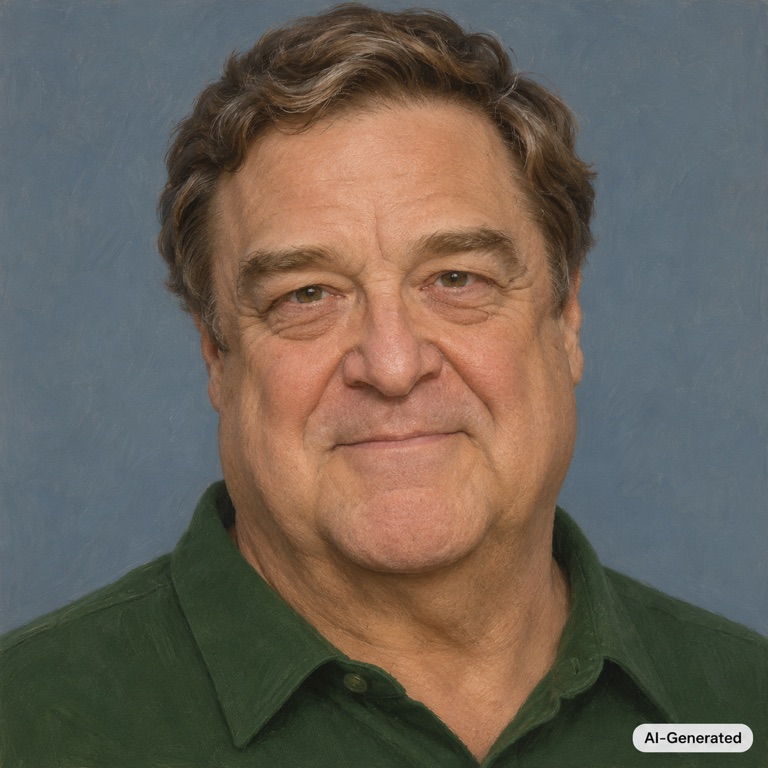
Artwork: Original AI-generated portrait created for Famous Faith; not a photograph. No endorsement is implied.