People · Beliefs
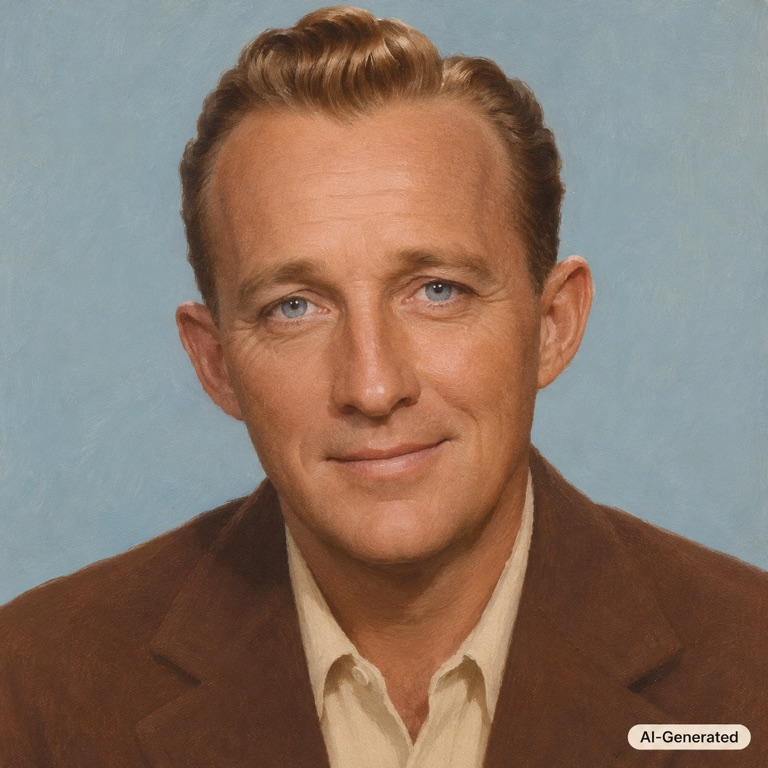
Bing Crosby
Bing Crosby’s voice became part of Christmas for generations, and his Oscar-winning turn as a priest made his connection with religion familiar on screen. His real Catholic background began much earlier, in the schools and parish life of Spokane.
- Full name
- Harry Lillis Crosby
- Life
- 1903–1977
- Profession
- Singer and actor
- Religious background
- Roman Catholic
For many listeners, Bing Crosby’s voice is part of the sound of Christmas. His easy delivery could make a large audience feel as though he were singing to one person. Yet the performer behind White Christmas had a career much larger than a single season: records, radio, movies, and television all carried his voice.
Crosby was Roman Catholic. His early parish life and Catholic education are documented, but his screen roles are not the evidence on which that identification should rest. He was a real person, with a life more complicated than the kindly priest audiences saw in a favorite film.
From Spokane to a much larger stage
Gonzaga University’s account of Crosby’s early life describes a boy raised in Spokane who held a variety of jobs, attended Gonzaga High School and the university, and served as an altar boy at St. Aloysius. He did not finish his university studies before pursuing entertainment.
The PBS American Masters timeline follows his rise across music, radio, and film. His career illustrates an earlier age of mass entertainment, when a familiar radio voice could become a record star and a movie attraction at the same time.
Christmas music became an enduring part of that reach. The holidays bring earlier generations back into the same listening space as children who may never have watched one of his films. The recording is old; the feeling of familiarity can be new to each listener. Crosby died in Spain on October 14, 1977, but his work continues to reach people who were born long afterward.
Father O’Malley was a performance
In Going My Way, Crosby played Father O’Malley, a young priest arriving at a parish with financial troubles. The studio’s film description records Crosby’s Best Actor Academy Award and the picture’s seven Oscars. The character blended music, warmth, and care for other people in a story audiences embraced.
The distinction between a role and a life still matters. A persuasive performance does not show us every belief of the actor. In Crosby’s case, there is separate historical evidence of Catholic identity. Viewers do not need to confuse him with Father O’Malley to recognize that connection.
Catholic identity and a complicated legacy
Alongside the Gonzaga record, a 2026 Architectural Digest retrospective describes Crosby as a practicing Catholic who attended local parishes. These sources support a Catholic identification rather than a label inferred from Christmas songs.
The same retrospective acknowledges his son Gary’s later allegations of abuse and disagreement among family members about those accounts. Those claims should not be treated as an invitation to gossip, but a warm public image should not erase difficult parts of a historical record.
Neither awards nor a religious label can tell a reader the whole truth of another person’s heart. Christians can examine conduct honestly while leaving final judgment to God. Remembering an entertainer accurately allows room for both the work people love and questions that a polished screen image cannot answer.
Beyond the Spotlight
Christmas songs can stir memories of home, absence, comfort, and hope. Famous Faith’s Christian message asks us to look beyond those feelings to the person at the center of Christmas: Jesus Christ. God’s love is more than a seasonal mood. He made us for himself and is holy as well as merciful.
His Ten Commandments expose our need. Lying, stealing, coveting, and putting created things ahead of God are sins because they break his law. We all stand in that same need of forgiveness, including the writer. A familiar hymn, a church connection, or a reputation for kindness cannot make us innocent.
Scripture speaks of judgment and warns that hell is real punishment for sin. We should not soften that warning into meaninglessness or use it to declare the eternal destiny of someone we have never known. God himself has provided the rescue we cannot earn.
Jesus, the sinless Son of God, died on the cross for sinners and rose bodily from the dead. His death and resurrection, summarized in 1 Corinthians 15:3–4, are the heart of the gospel. Salvation is by grace through faith, not payment for good works, religious service, or a respectable public life (Ephesians 2:8–9).
Repentance means turning from sin and rebellion toward God with a changed mind and heart, trusting the love shown through Jesus. As we learn to follow him, our conduct changes; those changes do not buy forgiveness. Honest questions can be brought to Christ along with our failures and grief.
This is Famous Faith’s invitation to the reader, not a verdict about Crosby’s salvation. Beyond the music is the hope of forgiveness and new life in Jesus. The Good Person Test offers further reflection.
Sources
- Gonzaga University — Celebrating the 100th Anniversary of Bing Crosby’s Road to Hollywood (2025)
- PBS American Masters — Bing Crosby life and career timeline
- Universal Pictures — Going My Way
- Architectural Digest — Bing Crosby at Home (2026)
Artwork: Original AI-generated portrait created for Famous Faith; not a photograph. No endorsement is implied.