The profile · Director and producer
Anthony Russo
Anthony Russo was in his first year of law school when making comedy with his brother began to change the plan. A career in independent film and television followed before the enormous movie sets.
- Early graduate study
- One year of law at Case Western Reserve[1]
- Company
- AGBO, co-founded in 2017[3]
- Current film credit
- Co-director of Avengers: Doomsday[4]
The person behind the work
Law school did not become the whole plan
Anthony Russo grew up in Cleveland. At Case Western Reserve, his first year studying law overlapped with his brother Joe’s graduate acting program. The two began making comedy together, including a student sketch troupe. A professional identity that might have looked settled on paper was still changing through the work they enjoyed.[1]
Their early feature Pieces did not become a conventional success. It did, however, help connect them with filmmaker Steven Soderbergh. Welcome to Collinwood followed, with its ensemble of would-be criminals and overlapping plans. The move from a student film to a released feature still depended on other people seeing something they wanted to develop.[1][2]
Television then became a substantial part of the career. Arrested Development and Community gave the brothers experience with ensembles, quick changes, and comedy built from very different personalities. That history matters when their later films are described only in terms of budgets and box-office scale.[3]
A career in range
Selected work, at a glance
2002
Welcome to Collinwood
Co-director and co-writer
An early ensemble feature with his brother Joe.[2]
2003 onward
Arrested Development
Television director and producer
Comedy became a major part of the brothers’ working life.[3]
2009 onward
Community
Director and executive producer
A group of mismatched personalities offered room for visual comedy.[3]
2022
Everything Everywhere All at Once
Producer
A producing credit on the later best-picture-winning film.[3]
The person behind the work
Two directors still need one clear conversation
Anthony explained to the Directors Guild that he and Joe do not divide every directing duty between them. Both stay involved. They see remaining aligned as their own responsibility, so that the cast and crew do not receive conflicting instructions from two people who are meant to be leading the same production.[2]
That approach is easier to understand as an ongoing conversation than a fixed formula. A performance, a camera position, and a cut can all change how an audience understands a moment. Two directors have to work through those choices before asking a much larger group to carry them out.
AGBO, which the brothers founded in 2017, expanded their work as producers as well as directors. Their producing credits include Everything Everywhere All at Once, the film that won the 2023 best-picture Oscar. Producing that winning film is not the same as personally receiving its Academy Award; the distinction keeps a career credit accurate.[3]
Disney lists Anthony and Joe as the directors of Avengers: Doomsday. That current assignment belongs beside the independent films and television comedies, not in place of them. A shared cast or a familiar studio does not make every directing problem the same.[4]
A closer look
Three ways into the work
Welcome to Collinwood: start with an ensemble
The early feature is useful for seeing an interest in people whose plans collide. That interest did not begin with superheroes. Comedy gives a director a clear test: does the audience understand enough to see the plan going wrong?[2]
Community: make a group legible
An ensemble sitcom needs viewers to recognize different wants quickly. A look, a reaction, or the arrangement of people in a room can do work that another speech would only repeat. The television years offered repeated practice.[3]
Everything Everywhere All at Once: producing is another kind of support
A producer helps a film reach the screen without becoming its director. The credit is worth naming accurately because a collaborative production contains different creative responsibilities. The film itself contains strong adult material.[3]
The person behind the work
Collaboration is more than agreeable talk
The interviews here are detailed about communication and storytelling, but they do not clearly describe Anthony’s current religion. A family’s ethnic background is not enough to supply that answer. The public record is strongest when it stays with the work and statements he has actually shared.
The practical value of collaboration is that another person can challenge an idea before it becomes expensive or harmful. It requires speaking clearly and listening without treating every correction as a defeat. Those are useful habits in a family, a workplace, or any project where people depend on one another.
Shared work also raises a harder question. Good communication can improve a plan, but it cannot make every motive good or erase a wrong already done. The Christian perspective that follows values teamwork while placing our need for mercy on a deeper foundation.
Listen to the person
In their own words
Spring 2019
“We like to give actors lots of freedom.”
Famous Faith’s Christian perspective
Beyond the Spotlight
Collaboration works best when people can admit that another person sees something they missed. The Bible asks for an even deeper honesty: we need more than better plans, because our choices can harm people. God’s love makes room for truth rather than requiring a successful appearance.
The Ten Commandments speak plainly about truth, theft, faithfulness, and envy. A good team reputation does not excuse a private lie or a desire to take what belongs to someone else. These commands show all of us where love has failed and where mercy is needed.
God’s law reveals more than a communication problem. Sin is its violation (1 John 3:4), and all of us have fallen short. Jesus’ warnings about hell and judgment call us to consider that seriously. A Christian response should be concerned for people, not pleased to place someone beyond hope or pretend to know their final destiny.
Jesus Christ is God’s Son, who became human and lived without sin. He died for our sins on the cross and rose bodily from the grave. The offer of forgiveness rests on what he did. We receive it through faith by grace, rather than earning it with leadership, teamwork, or religious achievement (Ephesians 2:8–9).
Repentance is turning from sin and our resistance to God, with a changed mind and heart. We come to trust him as he truly is, looking to Jesus Christ as the proof of his love. It ordinarily affects the way we act: listening to correction, admitting wrong, and seeking to repair damage. Such changes are a response to mercy, not a fee for it. Christians share this invitation as fellow people in need of grace.
A simple prayer can be an honest beginning: ask God for mercy through Jesus and turn toward him. A faithful church can help you learn what love and responsibility look like in daily decisions.
Explore the Good Person Test and the promise of forgiveness →
This section shares Famous Faith’s Christian beliefs. It does not speak for Anthony Russo.
People connected to the story
Follow the connections

Stephen McFeely
Their long-time writing collaborator and Disney’s credited Doomsday writer.[4][5]
Read the profile →Sources and further reading
- AGBO / Case Western Reserve — Anthony and Joe Russo interview (2026)
- Directors Guild of America — Interview with Anthony and Joe Russo (2019)
- AGBO — Anthony and Joe Russo professional biography
- Disney — Avengers: Doomsday credits
- Disney — Avengers: Endgame credits
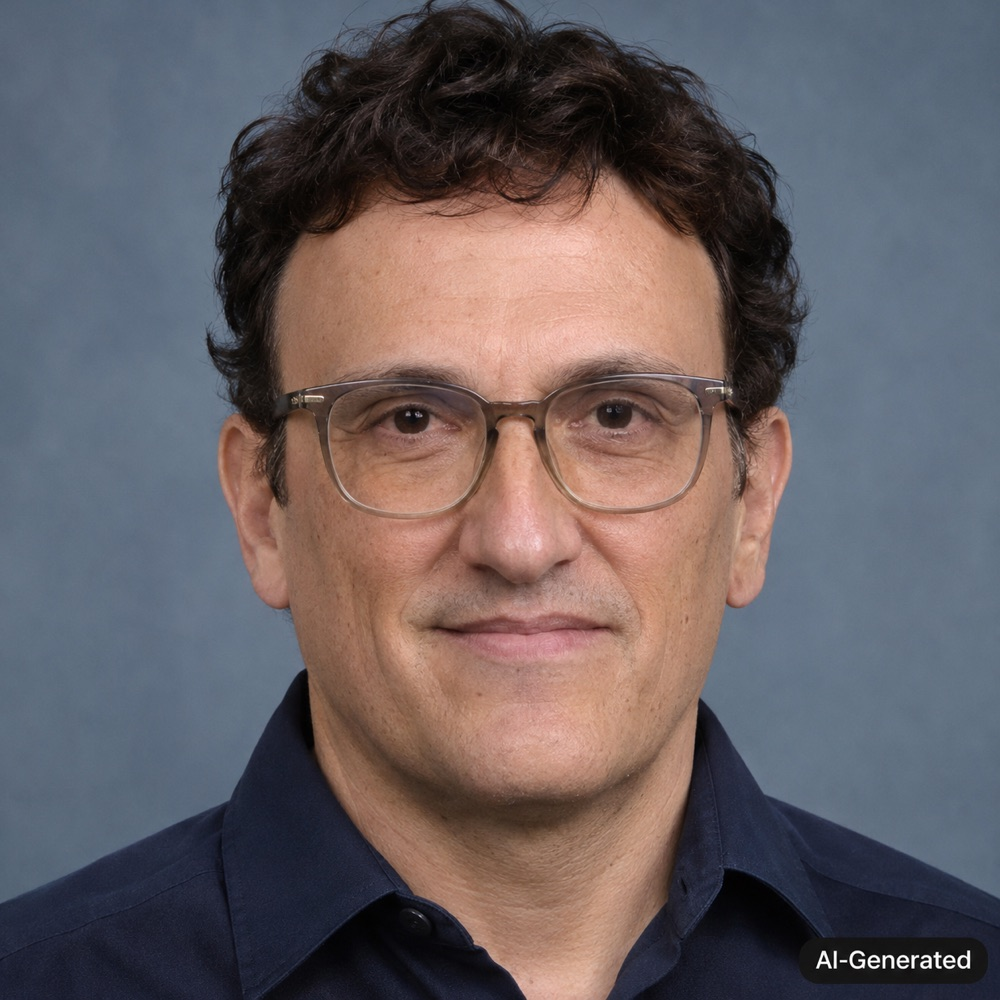
Artwork: Original AI-generated portrait of Anthony Russo, created for Famous Faith; not a photograph. The other AI-generated portraits shown here were also created for Famous Faith. No endorsement is implied.
Film and book titles identify the works discussed. A career credit is not a recommendation that every reader watch or read that work.