The profile · Screenwriter and producer
Stephen McFeely
Before screenwriting, Stephen McFeely taught high-school English and spent a year guiding visitors at Carlsbad Caverns. His later partnership with Christopher Markus grew through day jobs, early mornings, and repeated rewriting.
- Undergraduate degree
- English, Notre Dame, 1991[1]
- Earlier work
- High-school teacher and Carlsbad Caverns guide[1]
- Graduate writing
- UC Davis, 1994–1996[2]
- Current credit
- Writer of Avengers: Doomsday[3]
The person behind the work
Teaching, caves, and a deliberate attempt to write
Stephen McFeely studied English at Notre Dame and graduated in 1991. He returned to the San Francisco Bay area to teach at his former high school, then spent a year volunteering as a guide at Carlsbad Caverns. The change gave him experience outside the classroom before graduate study.[1]
He met Christopher Markus in UC Davis’s creative writing program, where both studied from 1994 to 1996. Afterward, they moved to Los Angeles to try screenwriting while supporting themselves with other jobs. The partnership offered discipline as well as company: another person was depending on the work being done.[2][1]
The Life and Death of Peter Sellers brought the pair a 2005 writing Emmy. Their first original screenplay, You Kill Me, reached the screen in 2007. The order is a useful detail: a script that helps open doors does not always become the first completed film with a writer’s name on it.[4][5]
A career in range
Selected work, at a glance
2004
The Life and Death of Peter Sellers
Co-screenwriter
A biography that brought an Emmy for writing.[4]
2005
The Lion, the Witch and the Wardrobe
Co-screenwriter
An adaptation of the first published Narnia novel.[5]
2011
Captain America: The First Avenger
Co-screenwriter
The first of three Captain America scripts with Markus.[5]
2015–2016
Agent Carter
Co-creator and executive producer
A television project centered on Peggy Carter.[5]
The person behind the work
Make the audience care before the spectacle
McFeely’s work with Markus includes Narnia adaptations, Captain America films, and Agent Carter. The different assignments required both respect for existing material and choices about how a story would work on screen. Adapting a book is not simply copying its dialogue, and a long-running film series still needs an understandable human conflict.[5]
At a 2020 UC Davis event, McFeely said spectacle has little purpose when viewers do not care about the person involved. The point gives readers a practical way to judge an action scene. Beyond asking whether it looks impressive, ask whose hope, fear, or decision makes the outcome matter.[2]
Disney currently credits McFeely as the writer of Avengers: Doomsday. His earlier partnership with Markus is an important part of the story, but current credits should not be filled in by habit. A familiar group of collaborators can change from one project to the next.[3]
Writing also contains work that a viewer never sees: outlines, discarded scenes, and another pass at a line that still does not land. A polished result can hide that uncertainty. The history of this partnership makes persistence and rewriting more useful explanations than effortless inspiration.[1]
A closer look
Three ways into the work
Peter Sellers: tell a life without pretending to contain it
A biographical film must choose which moments carry its argument about a person. McFeely and Markus’s screenplay became an early career milestone, while the subject’s full life still reaches beyond a dramatization.[4]
Narnia: the source has a voice of its own
McFeely has described trying to be truthful to the stories rather than turn them into a vehicle for a private agenda. That makes the source material, including its Christian ideas, relevant without settling his own religion.[1]
You Kill Me: an early script can have a later life
The film’s place in the partnership’s history shows how development and release can follow different calendars. Writing something useful is not the same as seeing it produced immediately. The finished film contains adult material.[5]
The person behind the work
Narnia is not a shortcut to a religious label
In his Notre Dame interview, McFeely said some personal plays explored relationships and thoughts about God. He also described trying to serve the Narnia stories without reshaping them to fit a personal agenda. Those comments show engagement with the material, but they do not clearly identify his current faith.[1]
A university’s religious identity, an adaptation’s themes, and a writer’s own beliefs are separate pieces of information. Keeping them separate allows the actual work to be discussed more fairly. Narnia can introduce readers to Christian ideas without turning its screenwriter into a spokesman he has not claimed to be.
The concern for a person inside the spectacle also opens a wider thought. People are more than the part they play in someone else’s plan. A Christian view grounds that value in the God who made them and whose mercy reaches beyond a successful ending.
Listen to the person
In their own words
November 2020
“The spectacle is pointless if you don’t care about the person involved in it.”
Famous Faith’s Christian perspective
Beyond the Spotlight
Caring about the person inside a story is a good place to begin. The Bible asks us to carry that care into life, where our choices can help or wound real people. Its message of salvation does not offer a convenient ending that ignores what has happened.
The Ten Commandments tell us not to steal, lie about our neighbor, or covet. They also call us to honor parents and remain faithful. These are specific ways to recognize sin in our own lives, not only in the people whose failures are easy for us to see.
The Bible calls sin a transgression of God’s law (1 John 3:4). It is a real moral debt, not simply a weak part of the story we can skip. Jesus’ teaching about hell and judgment asks us to take it seriously. Love should shape how Christians speak of that danger, while humility keeps us from assigning a stranger’s final destiny.
God’s Son, Jesus Christ, lived a human life without sin. He died for sinners on the cross and rose bodily from the dead. The good news is forgiveness through faith in him. Grace gives what we cannot earn through hard work, service, or a religious background (John 3:16; Ephesians 2:8–10). God cares about the actual person who needs mercy.
Repentance turns our heart and mind from sin and resistance toward God. It means learning to trust who he is, with our confidence placed in the love he has shown us through Jesus Christ. Turning from sin usually shows itself in changed behavior: telling the truth, seeking reconciliation where possible, and treating people with more love. Those efforts matter as the result of forgiveness. They are never a substitute for trusting Christ or a price placed on his welcome.
There is time to examine Jesus’ claims with care. Read one of the Gospels, ask him for forgiveness, and speak with a Christian who will take your questions seriously and keep pointing you toward him.
Explore the Good Person Test and the promise of forgiveness →
This section shares Famous Faith’s Christian beliefs. It does not speak for Stephen McFeely.
People connected to the story
Follow the connections

Christopher Markus
His continuing collaborator across many film and television scripts.[2]
Read the profile →

Hayley Atwell
Agent Carter and the Captain America films helped develop her Peggy Carter role.[5]
Read the profile →Sources and further reading
- Notre Dame Magazine — Stephen McFeely career interview
- UC Davis — Chancellor’s Colloquium with Markus and McFeely (2020)
- Disney — Avengers: Doomsday official credits
- UC Davis — Writers’ 2005 Emmy recognition
- Christopher Markus and Stephen McFeely — Film and television credits
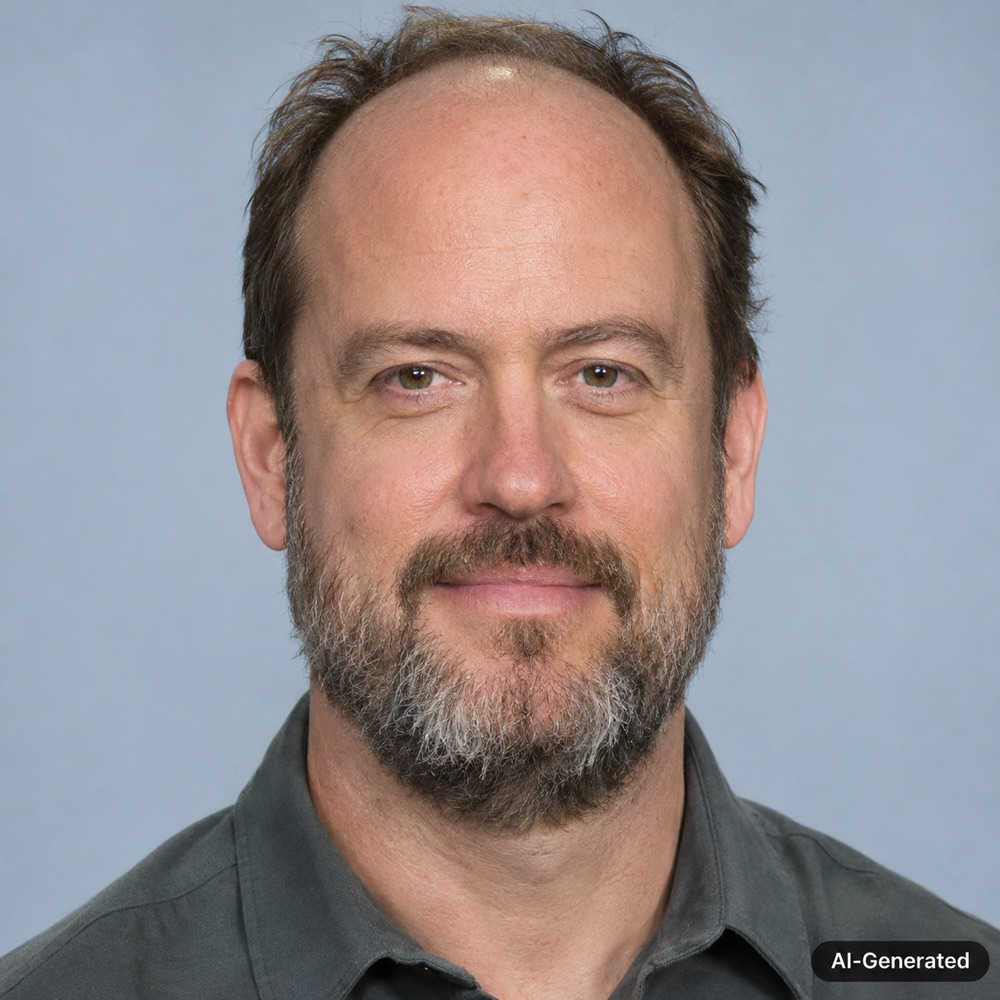
Artwork: Original AI-generated portrait of Stephen McFeely, created for Famous Faith; not a photograph. The other AI-generated portraits shown here were also created for Famous Faith. No endorsement is implied.
Film and book titles identify the works discussed. A career credit is not a recommendation that every reader watch or read that work.