The profile · Director and producer
Joe Russo
Joe Russo trained as an actor before becoming a director. He has described how that experience helps him talk with performers, and how an early film that disappointed its audience taught him to care more about storytelling.

- Graduate training
- MFA in acting, Case Western Reserve[1]
- Directing partner
- His brother, Anthony Russo[2]
- Company
- AGBO, co-founded in 2017[3]
- Doomsday credit
- Co-director[4]
The person behind the work
An actor’s education behind the camera
Joe Russo studied acting at Case Western Reserve University. In a 2026 interview, he said that three years of training helped him understand performers and communicate about the tone of a project. The degree did not disappear when he moved behind a camera; it became one of the tools he could use there.[1]
His brother Anthony was studying law when their creative work together began. The student film Pieces grew from that period. Joe recalled that more than half the premiere audience walked out. It was a painful lesson in the difference between enjoying an experiment and making a story other people can enter.[1]
The brothers went on to Welcome to Collinwood and an extended period in television comedy. Arrested Development, Community, and Happy Endings belong to that history. These were working environments where an ensemble had to make sense quickly and a scene’s timing could change its meaning.[2]
A career in range
Selected work, at a glance
1997
Pieces
Co-director and co-writer
An early student-era feature and an important learning experience.[1]
2003 onward
Arrested Development
Television director and producer
Part of the brothers’ long apprenticeship in ensemble comedy.[2]
2011 onward
Happy Endings
Director and executive producer
Another television comedy in their working history.[2]
2022
Everything Everywhere All at Once
Producer
A producing role on the 2023 best-picture-winning film.[2]
The person behind the work
The spectacle still has to tell a story
For the Directors Guild, Joe described bringing a television-style process into films: writers and directors in a room, testing ideas, with collaboration central to the work. A large project can make that need more urgent, since so many departments have to understand what the same scene is trying to do.[6]
A viewer sees a finished action sequence. Before that come decisions about where everyone is, what a character wants, and what information the audience needs next. If the geography is confusing, an impressive image can still weaken the scene. Clarity is part of the craft, not a limit on imagination.
The brothers founded AGBO in 2017, extending their work into producing. The company’s projects include Extraction and Everything Everywhere All at Once alongside films they directed themselves. Those are different credits: helping produce a film is not a claim to have directed its performances or written its screenplay.[3]
Disney’s current Doomsday credits name Joe and Anthony as directors. That assignment follows The Winter Soldier, Civil War, Infinity War, and Endgame. It is a continuation of a working relationship, while the outcome of an unreleased film remains something viewers have yet to judge.[4][2]
A closer look
Three ways into the work
Pieces: an experiment can teach through failure
Joe’s recollection of the premiere is unusually useful. The audience’s reaction became information he could learn from. The film’s failure to sell did not make the effort meaningless, but it did challenge how the brothers wanted to tell stories.[1]
Arrested Development: an ensemble needs clear relationships
The comedy depends on people misunderstanding one another while the audience keeps up. Direction helps establish those different viewpoints without flattening them into one attitude. It is part of the background to the later large casts.[2]
The Gray Man: action outside the familiar universe
Working with a different set of characters creates a useful comparison. The practical questions remain: who is pursuing what, where is the danger, and what can the audience understand at this moment? The film contains strong violence.[3]
The person behind the work
Learning what an audience needs
The graduate-school interview gives a concrete way to understand a change in priorities: Joe moved from protecting a complicated experiment toward asking what makes a story accessible. That does not mean every film should be simple. It means the people watching need a reason to stay involved.[1]
His public comments here focus on craft, family collaboration, and community. They do not clearly name a present religion. There is no need to infer one from the brothers’ Italian-American background or from a film’s moral language.
The larger question is familiar outside a theater: can we hear another person’s response without dismissing them as the problem? Learning from failure can make us wiser. Christianity also asks what kind of change is needed when the problem is a moral wrong rather than an unsuccessful attempt.
Listen to the person
In their own words
Spring 2019
“It’s a room, and the best idea wins.”
Famous Faith’s Christian perspective
Beyond the Spotlight
Failure can teach us when we are willing to hear it. Moral responsibility asks for more than learning a better technique, though. The Bible calls us to face the ways we have failed to love God and people, and then points us toward a hope we cannot produce for ourselves.
The Ten Commandments forbid false witness, stealing, adultery, and coveting. These are not only dramatic wrongs for a story’s villain. They reach ordinary lies, disloyal choices, and envy in people who otherwise seem successful. God’s law brings our own lives into the conversation.
Scripture names our breaking of God’s law sin (1 John 3:4). The problem cannot be solved only by improving the next attempt. Jesus taught that judgment and hell are real, which gives forgiveness an urgency beyond self-development. We speak about that with love, without imagining that an outsider can read a director’s heart or decide his eternal future.
God sent his Son, Jesus, into the world. He lived without sin, died on a cross for sinners, and rose physically from the dead. Through faith in him, God offers forgiveness and lasting life. Salvation is a gift of grace; a successful body of work or a record of generous deeds cannot earn it (Romans 5:8; Ephesians 2:8–10).
A repentant mind and heart turn away from sin and from refusing God’s rightful place in our lives. We begin trusting who he is and the love he has shown through Jesus. That turn normally leads to changed behavior, including honesty about a wrong and greater care for other people. Change is not instant perfection, and it does not pay God back. It is the growth of a life receiving mercy rather than defending every past decision.
You can bring an unfinished life to Jesus without excusing what needs to change. Ask for his forgiveness and seek a faithful Christian community where questions, correction, and patient growth have room.
Explore the Good Person Test and the promise of forgiveness →
This section shares Famous Faith’s Christian beliefs. It does not speak for Joe Russo.
People connected to the story
Follow the connections

Chris Evans
Evans worked with the brothers on their Captain America and Avengers films.[5]
Read the profile →
Sources and further reading
- AGBO / Case Western Reserve — Brothers on training and early failures (2026)
- AGBO — Anthony and Joe Russo biography
- AGBO — Company history and projects
- Disney — Avengers: Doomsday credits
- Disney — Avengers: Endgame credits
- Directors Guild of America — Interview with the Russo brothers (2019)
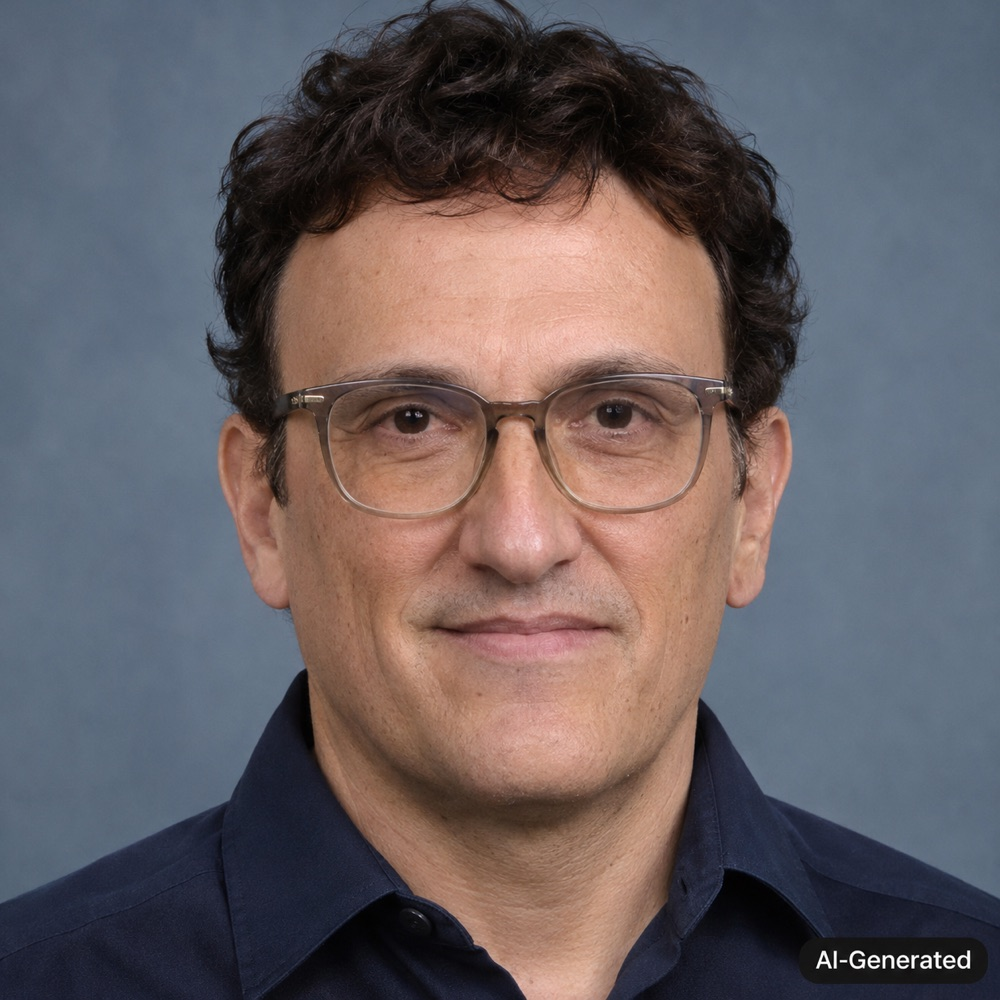
Artwork: Original AI-generated portrait of Joe Russo, created for Famous Faith; not a photograph. The other AI-generated portraits shown here were also created for Famous Faith. No endorsement is implied.
Photograph: Chris Evans by Gage Skidmore, via Wikimedia Commons, CC BY-SA 2.0. Cropped to a square card for display.

Film and book titles identify the works discussed. A career credit is not a recommendation that every reader watch or read that work.