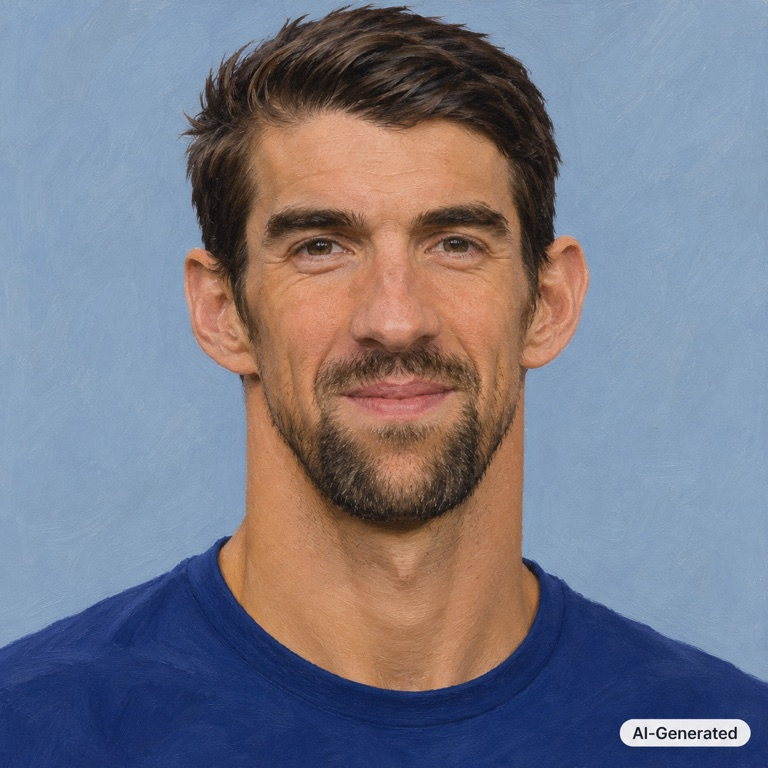
People · Beliefs
Michael Phelps
Michael Phelps won more Olympic medals than anyone, yet some of his most meaningful public conversations concern life outside the pool. His search for purpose shows why achievement and inner well-being are different questions.
- Sport
- Swimming
- Olympic medals
- 28 total, including 23 gold
- Olympic appearances
- 2000, 2004, 2008, 2012, and 2016
- Foundation focus
- Water safety, mental wellness, and healthy living
Michael Phelps’s Olympic record is extraordinary: 28 medals, including 23 gold. The World Aquatics medal record sets out the results plainly. Yet the numbers cannot tell the whole story of the person who earned them. Phelps has also spoken publicly about emotional struggles, help from others, and the need to discover a purpose beyond winning.
One part of that story involves Rick Warren’s Christian book The Purpose Driven Life. Phelps credited it with helping him think differently about his place in the world. That account is worth hearing carefully, without turning it into a more detailed declaration of Christian faith than he actually gave.
A champion with a life beyond results
Phelps first competed at the Olympics in Sydney in 2000. The U.S. Olympic & Paralympic Museum records his five Olympic appearances and his eight gold medals at the 2008 Beijing Games. His final Olympics came in Rio de Janeiro in 2016. His versatility across strokes and distances made his career much larger than a single famous race.
Away from competition, the Michael Phelps Foundation focuses on water safety, mental wellness, and healthy living. That work connects a world-famous swimmer’s experience with needs that reach far beyond elite sport. Learning to be safe in water or to speak honestly about mental health can matter to people who will never enter a competitive race.
Phelps has also encouraged students to talk about their struggles and seek support. A 2022 account from California State University, Fullerton describes his discussion of mental health and his effort to make those conversations easier. Public achievement and emotional suffering can exist in the same life; his willingness to discuss both has become part of his influence.
A book, a friend, and a sense of purpose
Before the 2016 Olympics, ESPN explored Phelps’s struggles and recovery. Bible Gateway’s contemporary account, which links the ESPN feature and video, records the role played by his friend Ray Lewis. Lewis gave him The Purpose Driven Life. Phelps said the book helped him believe in a power greater than himself and in a purpose for his life.
That is a meaningful statement, and its date and wording matter. The book is Christian, but receiving help from it does not by itself establish every belief Phelps holds about Jesus, salvation, or church membership. The sources here support saying that Christian ideas influenced an important part of his search for meaning. They do not establish a verified current denomination or a full public Christian testimony.
His recovery story also included support and treatment. It should not be retold as though emotional illness proves a lack of faith or as though spiritual encouragement makes professional care unnecessary. Respect for Phelps includes allowing the whole account to remain more human and complex than a simple inspirational slogan.
Beyond the Spotlight
The following is Famous Faith’s Christian perspective, not a claim about Phelps’s private convictions. The search for purpose is larger than the search for a podium. Christianity teaches that our lives matter because God made us, and that his love cannot be measured by achievement.
That loving God is also holy. His Ten Commandments show a moral standard none of us has perfectly kept: do not lie, steal, commit adultery, or put another god before him. Sin is breaking God’s law in our thoughts, desires, and actions. The writer stands with every reader in needing mercy. Mental illness is not proof that one person is more sinful than another, and suffering should never be treated as a scoreboard of spiritual failure.
God’s judgment of sin is real, and the Bible speaks seriously of hell. But it also announces that Jesus Christ, God’s sinless Son, died on the cross for sinners and rose bodily from the dead. His death and resurrection are the center of the gospel (1 Corinthians 15:3–4). Our hope rests in what he has done, not in our strength or our ability to overcome every struggle.
Forgiveness is received by grace through faith in Christ, not earned by records, good deeds, or religious performance (Ephesians 2:8–9). God calls us to repent: to turn from sin and rebellion toward him with a changed mind and heart, trusting his character and the love revealed through Jesus. A changed life grows from that faith; it does not pay for salvation.
You can bring your questions and weaknesses to Christ. Needing help does not place you beyond his invitation. The Christian hope is mercy, forgiveness, and life with him, offered to ordinary people as well as champions. The Good Person Test offers further reading.
Sources
- World Aquatics — Michael Phelps medal record
- U.S. Olympic & Paralympic Museum — Michael Phelps
- Michael Phelps Foundation — About Us
- Bible Gateway — The Purpose Driven Life of Michael Phelps, August 4, 2016
- California State University, Fullerton — Phelps mental-health conversation, April 2022
Artwork: Original AI-generated portrait created for Famous Faith; not a photograph. No endorsement is implied.