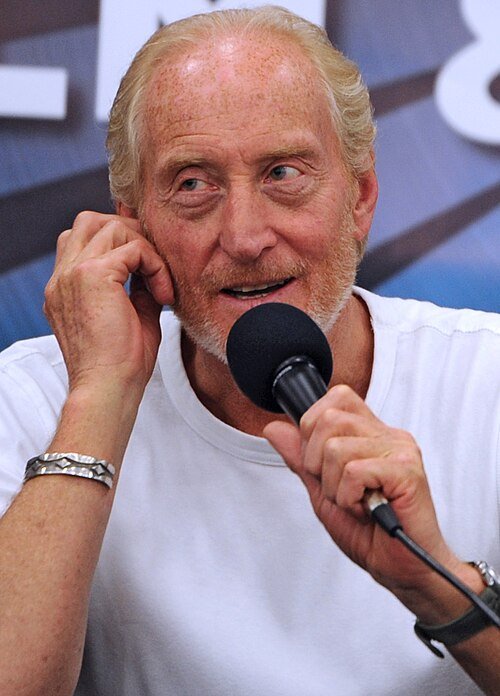
Charles Dance has described himself as agnostic. In an interview with Nigel Farndale, preserved on the journalist’s website, Dance said that he did not know and was not troubled by that uncertainty. He was discussing his portrayal of C. S. Lewis in Shadowlands, and made a clear distinction between the Christian beliefs of the person he played and his own position.
That is a useful direct statement, though an archived interview should not be mistaken for a fresh account of every present belief. It would be inaccurate to identify Dance as Christian simply because he portrayed a Christian writer. His role as Tywin Lannister in Game of Thrones is likewise a performance.
Charles Dance and the work of pretending
In the Farndale interview, Dance explained that acting involves portraying people unlike oneself. The religious concerns at the center of Shadowlands did not require him to share Lewis’s faith. His explanation helps an audience keep artistic interpretation separate from personal testimony.
That distinction protects both the actor and the subject. An effective performance may make an idea feel immediate without telling us whether the performer accepts it. We should not use Tywin’s ruthlessness to judge Dance’s character, or use Lewis’s Christianity to supply Dance with a religious label he did not claim.
What does agnostic mean here?
In ordinary use, agnosticism concerns not knowing whether God exists or what can be known about Him. People use the term in different ways. It is better to stay close to Dance’s explanation of his own uncertainty than assume that he shares every argument associated with the word.
A respectful Christian response can acknowledge that uncertainty while explaining why Christians believe God has made Himself known. The New Testament does not present Jesus merely as a private spiritual preference. Hebrews 1:1–3 teaches that God has spoken through His Son. Christianity therefore asks readers to consider the person of Christ and the claims about His life, death, and resurrection.
This is a real difference in belief, but a difference does not require contempt. We can listen carefully, ask honest questions, and avoid pretending that a short interview reveals the whole of a person’s thought.
Power cannot make us right before God
Tywin Lannister’s story offers a picture of earthly authority and the effort to control a family’s future. The biblical reflection is for us: influence can shape what other people say, but it cannot change what God knows. Our standing before Him is not decided by how commanding we appear.
God’s Ten Commandments reveal His holy law. He forbids lying, theft, adultery, coveting, murder, and worshiping anything in His place. Jesus also confronts hateful anger and lust in the heart (Matthew 5:21–28). Private motives matter along with public actions.
Romans 3:23 says that all have sinned and fall short of God’s glory. The person confident in religious answers and the person unsure about them both need forgiveness. We deserve God’s just judgment for our sin. Neither power nor uncertainty makes guilt disappear. This is a universal need, not a claim to know the hidden details of Dance’s life.
God’s answer in Jesus Christ
The Gospel announces the saving work of Jesus, God’s eternal Son. He became truly human while remaining truly God. He lived a sinless life, perfectly obeying the Father. He did not merely explain an ideal that He could not meet Himself.
Jesus willingly died on the cross as the substitute for sinners, bearing the judgment we deserve. He was buried and rose bodily from the dead on the third day (1 Corinthians 15:3–4). The resurrection is central to Christian faith. It is not simply a metaphor for the influence of a great teacher or the emotional force of a good story.
Forgiveness and eternal life are offered by grace through faith in Christ, not earned through works (Ephesians 2:8–9). Religious achievement, intellectual ability, and a respected career cannot purchase salvation. Jesus has finished the saving work. Those who trust Him depend on His sacrifice and righteousness rather than their own ability to deserve acceptance.
An invitation beyond a label
Dance’s stated agnosticism should be reported accurately and respectfully. We cannot judge his heart, and we should not collapse the distance between a man and the many people he has portrayed. The evidence supports a description of what he said, not a verdict on his eternal destiny.
For each reader, the claims of Christ deserve a personal response. Acknowledge your sin before God and place your faith in Jesus alone—His death for sinners and His bodily resurrection. Salvation rests on His finished work. The Christian invitation is to trust a living Savior, not to perform certainty for an audience or earn forgiveness through an impressive explanation of yourself.
Sources and photo credit
Nigel Farndale’s archived interview with Charles Dance, reposted in 2021. Scripture: Hebrews 1:1–3; Matthew 5:21–28; Romans 3:23; 1 Corinthians 15:3–4; Ephesians 2:8–9.
Featured photo: Charles Dance at London Film and Comic Con, 2012, by Alan Chang / Wikimedia Commons, CC BY-SA 2.0. Existing cropped version, resized.
