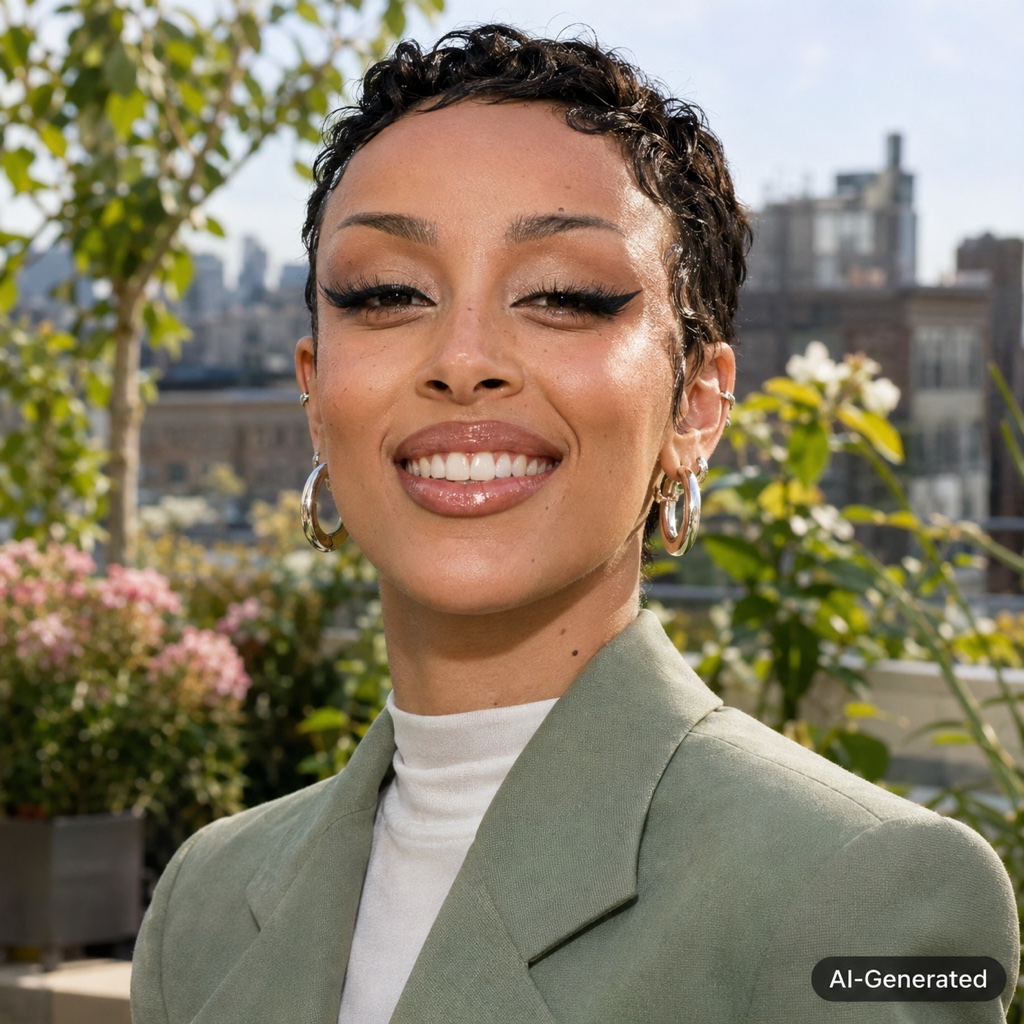
Doja Cat has publicly described belief in a higher power while saying that she does not follow a traditional religious formula. Her interviews do not establish a Christian profession or a current denomination. They also give a more reliable account of her outlook than attempts to identify her religion solely from a music video, costume, or online rumor.
A musician whose image attracts intense interpretation
Doja Cat works across rap, pop, singing, and visual performance. Projects such as Scarlet and Vie have presented different musical and artistic directions, encouraging listeners to discuss both the songs and the person behind them. The contrast between those projects was part of her October 2025 conversation with Angie Martinez. The interview covered creativity, childhood, therapy, and her relationship with public attention.
That attention can blur important distinctions. A performer may use an unsettling image to dramatize a feeling or provoke a reaction. Viewers may then treat the image as a literal description of private worship. A religious claim needs stronger evidence than that leap. The relevant questions are what the artist has actually said, when she said it, and whether the source preserves her meaning.
What she told Angie Martinez about belief
During the Angie Martinez IRL interview, Doja was asked directly about her relationship with God and religion. Around forty minutes into the conversation, she described believing that something greater than herself exists. She also explained that she did not follow the formula of a traditional religious practice. Her answer was exploratory rather than a detailed creed.
She connected belief in something beyond herself with the need to avoid becoming lost in self-importance. The discussion also touched on the relationship between personal growth and spirituality. These are her explanations of her outlook. They should not be rewritten as a declaration of Christian conversion, membership in a particular church, or agreement with every teaching associated with belief in God.
The interview gives a useful limit as well as useful information. It shows that she was willing to discuss spiritual questions publicly, while leaving many theological questions unanswered. A belief in a higher power is not identical to belief in the God revealed in Scripture. It also is not evidence of Satanism. Accurate reporting should preserve those distinctions rather than choosing a dramatic label.
Her response to the Satanist label
In a 2023 Apple Music conversation with Ebro Darden, Doja addressed the way people interpreted imagery around Scarlet. Contemporary reporting reproduced her response to claims that she was a Satanist. She rejected the certainty with which strangers assigned that identity and objected to the narrative being imposed on her work.
Reporting that response does not require endorsing every artistic choice. Christians can evaluate an image critically while still being truthful about the person who created it. Disapproval is not permission to invent beliefs, and a denial of one label does not prove a different religious identity. Her own later account of a nontraditional spiritual outlook remains the more useful evidence.
What Christians should do with spiritual curiosity
Curiosity about a famous person can expose how easily people confuse impressions with knowledge. Proverbs 18:13 warns against answering before hearing. That principle matters when a claim is shocking, when it confirms a suspicion, and when sharing it would attract attention. A Christian commitment to truth applies to people whose art we dislike as much as to people we admire.
The question of belief itself also deserves more than an image. Christianity makes particular claims about Jesus Christ, sin, forgiveness, and resurrection. It cannot be reduced to sensing that something larger exists. A spiritual search can be a starting point for considering those claims, but feelings and artistic symbolism cannot decide whether they are true.
The gospel’s invitation
The Bible teaches that all have sinned and need God’s mercy (Romans 3:23). Jesus Christ lived without sin, died for sinners, and rose bodily from the dead (1 Corinthians 15:3–4). Salvation is God’s gift, received through faith rather than earned by creativity, sincerity, self-improvement, or religious reputation (Ephesians 2:8–9).
That is Famous Faith’s Christian reflection, not a belief being attributed to Doja Cat. Her interviews support a careful account of a spiritual outlook without a verified Christian profession. For readers, the more personal invitation is to seek truth about Jesus, repent of sin, and place hope in Him rather than in an attractive image of ourselves or someone else.
Sources
- Angie Martinez IRL: Doja Cat interview, October 1, 2025
- Apple Music: Doja Cat discusses Scarlet, fame, and her artistic choices
- HipHop-N-More: reporting and excerpts from the Apple Music interview, December 15, 2023
Image disclosure: AI-generated editorial portrait representing Doja Cat, created for Famous Faith; not a photograph. The setting is illustrative and does not document an actual event. No endorsement implied.