People · Beliefs
Alan Alda
Alan Alda helped make Hawkeye Pierce a television landmark, then used the skills of an actor to help scientists communicate. His public reflections on belief tell a different story from a simple religious label.
- Born
- January 28, 1936
- M*A*S*H role
- Captain Benjamin Franklin “Hawkeye” Pierce
- Known for
- Acting, writing, directing, and science communication
- Faith background
- Raised Catholic; later publicly described himself as a nonbeliever
Alan Alda made a surgeon in a battered army hospital feel like someone viewers knew. As Hawkeye Pierce on M*A*S*H, he could move from a ridiculous joke to the cost of war without making either moment feel disposable. His contribution also went beyond acting: he wrote and directed episodes and became one of the people who shaped the program’s voice.
Readers asking about Alan Alda’s religion should distinguish his Catholic upbringing from the views he later expressed for himself. His own published reflections describe a move away from religious belief, while leaving room for uncertainty about questions he could not settle.
A career built on more than Hawkeye
Born in New York City, Alda grew up with a father who was also an actor, Robert Alda. The younger Alda developed a career across stage, film, and television rather than arriving fully formed as a sitcom star. The Television Academy records six Emmy wins across his work and inducted him into its Hall of Fame in 1994.
His best-known television roles include Hawkeye and the Republican presidential candidate Arnold Vinick on The West Wing. Those two men occupied very different worlds. Together they show how a performer’s job involves entering a character’s outlook without turning every line into a statement of personal belief. Alda also received an Academy Award nomination for his supporting performance in The Aviator.
A second major part of his working life grew from curiosity about science. Hosting Scientific American Frontiers brought him into conversation with researchers. He became interested in why people with something important to explain can struggle to reach an audience. That question helped lead to the Alan Alda Center for Communicating Science at Stony Brook University in 2009.
What Alan Alda has said about religion
In his contribution to Edge’s 2008 question about changing one’s mind, Alda described changing his understanding of God more than once. He recalled strong belief in childhood, then rejecting the picture of God he had grown up with. At first he understood himself as an atheist. Later he questioned whether he could claim certainty about the absence of a God and considered the meaning of agnosticism.
He ultimately preferred the plain description of being a nonbeliever to a more elaborate label. That is a public statement of his position at the time, not evidence of a hidden Christian profession. A separate Beliefnet interview also has him distinguishing the Catholic faith in which he was raised from his later beliefs and explaining why he considered parts of belief private.
The careful answer, therefore, is that Alda was raised Catholic but has publicly described himself as no longer Catholic and as a nonbeliever. Those dated statements are stronger evidence than guesses based on his warm public manner, scientific interests, or television characters. They should not be turned into a claim that we know every thought he holds today.
The value of listening closely
The Alda Center’s work makes an interesting connection with acting: understanding another person requires more than waiting for a turn to speak. The center describes communication that grows through attention, connection, and responsiveness. A familiar face can open a door, but clear language and patient listening help people walk through it.
That approach is useful in conversations about religion, too. A Christian can disagree with Alda’s stated nonbelief while still hearing the questions he raises. Respect does not require pretending that different beliefs mean the same thing, and conviction does not require treating a thoughtful question as an enemy.
Beyond the Spotlight
From Famous Faith’s Christian perspective, questions about God deserve an honest hearing. Christianity points to a God who is both holy and loving, not merely a distant observer waiting to catch people making mistakes. Yet his moral law is real. The Ten Commandments expose lies, theft, false worship, and the selfishness that reaches deeper than public behavior. The writer and the reader share that need for mercy; fame and intelligence do not remove it.
The Bible teaches that sin brings judgment and that separation from God in hell is a terrible reality. It also gives the reason for Christian hope: Jesus Christ, the sinless Son of God, died for sinners and rose bodily from the dead. As 1 Corinthians 15:3–4 explains, his death and resurrection stand at the center of the gospel.
Forgiveness is a gift of grace received through faith, not a reward for being clever, useful, respectable, or religious. Repentance means turning from sin toward God with a changed mind and heart, learning to trust the love he has shown in Christ. Changed conduct follows that turning; it does not buy salvation. Honest questions can be brought into that conversation. This is Famous Faith’s invitation to the reader, not a statement that Alda shares these beliefs or a verdict on his eternal destination.
M*A*S*H collection
Alan Alda played Hawkeye Pierce in M*A*S*H. Explore the M*A*S*H cast profiles for the people behind the series.
Sources
- Alan Alda — Television Academy biography and awards
- Alan Alda — official Masterworks Broadway biography
- Alan Alda — Edge 2008 response on belief
- Alan Alda interview — Beliefnet
- Alda Center Origins — Stony Brook University
- Alan Alda on living with Parkinson’s — AARP, October 2026
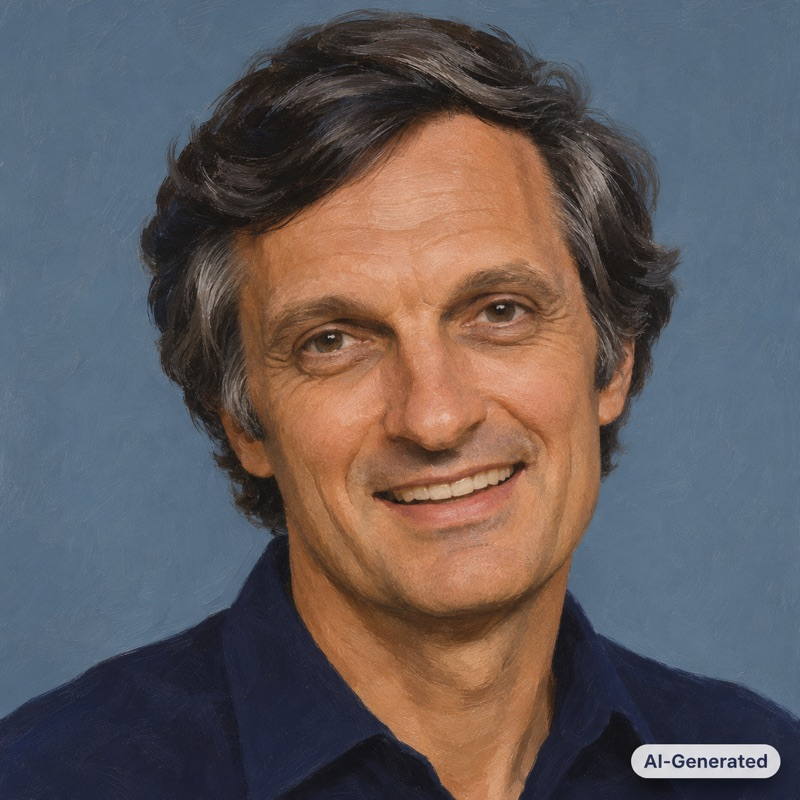
Artwork: Original AI-generated portrait of Alan Alda created for Famous Faith; an illustration, not a photograph. No endorsement is implied.