People · Beliefs
Candace Parker
Candace Parker won WNBA championships with three different teams, then carried her voice into broadcasting and writing. Her story offers far more than a highlight reel, while her personal religious beliefs call for a careful answer.
- Sport
- Basketball
- WNBA championships
- 2016, 2021, and 2023
- College
- University of Tennessee
- Book
- The Can-Do Mindset, published in 2025
Candace Parker left a rare mark on basketball: WNBA championships with Los Angeles, Chicago, and Las Vegas. The Aces’ retirement announcement describes her as the first player in league history to win titles with three different teams. It is a career that can be followed across cities, generations of teammates, and changing stages of the women’s game.
Parker’s public life also includes family, broadcasting, and a book about meeting challenges. Readers may naturally wonder about the beliefs behind that life. The reliable sources used here do not establish her current religion or a clear public profession of Christian faith, so this profile does not assign one to her.
A career across teams and generations
Parker played college basketball for Pat Summitt at Tennessee. The university’s account of her career records national championships in 2007 and 2008 before she entered the WNBA. Her college years established the combination of skill and versatility that later became familiar to professional fans.
The Los Angeles Sparks selected her first overall in the 2008 draft. Her official Aces biography records her championships, league honors, international experience, and two Olympic gold medals. She spent her first 13 WNBA seasons with Los Angeles before playing for Chicago and Las Vegas. She announced her retirement in April 2024 after a 16-year WNBA career.
The timeline contains more than success after success. Injuries and the demands of a long career also shaped its ending. The retirement announcement describes the foot surgery that cut short her 2023 season. In that setting, deciding to leave competition involved accepting the limits of a body that had carried her through years of work. A complete sporting story has room for those decisions as well as for trophies.
Lessons beyond the court
Parker’s book The Can-Do Mindset was published in June 2025. The publisher presents it as a collection of personal lessons about community, authenticity, facing negativity, appreciating daily life, and pursuing opportunity. It carries a nickname from childhood into a wider discussion about how she approaches difficulty.
That gives readers another way to encounter Parker beyond game statistics. A basketball career is played in public, but it is lived by a person with responsibilities and relationships outside the arena. Her book’s emphasis on purpose and vulnerability makes those dimensions part of the conversation. It should not, however, be treated as a religious confession simply because it uses words that can also appear in faith discussions.
What can be said about her religion?
The answer needs to stay limited: Parker’s present religious identity is not clearly established by the reliable sources used for this article. Her official sporting biographies describe her career, while the publisher’s account of her book explains its personal-development themes. Neither gives a sufficient basis for a specific denomination or a claim that she has publicly professed Christianity.
Some short celebrity fact pages supply religious labels without showing the original evidence. Famous Faith does not treat those labels as enough. Equally, the absence of a detailed public statement is not evidence that she has no faith. Religious identity should come from a person’s own clear account or reliable documentation, not from assumptions about family life, sporting success, or personal values.
Beyond the Spotlight
This is Famous Faith’s Christian reflection, separate from Parker’s own beliefs. Sport rewards effort, discipline, and perseverance. Those qualities can do much good. Christianity also teaches that our deepest need cannot be met by accumulating achievements, even admirable ones.
God is holy and loving. His Ten Commandments forbid lying, stealing, adultery, and worshiping anything in his place. They reveal that sin is more than failing to reach our potential: it is breaking God’s law. The writer and reader share that problem. We cannot make ourselves innocent by pointing to our best moments or comparing our record with someone else’s.
The Bible teaches that God will judge sin and that hell is real. That truth calls for humility, not a harsh attitude toward another person. God’s mercy is revealed through Jesus Christ, his sinless Son, who died on the cross for sinners and rose bodily from the dead. First Corinthians 15:3–4 identifies those events as the heart of the good news.
Salvation comes by grace through faith in Christ, not as a reward for hard work, good behavior, or religious performance (Ephesians 2:8–9). God calls us to repent: to turn from sin and rebellion toward him with a changed mind and heart, learning to trust his character and the love shown through Jesus. Changed conduct follows that trust, but it does not purchase forgiveness.
A new life with Christ begins by receiving mercy, not by proving we belong on a winning team. Honest questions are welcome as we consider who he is and what he has done. Our Good Person Test explains more about the need for forgiveness.
Sources
- Las Vegas Aces — retirement announcement, April 28, 2024
- University of Tennessee — career and retirement, April 28, 2024
- Las Vegas Aces — full biography
- Penguin Random House — The Can-Do Mindset, June 3, 2025
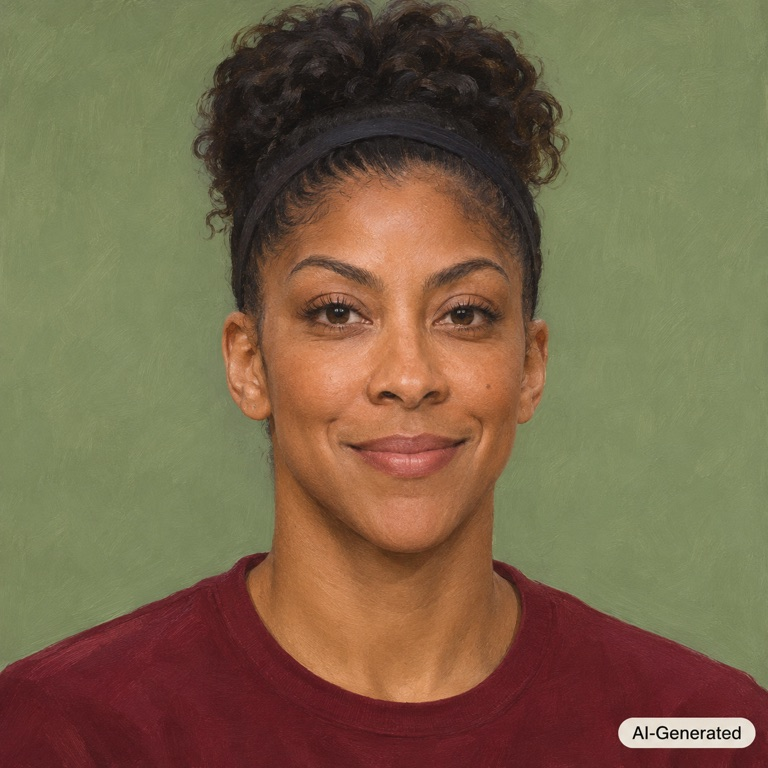
Artwork: Original AI-generated portrait created for Famous Faith; not a photograph. No endorsement is implied.