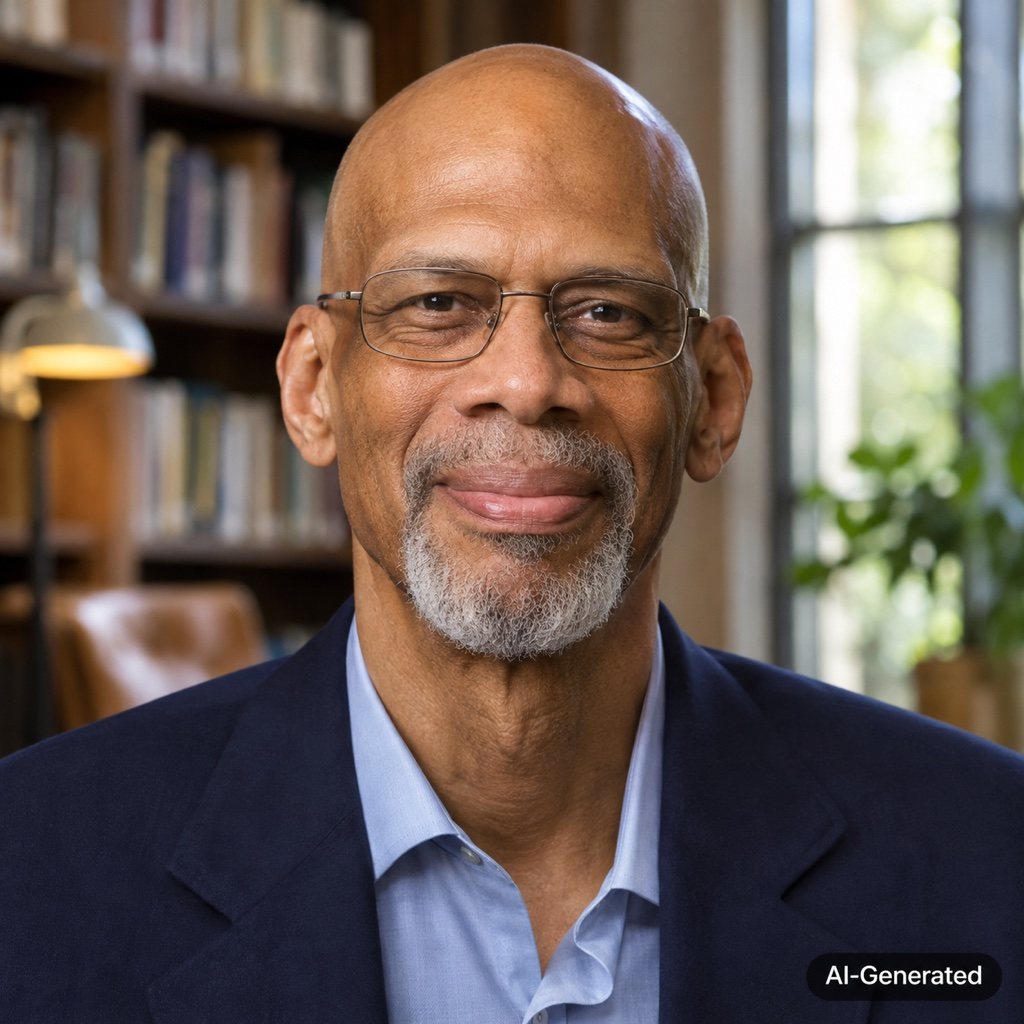
Kareem Abdul-Jabbar publicly identifies as Muslim. He has explained his conversion to Islam in his own writing and in direct interviews, including how it differed from his Catholic upbringing. His religious identity is therefore established by personal testimony rather than inferred from his name or cultural background.
A basketball figure who explains his own convictions
Abdul-Jabbar’s achievements with UCLA and in professional basketball made him a familiar figure to generations of sports fans. His life after playing has also included writing and public discussion of history, culture, and belief. That willingness to explain himself provides unusually substantial sources for a question that is often answered too casually in celebrity profiles.
In an essay published on his own website, Abdul-Jabbar described the change from Lew Alcindor to Kareem Abdul-Jabbar as much more than a public name change. He connected the decision with religious conviction, personal identity, and a reassessment of the expectations other people had placed on him. The essay presents his understanding of his life in his own voice.
From Catholic upbringing to Islam
His Academy of Achievement interview also describes Catholic schooling and encountering Islam while a student at UCLA. Reading The Autobiography of Malcolm X was important to his thinking. He described examining faith alongside African American history. His public embrace of Islam and use of his Muslim name became widely known in 1971.
These details should be kept distinct. A Catholic upbringing describes an earlier part of his life; his Muslim identification describes the religious choice he later explained. It would be misleading either to erase that upbringing or to use it as though it overruled his adult profession. A person’s account of changing belief deserves to be reported as a change, with its chronology intact.
A moral foundation in his own explanation
In the Academy of Achievement’s direct interview, Abdul-Jabbar discussed Islam as a moral foundation. He described the need to balance personal ambition with responsibility and addressed the difference between religious belief and political conflicts involving societies associated with it. The interview is useful because it allows him to explain ideas rather than merely supply a label.
He also discussed embracing Islam publicly in an NPR Fresh Air interview. His statements provide several opportunities to hear how he understands his own religious choice. They do not require an audience to invent an unverified current affiliation within Islam or assume that his views represent every Muslim person’s experience.
Belief is more than a public image
A famous person’s change of religion can become a story about branding, controversy, or the reactions of supporters. Those reactions may be part of the history, but they do not exhaust the subject. Religious commitment concerns what a person believes to be true, how that belief shapes responsibility, and what claims deserve trust. Reducing it to a new name leaves the most important questions unanswered.
The same care is needed when Christians discuss a Muslim public figure. Accuracy does not require agreement, and disagreement does not excuse careless description. Abdul-Jabbar has offered his own reasons for conversion. Readers can consider them seriously while recognizing that Islam and Christianity make different claims about the person of Jesus and the way people are reconciled to God.
The Christian claim about Christ and grace
Christianity teaches that Jesus Christ is God’s Son, not simply a respected religious teacher. He lived without sin, died for sinners, and rose bodily from the dead. Paul summarizes those events as central to the gospel in 1 Corinthians 15:3–4. The cross is not a detail that can be removed while leaving the Christian message unchanged.
The Bible says all have sinned and fall short of God’s glory (Romans 3:23). Salvation is God’s gift, received by grace through faith rather than earned by moral achievement, religious discipline, or a respected public life (Ephesians 2:8–9). Christian hope rests on Christ’s saving work rather than on an individual’s ability to construct a sufficiently admirable identity.
Those statements explain the Christian perspective of this site; they do not pretend to summarize Abdul-Jabbar’s own theology. His public testimony supports a clear answer: he has identified as Muslim and explained his conversion from a Catholic background. That history can encourage readers to move past assumptions and examine the deeper questions of belief, truth, and the hope on which they themselves depend.
Sources
- Kareem Abdul-Jabbar: Why he converted to Islam, in his own words
- Academy of Achievement: Kareem Abdul-Jabbar biography and interview
- NPR Fresh Air: Kareem Abdul-Jabbar discusses embracing Islam
Image disclosure: AI-generated editorial portrait representing Kareem Abdul-Jabbar, created for Famous Faith; not a photograph. The setting is illustrative and does not document an actual event. No endorsement implied.