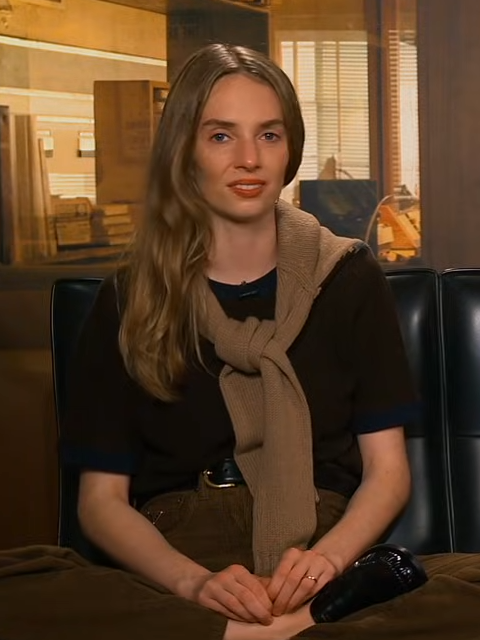
Maya Hawke has described herself as spiritually curious and has said she has no denominational beliefs. Her interviews explore religion, the afterlife, and the ideas behind her music. They show an interest in spiritual questions without establishing a settled Christian, Buddhist, or other religious affiliation.
Hawke plays Robin Buckley in Stranger Things and also works as a musician. Her role as writer Flannery O’Connor in Wildcat brought her into close contact with Catholic ideas. A performance, however, is different from a personal profession of faith.
What has Maya Hawke said about spirituality?
In a 2024 Vogue interview about Chaos Angel, Hawke described herself as spiritually curious. She said she had not been brought up within a single imposed religious system and saw both value and potential problems in religion. Her account presented curiosity rather than a clear denominational commitment.
Speaking with Coup de Main in June 2024, she said she did not know exactly what she believed about the afterlife and did not hold denominational beliefs, while expressing optimism that there is something beyond what she can explain. That uncertainty should not be replaced with a more definite label than she chose.
In The Line of Best Fit, Hawke also discussed exploring spiritual ideas while preparing to portray O’Connor. She wanted to understand the relationship between the writer’s art and devotion to God. Studying that relationship explains part of Hawke’s creative work, but it does not mean she adopted O’Connor’s Catholic faith.
Is Maya Hawke a Christian?
The interviews reviewed here do not establish a public profession of trusting Jesus Christ as Savior and Lord. They point to spiritual curiosity and uncertainty about specific beliefs. It would therefore be inaccurate to present her as a confirmed Christian on this evidence.
Family connections cannot settle the question either. A relative’s religious tradition, even when important in someone’s life, is not automatically that person’s own faith. Her artistic use of angels and religious themes likewise should not be treated as a complete personal creed.
Curiosity and the question of truth
Christianity welcomes serious consideration of the questions Hawke raises. What happens after death? Does life have a purpose beyond immediate experience? Are we accountable to someone greater than ourselves? These are important questions, and a thoughtful answer deserves more than a slogan.
The Bible points people toward what God has revealed. Acts 17:24–31 presents Him as the Creator who gives life, calls people to seek Him, and has appointed a day of judgment. The passage ends with the resurrection of Jesus as a decisive claim about God’s action in history.
Spiritual curiosity can open a conversation, but curiosity alone does not establish which beliefs are true. Different religions make different claims about God, humanity, and salvation. Respectful discussion should acknowledge those differences rather than treating them as interchangeable ways to express the same feeling.
Angels, art, and the center of Christian faith
Angels appear in Scripture as servants and messengers of God. They are not independent objects of worship. In Revelation 22:8–9, an angel directs John to worship God rather than the messenger. Colossians 2:18 also warns against misplaced religious fascination with angels.
Religious imagery can be powerful in art, and Christians should consider what an artist means before assuming agreement or hostility. Yet the center of Christianity is Jesus Christ, not a general interest in unseen beings. Hebrews 1 presents the Son as greater than angels and identifies His unique authority.
The same distinction applies to reading a Christian author or portraying one on screen. A person can study religious imagination without sharing the faith behind it. Viewers should appreciate the work while allowing the performer to speak for herself.
Hope beyond uncertainty about death
Scripture does not ask Christians to invent a comforting afterlife from wishful thinking. It grounds hope in the bodily resurrection of Jesus. Paul says that if Christ has not been raised, Christian faith is futile (1 Corinthians 15:17). The claim is central enough that Christianity stands or falls with it.
That hope also confronts our need for forgiveness. Death is not merely an interesting mystery; the Bible connects it with sin and accountability before God. No amount of creativity, intelligence, or openness can remove guilt. We need the mercy of the One who made us.
The gospel of Jesus Christ
All have sinned and fall short of God’s glory (Romans 3:23). Sin brings death and judgment (Romans 6:23; Hebrews 9:27). We cannot earn reconciliation through spiritual exploration, good intentions, or religious effort.
Jesus Christ, the eternal Son of God, became truly human and lived without sin. Fully God and fully man, He willingly died on the cross as a substitute for sinners, bearing the judgment we deserve. He was buried and rose bodily on the third day (John 1:1–14; 1 Peter 2:22–24; 1 Corinthians 15:3–4).
Salvation is God’s gift of grace received through faith, not earned by works (Ephesians 2:8–9). God calls us to repent, turning from sin and self-rule, and trust His crucified and risen Son. The Christian invitation is to move from considering spiritual possibilities to considering Christ Himself, who offers forgiveness and new life.
Sources
- Vogue: Maya Hawke discusses Chaos Angel and spiritual curiosity, 2024.
- Coup de Main: Hawke on belief and the afterlife, June 14, 2024.
- The Line of Best Fit: Hawke on spiritual ideas and Wildcat, 2024.
Portrait: Beto Pasillas, CC BY 3.0, via Wikimedia Commons. Cropped or resized where needed.
