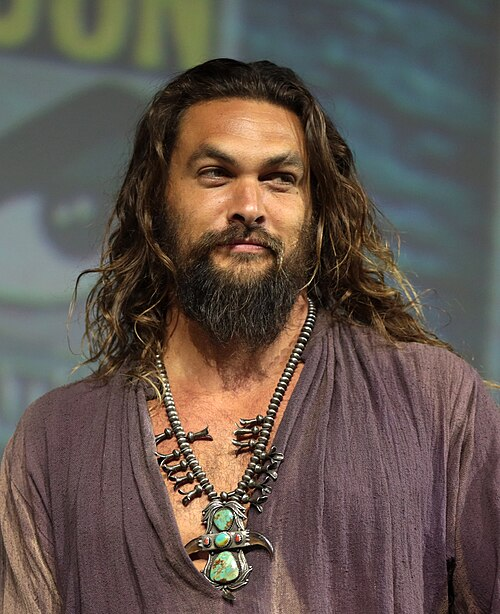
Jason Momoa has publicly described spiritual meaning in his Hawaiian family traditions, including the guardian symbolism of his tattoos. Those comments give us direct evidence of beliefs and practices that matter to him. They offer a firmer starting point than assuming his religion from Aquaman or from a celebrity database.
His interviews do not provide a complete religious creed. What we can report is a visible connection between family, ancestry, protection, and Hawaiian culture, alongside a strong commitment to the natural world.
His own explanation of spiritual symbols
In a December 2023 GQ tattoo interview, Momoa explained that his first tattoo represents an ʻaumakua, a guardian associated with a shark. He connected it with his family and described receiving it before his daughter was born. He also spoke about the personal importance of traditional Hawaiian tattooing.
In a 2022 WIRED interview, Momoa likewise discussed guardian and protection meanings in his tattoos. He explained that some designs relate to family, while others remember people he loved. These are his own explanations of personal markings, not guesses based on how they look.
Hawaiian spiritual traditions have histories and meanings that deserve respectful treatment. A tattoo can carry cultural, family, and spiritual importance at the same time. We should report what Momoa says without turning one symbol into an exhaustive account of his entire faith.
Some online profiles label him Buddhist. The firsthand material verified for this article does not establish how he would currently describe that affiliation. It also does not establish a personal Christian profession. The careful answer is to name the spiritual connections he has explained and leave unsupported labels aside.
Family roots and a public love of the ocean
Momoa was born in Hawaii and spent much of his childhood in Iowa. In a 2025 National Geographic interview, he described an early interest in marine biology. After moving to Hawaii, he learned to surf with his father’s family before acting changed his plans.
Television audiences came to know him through Baywatch, Stargate Atlantis, and Game of Thrones. Film audiences know him as Aquaman and Duncan Idaho in Dune. The official Dune: Part Three site lists him in its returning cast.
His environmental work also reaches beyond a screen role. National Geographic reported on his ocean advocacy, his work with the UN Environment Programme, and efforts to reduce plastic waste. He spoke about using his platform to help people hear from scientists. His public concern for water and marine life is a meaningful part of his story.
Creation, gratitude, and the Creator
There is much for Christians to appreciate in caring for the world. Genesis 2:15 places human work within the task of tending what God has made. Psalm 24:1 teaches that the earth belongs to the Lord. Waste and careless harm are poor ways to treat a world entrusted to us.
The Bible also honors family responsibility. Remembering those who helped us and caring for children are worthy concerns. Christian faith does not require someone to despise their ancestry or pretend that their family story has no value.
There is, however, a clear difference between honoring creation and placing spiritual trust in created things or guardian spirits. Scripture calls people to worship the Creator. Acts 17:24–28 presents God as the maker and sustainer of life. Christians look to Him for their deepest security, rather than treating a symbol as the source of protection.
This comparison does not claim that every person uses a tattoo in the same way. Nor does it judge Momoa’s motives. It identifies a difference between the spiritual language he has used and the Bible’s teaching about the One in whom we place our trust.
A hope deeper than physical protection
We all want the people we love to be safe. Yet no amount of strength, wealth, or planning can remove every danger. The Bible speaks to a deeper need as well: being reconciled to God.
God is holy and just. We have sinned against Him through pride, dishonesty, selfish desires, and failures to love. Romans 3:23 says that all have sinned. Caring for creation and loving our families are good responsibilities, but they cannot erase guilt or make us righteous before God. We need forgiveness that we cannot earn.
Jesus Christ, God’s Son, lived without sin. He willingly died on the cross for sinners, bearing the judgment we deserve. He was buried and rose bodily from the dead. As 1 Corinthians 15:3–4 explains, His death and resurrection stand at the center of the gospel.
God offers salvation by grace through faith, not as a reward for our achievements. Turn from sin and trust Jesus as Lord and Savior. His mercy does not depend on your fame, family line, or ability to protect yourself. He calls people from every nation and background to come to Him.
Momoa’s public story opens a conversation about roots, responsibility, and spiritual trust. For the reader, the next question is personal: who can deal with your sin and bring you into peace with God? The Christian answer is Jesus Christ.
Sources
- GQ, Jason Momoa’s Tattoo Tour, 2023.
- WIRED, Jason Momoa interview, 2022.
- National Geographic, ocean advocacy interview, 2025.
- Official Dune: Part Three cast information.
Photo: Gage Skidmore, Jason Momoa at Comic-Con, 2018, via Wikimedia Commons, CC BY-SA 2.0. Cropped by BartocX; resized to 500 pixels wide.
