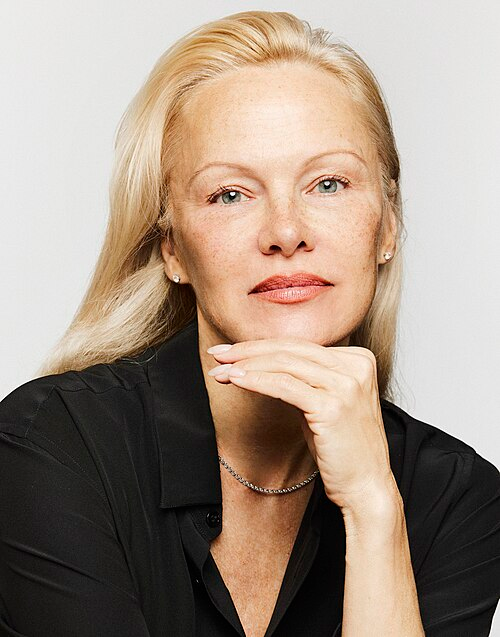
Pamela Anderson’s recent public comments describe an interest in spirituality, prayer, and rituals rather than a strong religious label. In an August 2025 interview with ELLE Australia, she said, “I’m not religious, but I love spirituality and rituals.” Earlier interviews also record belief in God, church attendance, and an interest in religious ideas. Reading those statements with their dates gives a fuller picture.
Her more recent comments about spirituality
In her 2025 ELLE interview, Anderson discussed routines that help her feel grounded while traveling and performing. She also described a small altar with a candle where she prays. She expressed affection for the prayer commonly associated with Saint Francis and spoke about seeking peace and joy.
Those are meaningful details about her spiritual life. They show that prayer and reflection remain part of her public account. They do not require us to decide that she belongs to a particular church. Her own description combines distance from a religious label with an active interest in spiritual practice.
What she told Larry King in 2002
During a July 2002 CNN Larry King Live interview, a caller asked about Anderson’s religious or spiritual beliefs. She said she believed in God and credited Him with helping her through difficult experiences. She also said she attended church and that her children went to Sunday school.
When King asked whether her faith was Protestant, she described it as non-denominational. This is a direct public statement worth reporting. It is also an older statement, so it should not be presented as proof of her current church attendance. Her later comments give readers a reason to keep the timeline visible.
Her childhood and interest in religious ideas
In a 2023 conversation with Ronan Farrow for Interview, Anderson said she did not grow up Catholic. She recalled her grandfather describing her as agnostic and telling her that no one could dictate what she believed. She also discussed a childhood fascination with religion, mythology, rituals, and fairy tales.
A recollection about what her grandfather told her is not the same as a present declaration that she is agnostic. The useful point is the context she gave: she grew up curious about belief and imagination, and she has continued to discuss spiritual interests in her own way.
From Lisa on Home Improvement to a wider career
Before becoming known around the world for Baywatch, Anderson played Lisa, the original assistant on Tool Time in Home Improvement. Her career later included V.I.P., film work, writing, and activism. Her biographical overview gives more of that history.
Her memoir Love, Pamela and the documentary Pamela, a Love Story gave audiences a more personal account of her life in 2023. She later starred in The Last Showgirl and the 2025 comedy The Naked Gun. These projects show a performer whose public story extends beyond the image many viewers first encountered.
That distinction matters in a faith profile. A public image is not a spiritual autobiography. Neither Lisa nor a later character tells us what Anderson herself believes. Her interviews are the evidence, and her own wording should remain more important than an audience’s assumptions about her roles.
Is Pamela Anderson a Christian?
Her public record includes belief in God and a non-denominational church connection in 2002, followed by broader spiritual language in more recent interviews. Her 2025 statement that she is not religious should be included alongside those earlier comments. The sources reviewed do not establish a current detailed profession of Christian faith.
A careful answer therefore describes the beliefs and practices she has shared rather than reducing them to a confident label. It leaves room for the difference between church history, spiritual interest, and present conviction. It also does not claim to know her private relationship with God.
Prayer, peace, and the Bible
Anderson’s interest in prayer and peace offers a thoughtful bridge to Scripture. Philippians 4:6–7 calls believers to bring their concerns to God with thanksgiving. Matthew 5:9 praises peacemakers. The Christian life should include seeking peace, caring for others, and turning to God honestly.
Yet prayer is more than a routine that helps us feel settled. In Christianity, it is a response to a personal God who has revealed Himself. Jesus teaches His followers to pray to the Father in Matthew 6:9–13. Their hope is grounded in God’s character, rather than in a candle, an altar, or the repetition of a phrase.
Those practices can provide a setting for reflection, but they cannot earn forgiveness. The Bible points to reconciliation with God through Jesus Christ. That is a real distinction between a broad interest in spirituality and the central Christian message. It should be explained respectfully, without treating Anderson’s curiosity as something to mock.
The gospel for the interested reader
God is holy and just, and Romans 3:23 teaches that all have sinned. We need forgiveness for our failure to love God and our neighbors as we should. Fame, good deeds, church attendance, and peaceful feelings cannot remove that guilt.
Jesus Christ, the Son of God, lived without sin, died on the cross for sinners, and rose bodily from the dead. First Corinthians 15:3–4 presents His death and resurrection as the heart of the gospel. Through Him, God offers forgiveness, reconciliation, and eternal life.
Salvation is by grace through faith, not earned by works (Ephesians 2:8–9). Repentance means turning from sin toward God. Faith means trusting Jesus to save you. His grace offers new life and calls us to love others, tell the truth, and follow Him.
If Anderson’s comments have made you curious about prayer or faith, read the Gospel of John and seek a Bible-teaching church. You can bring questions honestly. The Christian invitation is to know God through Christ, rather than relying only on a spiritual feeling or borrowing a famous person’s beliefs.
Photo credit: Pamela Anderson, 2024, by Norman Wong, via Wikimedia Commons, CC BY-SA 4.0. No endorsement implied.
