The profile · Actor; M’Baku, Gabe Wilson, and Will in Nine Days
Winston Duke
A Tobago childhood, a teacher’s encouragement, and an acting career that makes room for both scale and stillness.

- Born
- November 15, 1986[1]
- From
- Tobago[2]
- Education
- University at Buffalo; Yale School of Drama[3]
- Feature debut
- Black Panther (2018)[3]
The person behind the work
A different kind of village
Winston Duke moved from Tobago to Brooklyn with his mother and sister when he was a child. In a 2018 interview, he contrasted the large circle of relatives around him in Tobago with a quieter, more solitary life after the move. Comics became part of that world. His path toward performance began later, through a school play and encouragement from a teacher.[2][4]
He earned a theater degree at the University at Buffalo and an MFA at Yale. Those years belong in the story before the sudden visibility of Black Panther. The film was his feature debut, but it was not the beginning of learning to act. Television work included Person of Interest, where he played Dominic.[3][1]
A career in range
Selected work, at a glance
2019
Us
Gabe Wilson / Abraham
Two roles place familiar family behavior beside something frightening.[1]
The person behind the work
More than an imposing entrance
M’Baku makes a memorable arrival in Black Panther, but the role also calls for comic timing and a changing relationship to the film’s central conflict. Duke’s later films show different ways of using the presence that audiences first noticed there. In Us, he plays the father Gabe Wilson and his double, Abraham, inside Jordan Peele’s unsettling family story.[3][1]
Nine Days offers another change. Duke plays Will, who interviews souls before they enter life. The film uses a fantastical idea to ask questions about attention, suffering, and the value of ordinary experience. A quiet scene has a different job here from an action sequence. The comparison helps viewers see an actor working rather than simply recognize a large silhouette.[1]
A closer look
Three ways into the work
Us
The doubled roles ask Duke to make contrast visible within the same performer. They also put him inside a family dynamic rather than a royal or military one.[1]
Nine Days
Start here for a quieter central performance. The story’s unusual premise gives Will room to observe and question instead of driving the film through physical action.[1]
Person of Interest
This television work belongs before the feature-film success. It makes the career’s early stage more visible and gives viewers another character through which to meet him.[1]
The person beyond the premise
A film’s afterlife is a fictional world
Because Nine Days deals with souls and existence before birth, it can prompt questions about Duke’s own beliefs. The premise belongs to the film. His interviews here speak clearly about storytelling and his decision to pursue acting, but not enough about religion to assign him a personal creed. A remark about believing in himself should not be changed into a claim about faith in God.[2][1]
Listen to the person
In their own words
April 2018
“my first actual decision to act was probably in high school”
Famous Faith’s Christian perspective
Beyond the Spotlight
Nine Days asks viewers to notice the value of living. Its invented world is not a map of Christian teaching, but the question of what we do with ordinary days is real. Christians believe life is a gift from God and every neighbor has dignity. Listening, sharing a meal, keeping a promise, and caring for someone can matter more than the moments a crowd applauds.
The Bible also asks us to face what we do wrong with that gift. The Ten Commandments forbid lying, stealing, murder, and coveting, and call us to honor God (Exodus 20). First John 3:4 describes sin as breaking God’s law. We all need mercy. Jesus warned about judgment and hell, a serious truth to speak with love and humility rather than use as a verdict on a performer or a reader.
Christian hope rests on Jesus Christ, God’s Son. He lived without sin, died on the cross for our sins, and rose bodily from the dead. God offers forgiveness and eternal life through him. Salvation is received by grace through faith, not through a perfect use of our opportunities or a list of good deeds that makes us deserving (Romans 5:8; Ephesians 2:8–9).
Repentance turns the mind and heart from sin and rebellion toward God. We begin to trust who he is, taking his love shown in Jesus as a reason to come honestly rather than continue to push him away. That new direction normally changes behavior. We begin to tell the truth, seek to repair harm, and value people we once passed by. These are the results of grace at work, not the price of forgiveness. Faith can begin with an honest admission that we cannot remake ourselves alone.
You can bring that admission to Christ, with whatever questions you have about life and death. Read a Gospel, ask for forgiveness, and trust his death and resurrection. A caring church can help you grow. The invitation reaches the ordinary day you are living now, not only a future moment when everything feels clearer.
Consider the Good Person Test and the hope of forgiveness →
This section shares Famous Faith’s Christian beliefs. It does not speak for Winston Duke.
People connected to the story
Follow the connections
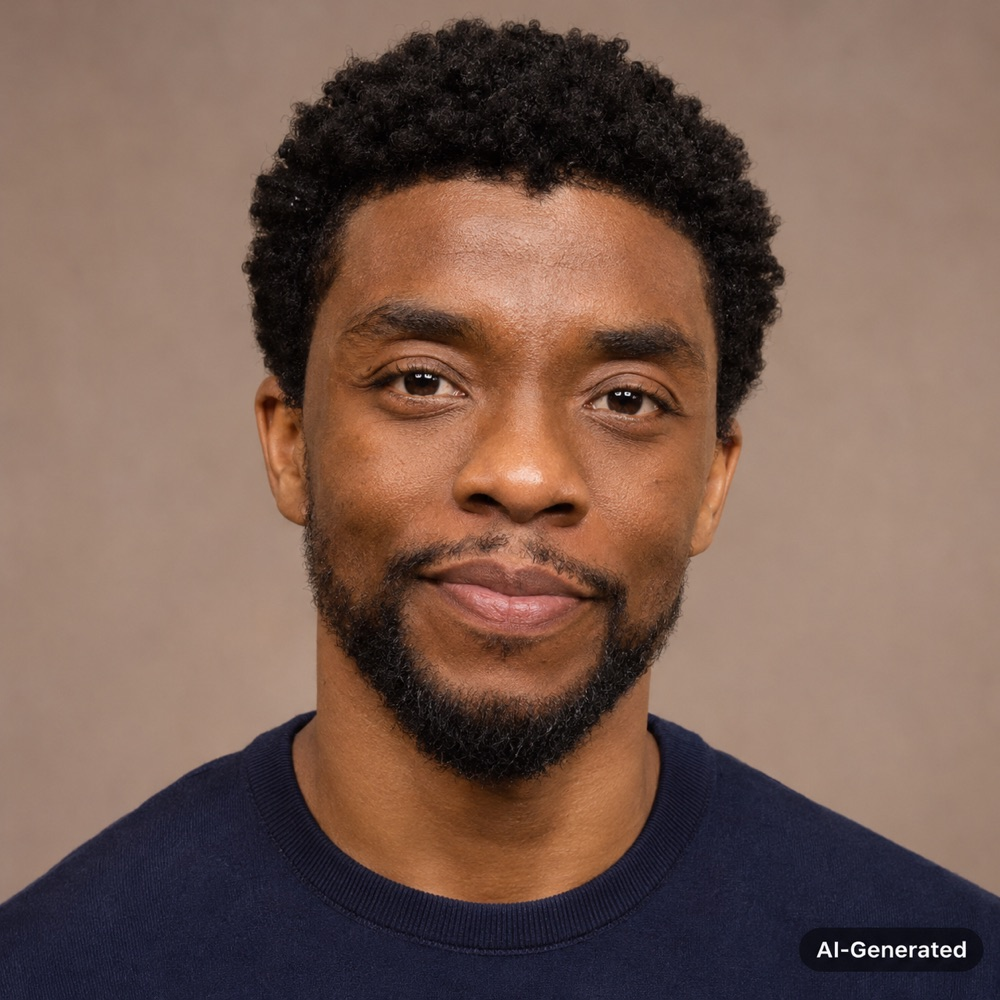
Chadwick Boseman
Their characters T’Challa and M’Baku form an important relationship in Black Panther.[1]
Read the profile →
Benedict Wong
Wong’s Kyo works alongside Duke’s Will in Nine Days, questioning how he judges prospective lives.[5]
Read the profile →
Sources and further reading
- Winston Duke: biography and filmography
- Okayplayer: Winston Duke on migration, comics, and acting
- University at Buffalo: Duke’s education and career
- 1883: Winston Duke interview
- SYFY: Benedict Wong on Nine Days and Winston Duke
Artwork: Original AI-generated portrait of Winston Duke, created for Famous Faith; not a photograph. The other AI-generated portraits shown here were also created for Famous Faith. No endorsement is implied.
Photograph: Danai Gurira by Gage Skidmore, via Wikimedia Commons, CC BY 4.0. Cropped to a square card for display.

Film and book titles identify the works discussed. A career credit is not a recommendation that every reader watch or read that work.