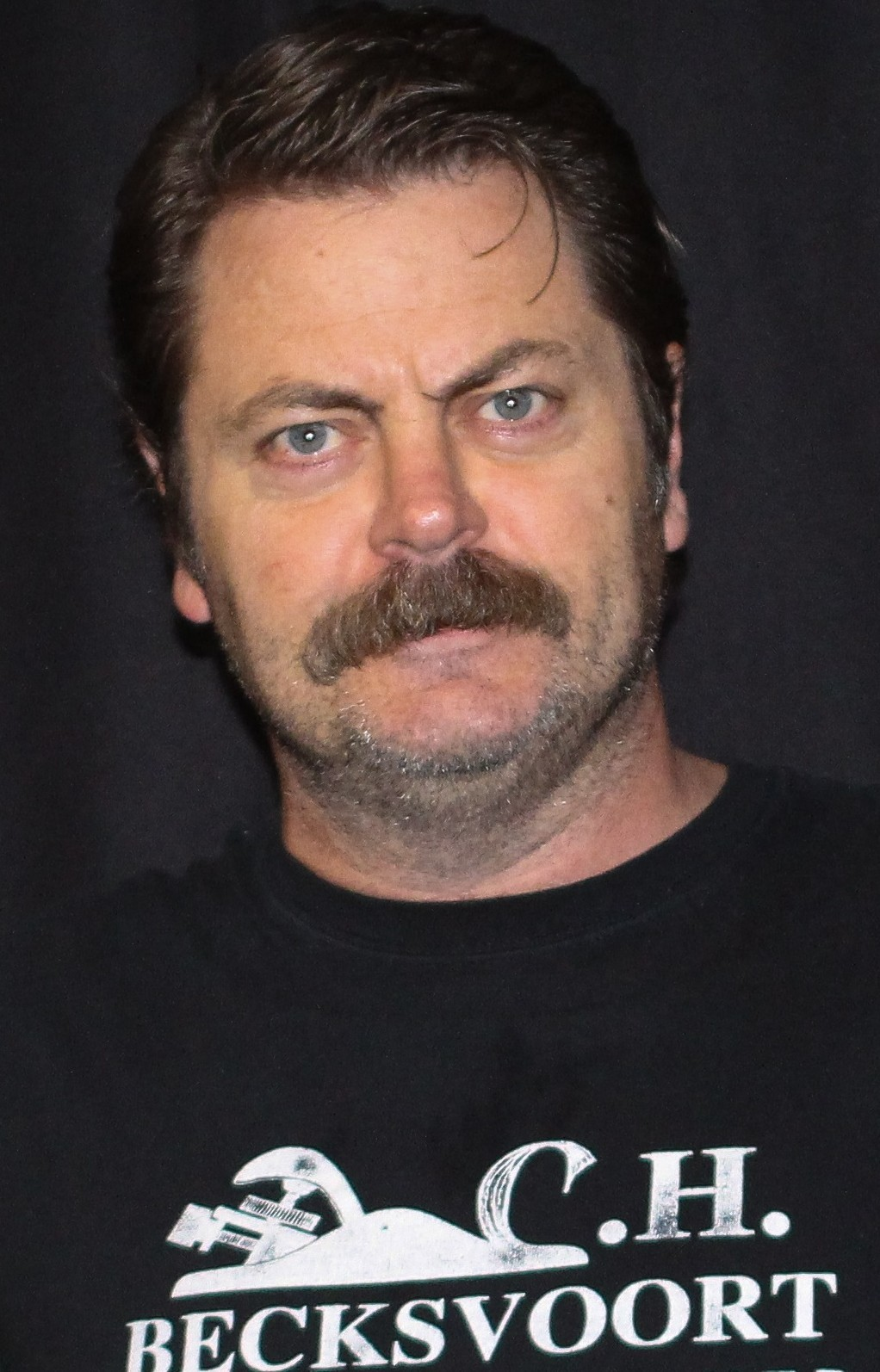
Nick Offerman was raised Catholic, but his later interviews describe a distance from organized religion rather than a clear profession of Christian faith. He has also spoken warmly about his parents’ Christian example. Those facts can coexist: respecting believers and valuing their service does not necessarily mean sharing all their beliefs.
Offerman is widely recognized as Ron Swanson in Parks and Recreation. His public interests in woodworking, practical skill, and the outdoors add to that familiar image. Yet neither a television character nor a fondness for traditional crafts can tell us what a person believes about God.
His Catholic background, in his own words
In an October 16, 2025 NPR Wild Card interview with Rachel Martin, Offerman recalled growing up in the Catholic Church and serving as an altar boy. He praised his parents as people whose Christianity showed itself through their lives and service. At the same time, he explained that the church had not felt like the right place for him.
A 2021 interview in The Independent also described his movement away from organized religion. In that conversation, he recalled disappointment with the lack of engagement he perceived in church services. These are dated accounts of his experience, not grounds for assigning him a detailed creed he has not supplied.
The careful answer is therefore more specific than either “Catholic” or “Christian.” Catholicism was part of his upbringing; later public comments describe a different relationship with religious institutions. A label such as atheist or agnostic should not be substituted simply because someone has criticized a church.
A character is not a confession
Ron Swanson’s confidence, bluntness, and distrust of bureaucracy are central to the comedy of Parks and Recreation. Viewers often enjoy the contrast between his independence and Leslie Knope’s enthusiasm for government service. The friendship works partly because the two do not approach life in the same way.
Offerman performs that role; he does not become the character. This distinction matters when viewers try to connect an actor’s politics, humor, or spiritual outlook to lines from a script. Fiction can start a useful conversation, but research about a real person should return to that person’s documented words.
The dignity of useful work
Woodworking offers a concrete picture of patience. Materials have limits. A careless measurement matters. Skills develop through practice, and a finished object can serve people long after the maker has left the room. There is something worth appreciating in work that is both attentive and useful.
Scripture gives ordinary labor dignity. Ephesians 4:28 connects honest work with having something to share with people in need. The point reaches beyond making a living: our abilities can become a means of loving our neighbors. Work does not need applause or a large audience to matter.
Still, the value of making something well is different from the question of being right with God. A skilled person can also be proud, impatient, dishonest, or unkind. Craftsmanship may improve a chair, but it cannot remove guilt from a conscience. The distinction applies to every profession, including writing about other people’s faith.
When religious disappointment deserves a hearing
People sometimes leave church after encountering empty routines or conduct that contradicts what was preached. Christians should listen carefully rather than assuming every criticism comes from ignorance. Jesus himself warned against honoring God with outward words while keeping the heart far away, in Matthew 15:8.
That warning should make churchgoers humble. Attendance, vocabulary, and appearances can hide a heart that does not love God or other people. A serious response to hypocrisy begins by examining ourselves, not merely defending an institution’s reputation.
At the same time, the failures of people who claim Christ do not settle whether Christ is true. The central Christian claims concern who Jesus is, what he accomplished through his death, and whether he rose from the dead. Those claims deserve to be considered on their own terms.
Self-reliance meets its limit
Independence can be useful when it means taking responsibility. It becomes a spiritual obstacle when it means refusing to admit our need. God’s commands require truthful speech, faithful love, and worship of him above everything else. Have we always met that standard? Have we loved others even when it cost us something?
Romans 3:23 says that all have sinned. The writer, reader, actor, and churchgoer stand together in that need. We cannot repair a guilty past with future good behavior, any more than praise from other people can overrule God’s judgment. We need forgiveness, not simply a stronger image of ourselves.
The Savior Christians proclaim
Jesus Christ, the Son of God, became human and lived without sin. He willingly died on the cross as the substitute for sinners, bearing the judgment we deserve. He was buried and rose bodily on the third day. First Corinthians 15:3–4 identifies these events as central to the gospel.
Salvation comes by grace through faith, not by works, according to Ephesians 2:8–9. We trust Jesus’ finished work instead of our own record. Repentance is a changed mind toward God and sin that bears fruit in a changed life. Good works follow grace; they do not purchase it.
Offerman’s comments invite a thoughtful discussion of example, work, and religious disappointment. They do not authorize us to judge his heart. The personal question remains for each of us: will we rely on our own resources, or receive the mercy God offers in Christ?
Sources and image credit
Interviews are linked above with their dates. Photograph: UMBC Student Events Board, via Wikimedia Commons, CC BY 2.0. Cropped headshot from 2013, displayed at web size.
