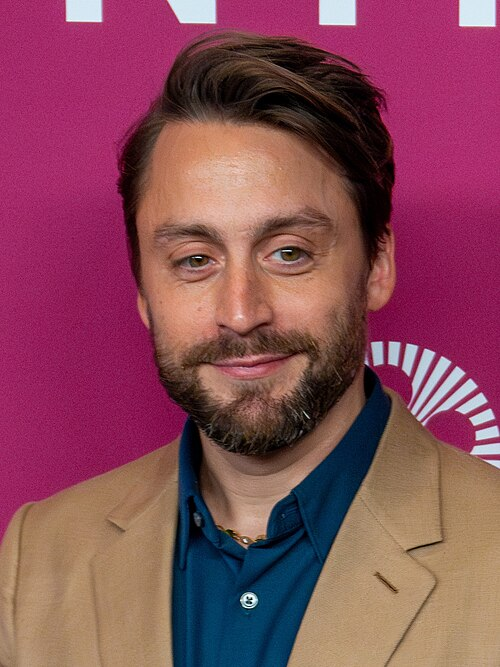
Kieran Culkin has a Catholic background, but his own account of childhood was less religious than that label may suggest. In a conversation with Marc Maron, he explained that his family attended Catholic school while not being very religious. His current adult beliefs are not clearly established by the public interviews reviewed here.
What Kieran Culkin has said about his upbringing
On WTF with Marc Maron, Culkin discussed his large family and early life. He recalled that his father’s work for the church helped the children attend its school. He described religion as something that did not play a very strong role at home, apart from occasions such as Easter.
That is useful firsthand evidence. It helps prevent an easy mistake: treating Catholic education as proof of a strongly religious family or a person’s adult commitment. Culkin was describing the life he remembered, not presenting a detailed statement of present belief.
A 2023 Esquire profile also records his Catholic schooling through third grade. It then describes his move to the Professional Children’s School, which served young performers. These details establish part of his education. They do not, by themselves, establish his current religion.
What his public family comments do show
In his 2025 Oscar acceptance speech, Culkin warmly thanked his wife, Jazz Charton, and spoke about their family and his wish for more children. The National Catholic Register covered the speech and its positive reception among readers who value family life.
That is a public expression of affection and gratitude. It deserves to be understood in its own setting. It was not a formal explanation of his beliefs about God, Jesus, or salvation. Religious readers may appreciate what someone says about family without assuming that person shares every part of their faith.
For now, the careful answer is limited: Culkin has Catholic roots and has spoken about a childhood that was not strongly religious. The material reviewed for this article does not provide a clear current profession of Christian faith, nor does it justify declaring him an atheist.
From Home Alone to major recognition
Culkin began acting as a child. In Home Alone, he played Fuller, while his older brother Macaulay played Kevin McCallister. He later appeared in films including Father of the Bride and Igby Goes Down, building a career with a different path from his brother’s.
Many viewers now know him as Roman Roy in Succession. The show’s sharp family conflicts helped bring his work to a large adult audience. His performance in A Real Pain earned the 2025 Academy Award for supporting actor. He also joins The Hunger Games: Sunrise on the Reaping as Caesar Flickerman.
His roles can be funny, harsh, wounded, or difficult to like. None should be used as a shortcut to his religion. The actor, the character, and the writer are different people. Good research keeps those voices separate.
Family and faith through a biblical lens
The Bible gives us good reason to value family relationships. Psalm 127:3 presents children as a gift. Ephesians 5:25 calls husbands to love their wives with self-giving care. Ephesians 6:4 tells fathers to guide children without provoking them to anger. These teachings place love and responsibility above status.
We can appreciate a public expression of love for a spouse or children without turning it into a full religious claim. That is one way to be both charitable and accurate. Admiration does not require guessing what someone believes in private.
Scripture also makes a distinction between religious background and personal trust in God. Growing up around a church can provide valuable teaching and community. Yet a person’s family story cannot answer every question about their own convictions. In John 3, Jesus speaks about the need for new birth, reaching deeper than ancestry or education.
This is a question for readers too. Have we only inherited familiar words, or have we considered the truth those words point to? Honest reflection can begin without pretending to know another person’s heart.
The gospel: grace for ordinary people
The Christian message does not begin with fame, a perfect family, or a record of religious achievement. It begins with a holy God who created us and made us to know him. We have sinned against him. Our selfishness, pride, dishonesty, and failures to love are real, and they bring guilt and judgment.
We cannot repair that broken relationship by earning awards, raising a family, or trying to outweigh our wrongs with good actions. God has provided the rescue we cannot provide for ourselves. Jesus Christ, God’s Son, lived without sin and willingly gave his life on the cross for sinners.
Jesus was buried and rose bodily from the dead. He is the living Savior, not simply an inspiring teacher from the past. The gospel calls us to repent of sin and trust him as Lord and Savior. Forgiveness comes by God’s grace through faith, rather than by works (Ephesians 2:8–9).
For the interested reader, this offers a clear next step: examine Jesus’s words and actions in the Gospels. Bring your questions about family, identity, guilt, and hope. Christian faith points to a Savior who welcomes repentant sinners and gives them new life. That invitation stands on his mercy, not on a person’s fame or upbringing.
Sources
- WTF with Marc Maron: Kieran Culkin interview transcript, episode 1150
- Esquire: Kieran Culkin profile (2023)
- National Catholic Register: Culkin’s Oscars speech (2025)
- The Hunger Games: Sunrise on the Reaping official website
Photo: Bryan Berlin / WikiPortraits, Wikimedia Commons, CC BY-SA 4.0. Cropped by LeeGer; displayed at reduced size.
