People · Beliefs
Gregory Jbara
Gregory Jbara brought a Broadway performer’s range to Garrett Moore on Blue Bloods. His story includes a Tony-winning father in Billy Elliot, film directing, and a Catholic upbringing he has described with both gratitude and distance.
- Blue Bloods role
- Garrett Moore
- Major award
- 2009 Tony Award, Billy Elliot the Musical
- Training
- Juilliard School
- Faith background
- Catholic upbringing; described himself as a “recovering Catholic” in 2023
Gregory Jbara’s Garrett Moore usually faced a problem that a badge alone could not solve: how to explain a difficult decision to the public. Long before those conversations on Blue Bloods, Jbara had built a substantial musical-theater career, including a Tony-winning performance in Billy Elliot the Musical.
His story connects stage, screen, and a move into directing. Exploring Gregory Jbara’s religion also means reading his own comments carefully: his Catholic upbringing is well documented, while his later descriptions deserve more nuance than a simple current-affiliation label.
A path through training and musical theater
Jbara’s professional training included the Juilliard School. In a 2021 interview, he recalled supportive public-school arts programs and the childhood experiences that helped draw him toward performance. He described playing sports before an injury and a school-play audition helped send his interests in another direction.
The Internet Broadway Database records a career that includes Serious Money, Born Yesterday, Damn Yankees, Victor/Victoria, Chicago, and Dirty Rotten Scoundrels. Those credits show a performer working across plays and musicals, rather than someone whose stage experience began with a single breakout part.
His portrayal of Dad in Billy Elliot the Musical brought the 2009 Tony Award for best featured actor in a musical. A musical about a boy’s ambition asks the adults around him to become more than obstacles or supporting figures. Jbara’s work gave the father a presence within that larger family story, while connecting spoken performance with the musical form.
From explaining the news to directing a film
On Blue Bloods, Garrett Moore’s public-information responsibilities gave him a different perspective from the police officers around Frank Reagan. Their conversations made room for questions about how an action would be understood outside the commissioner’s office. The character’s purpose was not simply to agree with every decision.
Jbara’s work has also moved behind the camera. His official website presents Original Sound as his feature-film directorial debut, based on Adam Seidel’s earlier play. The project follows a story involving a stolen musical track and a possible breakthrough, placing artistic ambition and responsibility near the center of the action.
The directing credit adds another dimension to a career already split among live theater, television, and film. It involves shaping the whole story rather than concentrating only on the character standing inside it. That broadens the picture of the actor many viewers first recognize as Garrett.
Catholic upbringing and his later descriptions
Jbara’s Catholic background is supported by his own account. In his 2021 WorldClassPerformer interview, he recalled serving as an altar boy and reading difficult biblical names before a congregation. That experience helped him become comfortable speaking in public.
On The Dance Studio Podcast, published October 1, 2023, he again described that upbringing. This time he also called himself a “recovering Catholic.” In the same passage, he expressed lasting gratitude for the opportunities his religious upbringing gave him to speak in front of people.
The publisher’s description of his July 4, 2024 appearance on Personally Speaking, hosted by Monsignor Jim Lisante, refers to discussion of his Catholic faith and sustaining values. That later description is relevant, but a publisher’s summary does not erase the more qualified language in his own earlier account.
Together, these sources establish a Catholic upbringing and public engagement with faith. They do not justify confidently labeling his present practice or assuming either full adherence to Catholic teaching or rejection of all religious belief. His own dated statements deserve to remain visible alongside that uncertainty.
Beyond the Spotlight
A public-information role raises questions about how words shape a reputation. Scripture takes us further, to the God who knows the truth even when our presentation is polished. Famous Faith’s Christian perspective begins with his holiness and love: he made us, cares for us, and has the right to call us to account.
The Ten Commandments expose our common sin. Lying, coveting, dishonoring God, and failing to love our neighbors are not merely problems in somebody else’s life. The writer shares the reader’s need for mercy. God’s judgment is real, and the Bible warns of hell as a terrible consequence of separation from him.
Our hope is Jesus Christ, the sinless Son of God, crucified for sinners and bodily risen from the dead. God offers forgiveness by grace through faith in him. Family religion, church service, professional achievement, and good works cannot purchase that gift.
Repentance is turning from sin toward God with a changed mind and heart, learning to trust the love demonstrated in Jesus. Such trust normally changes our conduct, but changed behavior is not the price of salvation. Honest questions can be brought to God. This explanation states Famous Faith’s convictions without assuming that Jbara agrees with every part of them.
Sources
- Gregory Jbara — official website and Original Sound announcement
- Gregory Jbara Broadway credits and awards — Internet Broadway Database
- Short Life Lessons From Gregory Jbara — firsthand interview, 2021
- Greg Jbara on his upbringing and later description — The Dance Studio Podcast, October 1, 2023
- Personally Speaking episode 214, July 4, 2024 — publisher RSS listing
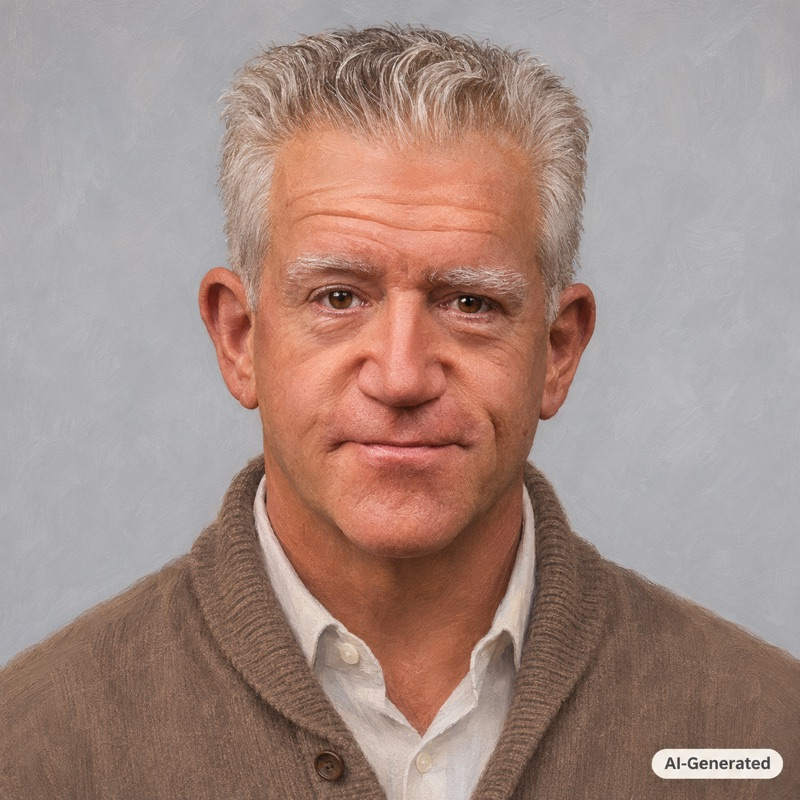
Artwork: Original AI-generated portrait of Gregory Jbara created for Famous Faith; an illustration, not a photograph. No endorsement is implied.