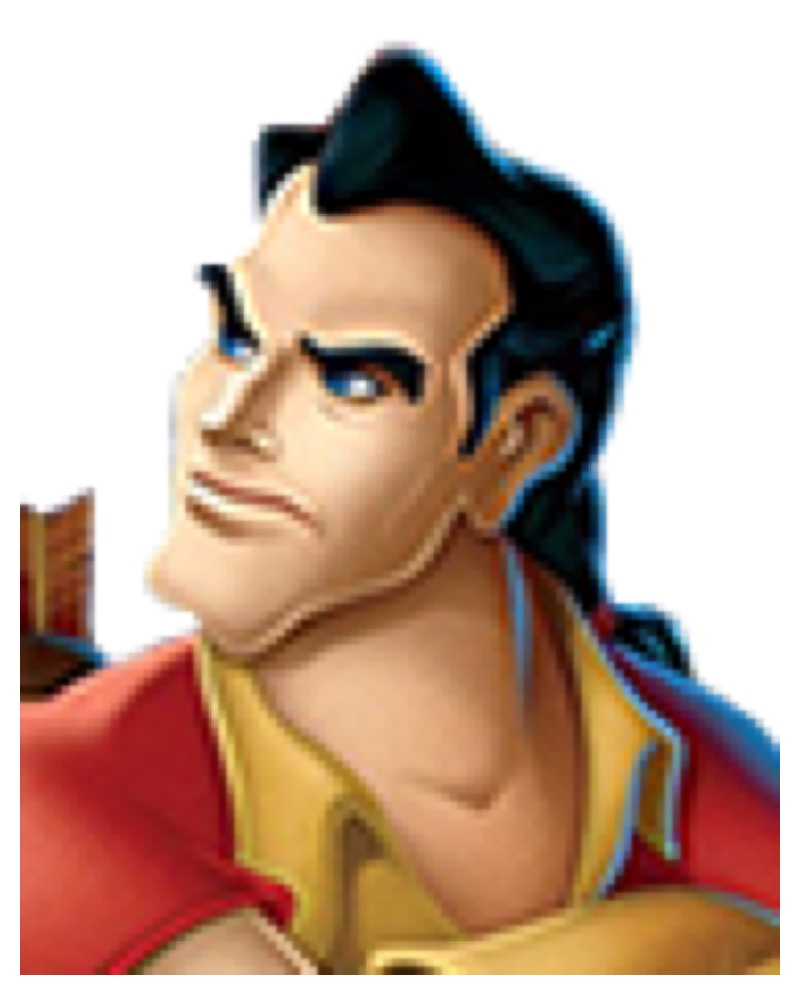
Gaston has the jawline, the admirers, and a room full of people ready to explain how wonderful he is. If a handsome face and a loud fan club made someone good, Beauty and the Beast would have a very different ending.
That is what makes him such an effective villain. He enters the story with the appearance of a conventional hero. The more seriously his wishes are challenged, the more clearly we see the heart beneath the performance. He is confident that Belle belongs in his future. Her agreement seems, to him, like an inconvenient detail.
Fictional character study: This article follows Gaston in Disney’s 1991 animated film. It discusses that character’s choices, with spoilers, rather than the beliefs or personal character of his voice actor.
He wants Belle, but does he want to know her?
Disney’s official story summary describes Belle ignoring the vain Gaston. That rejection matters because he cannot understand it as a decision she is entitled to make. He sees himself as the obvious answer and her independence as a problem to solve.
“It’s not right for a woman to read,” he tells her in the film’s dialogue. His dismissive response to her reading reveals the same attitude in miniature. The interests that make Belle a particular person do not fit the role he has prepared for her. He likes his picture of their future more than he values the person who would have to live in it.
That is a useful test of affection. Do I listen to what the other person actually says? Do I respect a refusal? Can I want someone’s good when their choice disappoints me? Attraction may start a relationship. It cannot excuse treating another person as a possession.
Applause can make pride feel reasonable
Gaston’s admirers give his self-image a soundtrack. The tavern celebration is funny because its admiration is so excessive. It also shows how a room can help a person avoid honest self-examination. If everyone keeps telling you that you are exceptional, correction starts sounding like an insult.
Many of us have a smaller tavern. It might be a group that always sides with us, a circle that laughs at our cruel remarks, or an online audience that rewards outrage. Agreement feels like evidence even when nobody has asked whether we are right.
Proverbs 27:5–6 teaches us to value faithful correction. A friend who challenges our behavior may be showing more love than the person who keeps cheering. Pride wants an audience. Wisdom can tolerate an honest witness.
A question for the fan club: Who in your life can tell you that you are wrong without being punished for it?
Rejection exposes the demand
Disappointment is not automatically sinful. Being rejected can hurt. Gaston’s failure is what he believes that hurt authorizes. He tries to force the outcome he wants instead of accepting Belle’s freedom and examining his own conduct.
The film’s plot becomes darker when he uses Maurice’s vulnerability as leverage. A marriage obtained through coercion would satisfy his demand while destroying the freedom that genuine affection requires. The issue has moved far beyond wounded vanity.
We may never arrange anything so theatrical. But we can make people pay for saying no. We withdraw kindness, recruit allies, question their character, or turn a boundary into an accusation that they do not care about us. Those responses reveal that our affection had conditions the other person never agreed to.
First Corinthians 13:4–7 describes love as patient and kind, free from envy and arrogant insistence on its own way. That passage gives us a better measure of love than the intensity of a person’s desire.
The handsome man becomes the monster
According to D23’s account of the film, Gaston recognizes the Beast as a rival for Belle’s affection and leads the villagers against the castle. His private jealousy becomes a public cause. He supplies the crowd with a threatening picture of the opponent he wants removed.
That is one of the story’s sharpest reversals. The visibly frightening character can learn restraint and care. The outwardly impressive man becomes more dangerous as his pride hardens. Appearance fails as a guide to moral character.
The biblical principle in 1 Samuel 16:7 challenges our habit of judging by outward appearance. This does not make the Beast a perfect example of virtue; his own behavior also needs to change. It means beauty, charm, popularity, and strength cannot tell us what a person loves.
Questions more useful than a mirror
- Do I admire a person’s qualities, or mainly what having them beside me would say about me?
- When someone refuses me, do I accept it or begin making them suffer?
- Have I presented a rival unfairly so that others will join my resentment?
- Do my closest friends help me repent, or help me justify myself?
Those questions apply to dating, marriage, friendship, work, and leadership. Entitlement is not limited to romance. We can demand someone’s time, loyalty, agreement, or attention as though our desire created their obligation.
The gospel confronts the hero in our own story
Gaston sees himself as the person who deserves the happy ending. We often tell our stories that way too. Scripture asks a more difficult question: Have we loved God and our neighbors as we should? Pride, envy, coercion, and dishonesty reveal guilt that charm cannot cover.
Jesus Christ lived without sin, gave his life for sinners, and rose again. His mercy is received through repentance and faith. We cannot win forgiveness by becoming more attractive, more admired, or even more useful. God saves by grace, and his grace teaches us a different way to live (Titus 2:11–14).
Gaston spends the film assuming the problem is everyone who will not give him what he wants. The better question for the rest of us is whether we will let God correct what we want—and how we treat people when we cannot have it.
Sources and image credit
- D23: Beauty and the Beast, official account of the 1991 film
- D23: Gaston, character and production credits
- D23: Animating Gaston, Andreas Deja on creating the character
Character dialogue is quoted briefly for commentary; other descriptions are paraphrased. Bible links identify the passages used in the interpretation.
Image credit: Gaston character artwork, Disney, via Wikipedia. Non-free copyrighted character artwork, reproduced as a limited headshot for identification and critical commentary. Cropped and resized for this article. No endorsement implied.
