People · Beliefs
Mark Harmon
Before he led the NCIS team as Gibbs, Mark Harmon quarterbacked UCLA. His later work as a producer and coauthor has taken him from a fictional investigation room into real naval-intelligence history.
- NCIS role
- Leroy Jethro Gibbs
- Before acting
- Quarterback at UCLA
- Other television
- St. Elsewhere; Chicago Hope; The West Wing
- Also a coauthor
- Ghosts of Honolulu, with Leon Carroll Jr.
Mark Harmon was accustomed to reading a field before he became known for reading an interrogation room. He quarterbacked UCLA, then built an acting career that eventually made Leroy Jethro Gibbs a familiar presence in homes around the world. The path joined two demanding kinds of teamwork rather than following a simple plan from childhood to television stardom.
NCIS became his signature series, but his working life also includes producing, other major television roles, and a book about real intelligence work. Those documented chapters give readers more to explore than Gibbs’ rules or an unsourced label about Harmon’s religion.
From the football field to television
Harmon’s college career is preserved in the National Football Foundation’s records. After playing at Los Angeles Pierce College, he chose UCLA, where he became a starting quarterback. The foundation recognizes him as a National Scholar-Athlete and recalls the athletic and academic standards he had to meet. Those records offer a concrete starting point for a story that can otherwise be swallowed by his later fame.
He did not move into acting as an entirely untested newcomer to pressure or collaboration. A football team depends on preparation and the ability to make decisions with other people relying on them. A television ensemble asks for a different kind of skill, but it also rewards arriving ready and understanding that the work is larger than one performer.
Harmon’s screen career included St. Elsewhere, Chicago Hope, and The West Wing before or alongside the role that would dominate his public image. The Television Academy records Emmy recognition for his work. His characters ranged across medicine, law enforcement, and public service, making it important to distinguish the roles from the man employed to play them.
A fictional agent and real intelligence history
As Gibbs, Harmon helped establish the central presence around which the original NCIS ensemble developed. He also became an executive producer. That behind-the-camera responsibility is a different part of a long-running program’s life: decisions about the work continue beyond the moment a scene is performed.
His collaboration with retired NCIS special agent Leon Carroll Jr. took that interest into nonfiction. Ghosts of Honolulu follows naval counterintelligence before the attack on Pearl Harbor, including Japanese American investigator Douglas Wada. The publisher’s announcement describes research into historical records and the collaboration between a television actor and someone with direct professional experience in the agency.
The book is not a claim that playing Gibbs made Harmon an investigator. Its interest lies partly in the meeting of different backgrounds: one partner helped make a fictional world convincing, while the other brought experience from real investigations. Harmon’s public career has therefore included both portraying authority and learning from people who exercised it outside a script.
What is known about Mark Harmon’s religion?
The professional and firsthand sources reviewed here do not establish a clear current religious self-description from Harmon. Celebrity databases sometimes identify him as Catholic, but a label without a traceable personal statement should not be treated as a complete account of his faith.
Famous Faith therefore does not confidently assign him a denomination or declare that he is or is not a Christian. Gibbs’ values and dialogue belong to a fictional character. Neither a television role nor a reputation for steady work can substitute for evidence about what an actor believes concerning God and Jesus.
Beyond the Spotlight
Famous Faith’s Christian perspective values preparation, loyalty, and responsible work, while recognizing that none of those can make a person right with God. The God described in Scripture is holy and loving. His moral law reaches beyond a professional code or the rules that help a team function.
The Ten Commandments expose sins such as lying, stealing, envy, and placing something other than God first. We all fall short, including the writer of this profile. Good work cannot erase that guilt. Scripture warns of judgment and hell, so the question of forgiveness is more serious than maintaining a respectable public image.
The gospel announces that Jesus Christ, God’s sinless Son, died for sinners and rose bodily from the dead. Salvation is offered by grace through faith in him, not as a reward for achievement, good conduct, or religious performance. Repentance means turning from sin toward God with a changed mind and heart, learning to trust the love demonstrated through Christ.
A changed life follows that trust; it does not buy forgiveness. Honest questions can be brought to Jesus. This is Famous Faith’s invitation to the reader, not a statement of Harmon’s private beliefs or a claim that his character speaks for him. The hope Christians offer rests in a Savior, rather than the strength of anyone’s record.
Sources
- Mark Harmon — National Football Foundation scholar-athlete record
- Mark Harmon — Paramount/CBS official biography
- Mark Harmon — Television Academy career and awards record
- Ghosts of Honolulu — Harper Select publisher announcement
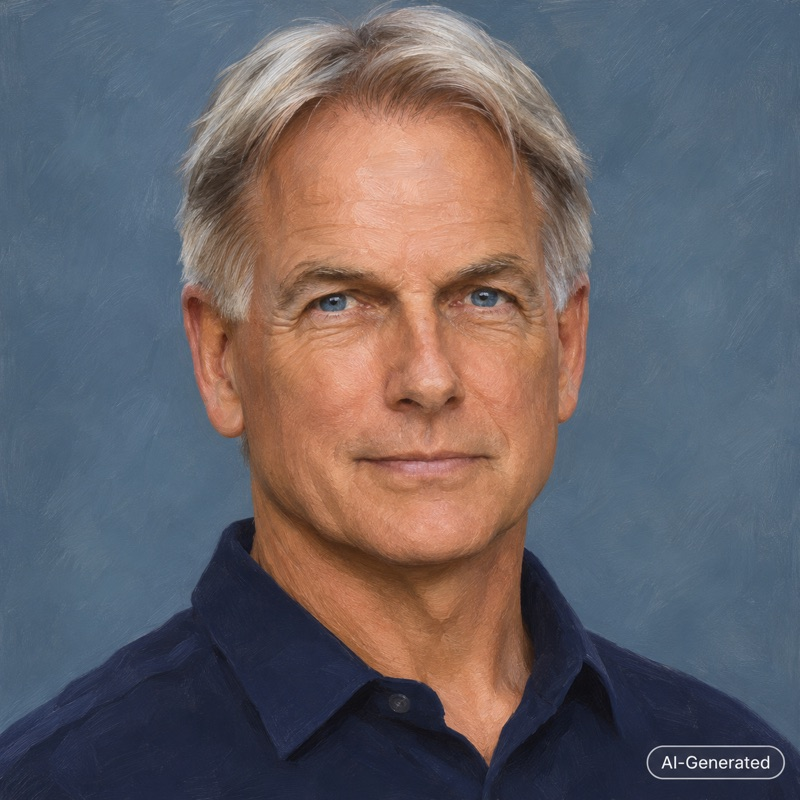
Artwork: Original AI-generated portrait of Mark Harmon created for Famous Faith; an illustration, not a photograph. No endorsement is implied.