The profile · Actor, director, producer, and advocate
Don Cheadle
Don Cheadle remembers the power of playing Templeton the Rat in a school production. A long career followed, but his own account still comes back to teachers, friends, and the experience of taking an audience somewhere new.
- Education
- CalArts, Theater BFA 1986[1]
- Early stage role
- Templeton in Charlotte’s Web[1]
- Directing debut
- Miles Ahead[2]
- Public service
- UN Environment Programme Goodwill Ambassador[3]
The person behind the work
A teacher helped make the possibility real
Don Cheadle told CalArts that a school production of Charlotte’s Web helped him discover the power of theater. He played Templeton the Rat. Later, a high-school teacher encouraged him to study acting formally and introduced him to schools with strong programs. He graduated from CalArts with a theater BFA in 1986.[1]
His memory of the early working years includes a group of young actors helping one another find auditions and pay the rent. That is an important detail in a profession often described as pure competition. In his account, friendship and practical cooperation belonged to the work from the beginning.[1]
His film career later moved through Devil in a Blue Dress, Boogie Nights, Traffic, Hotel Rwanda, and the Ocean’s films. Television gave him another kind of room in House of Lies and Black Monday. The range is a better guide than a single image of what a Don Cheadle role is supposed to be.[4]
A career in range
Selected work, at a glance
1995
Devil in a Blue Dress
Mouse Alexander
A supporting character can change the energy of a film quickly.[4]
2012–2016
House of Lies
Marty Kaan
A television comedy builds around performance, persuasion, and ambition.[4]
2015 festival / 2016 release
Miles Ahead
Miles Davis; director and co-writer
An imagined episode becomes a way to approach the musician’s spirit.[2]
2019–2021
Black Monday
Maurice “Mo” Monroe
A period comedy adds another restless, high-pressure world.[4]
The responsibility of a larger platform
The performer who also shapes the project
Miles Ahead made Cheadle a feature director as well as its leading actor and co-writer. Sony Pictures Classics described a story inspired by Miles Davis, imagining a few days during a difficult period of the musician’s life. That is a useful distinction: a drama’s invented structure should not be mistaken for a verified timeline.[2]
Directing a music story also creates a question about form. How should a film move if it wants to suggest a musician’s restless energy? Cheadle’s choices invite that kind of discussion. A biography can be judged by historical accuracy, while a dramatization also asks viewers to consider what its shape is trying to do.
Beyond entertainment, the UN Environment Programme identifies Cheadle as a Goodwill Ambassador and documents his environmental work. His activities include the climate documentary series Years of Living Dangerously. The public role makes one of his concerns explicit: he wants attention to become action on the conditions people need to live.[3]
A closer look
Three ways into the work
See what a supporting player changes
Devil in a Blue Dress is a useful place to notice an entrance. Watch how the other characters respond to Mouse and how the pace shifts around him. A memorable role does not always need the most screen time.
Compare a historical drama with a stylized portrait
Hotel Rwanda and Miles Ahead use different approaches to real people. One comparison to make is how each film asks the audience to understand responsibility. Neither movie replaces a careful account of the history.
Listen to the comic drive
House of Lies and Black Monday offer a different rhythm from the dramas. Watch how language becomes a tool of control, self-defense, or persuasion. Both series contain adult language and other mature material.
What he has shared
The record is more detailed on work and service
The sources used here do not give a clear statement of Cheadle’s personal religion. They give a much fuller account of his training, collaborations, and environmental concerns. Those choices are worth understanding in their own setting, without assigning a religious reason he has not stated.
Listen to the person
In their own words
UN Environment Programme biography
“What is more important than food and clean air?”
Famous Faith’s Christian perspective
Beyond the Spotlight
Cheadle’s memories of teachers, friends, and shared opportunities give achievement a human setting. His concern for food and clean air brings the discussion to the basic conditions people need to live. Scripture takes that care seriously. It also invites each of us to know the God who gives human lives their worth.
That relationship includes moral truth. The Ten Commandments call us to honor God and parents and forbid lying, stealing, adultery, and coveting (Exodus 20). Sin is breaking God’s law (1 John 3:4). All of us fall short, even while doing work that helps others. Jesus warned about judgment and hell. Such warnings should deepen compassion and honesty, never make Christians careless with people’s fear.
The gospel tells of Jesus Christ, God’s sinless Son, who died on the cross for our sins and rose bodily from the dead. Forgiveness and life with God come through faith in him. They are gifts of grace, beyond what service, success, or religious habits can earn (Romans 5:8; Ephesians 2:8–10).
Repentance changes our mind and heart, turning us away from sin and our refusal to follow God. We turn toward him in trust, because Jesus Christ has made his love for us clear. A changed direction normally leads to changed choices over time. A reader can come honestly to Christ, trust him, and receive mercy. Grace then gives practical love a new foundation: we care for others because God has loved and forgiven us, rather than trying to purchase his acceptance.
This section shares Famous Faith’s Christian beliefs. It does not speak for Don Cheadle.
People connected to the story
Follow the connections
Anthony Mackie
Mackie understudied Cheadle in Topdog/Underdog. It is a stage connection that predates their better-known shared film ensemble.[5]
Read the profile →
Benicio del Toro
They both appear in Traffic, another connection beyond their large fantasy-film credits.[4]
Read the profile →
Frank Grillo
Their film credits meet in the Avengers series. Grillo’s profile follows another performer whose preparation is central to the work.
Read the profile →Watch in context
A conversation about Black Monday
Published by SAG-AFTRA Foundation. Watch on YouTube ↗
Sources and further reading
- CalArts — A conversation with Don Cheadle (2023)
- Sony Pictures Classics — Miles Ahead
- UN Environment Programme — Don Cheadle
- Golden Globes — Don Cheadle biography and credits
- Backstage — Anthony Mackie on his stage work
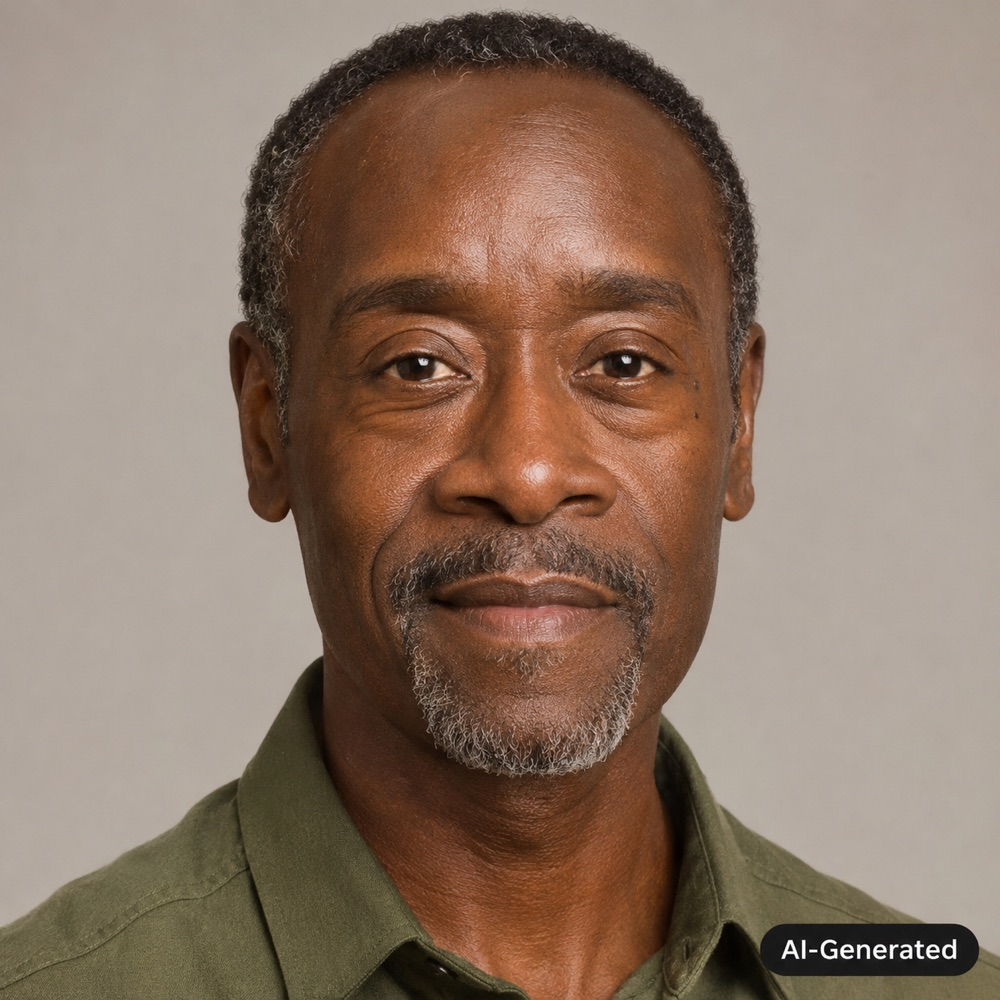
Artwork: Original AI-generated portrait of Don Cheadle, created for Famous Faith; not a photograph. The other AI-generated portraits shown here were also created for Famous Faith. No endorsement is implied.
Film and book titles identify the works discussed. A career credit is not a recommendation that every reader watch or read that work.