The profile · Actor and director
Andy Serkis
Andy Serkis helped audiences see a human performance inside a digital character. His career stretches from theater and live-action roles to Gollum, Caesar, directing, and new tools for telling stories.
- First studies
- Visual arts at Lancaster University[1]
- Breakthrough
- Gollum in The Lord of the Rings[1]
- Studio work
- Co-founded The Imaginarium in 2011[2]
- Recognition
- 2020 BAFTA Outstanding British Contribution to Cinema[1]
The person behind the work
Finding a way inside a character
Andy Serkis did not begin with a plan to become the face of performance capture. He studied visual arts at Lancaster University, became involved in theater, and moved toward acting. BAFTA’s account of his career traces that change from making visual work to building a character with his voice, face, and body.[1]
Gollum made that combination visible to a worldwide audience. What began as a much smaller voice commitment grew into work that helped shape how filmmakers captured a performance for a digital character. Later roles such as King Kong and Caesar in the Planet of the Apes films made the connection between an actor’s choices and the final image harder to overlook.[1]
There is a useful distinction for viewers: a digital character is made by many people, while the actor still supplies a performance. Animators, effects artists, editors, and directors help shape what reaches the screen. Appreciating Serkis does not require forgetting those collaborators. In fact, his career can make us more curious about them.
A career in range
Selected work, at a glance
2001–2003
The Lord of the Rings
Gollum
A conflicted digital character became a landmark for screen performance.[1]
2005
King Kong
Kong
Physical weight, attention, and feeling help make the creature more than a spectacle.[3]
2010
Sex & Drugs & Rock & Roll
Ian Dury
A live-action music biography shows a different form of transformation.[4]
2011
Rise of the Planet of the Apes
Caesar
The beginning of a performance that develops across a trilogy.[1]
2016 stage collaboration
The Tempest
The Imaginarium / RSC partnership
Digital tools helped bring a new visual layer to a live Shakespeare production.[2]
2014
Dawn of the Planet of the Apes
Caesar
The character’s growing authority adds moral and emotional weight to the spectacle.[3]
The human work underneath
Acting, directing, and building the tools
Serkis co-founded The Imaginarium with producer Jonathan Cavendish in 2011. The Royal Shakespeare Company later worked with the studio and Intel on a production of The Tempest that brought digital performance into a live theater setting. That collaboration is an important part of the story: the technology can serve a stage audience as well as a film camera.[2]
His live-action work includes playing musician Ian Dury in Sex & Drugs & Rock & Roll. It is a useful reminder that his interest in changing shape is not limited to digital creatures. A voice, a walk, or the tension in a hand can matter just as much in a filmed human face.[4]
For someone new to performance capture, watch for a character’s thinking. When does Gollum hesitate? When does Caesar decide to speak or remain silent? The technology lets an imagined body appear, but those moments ask familiar acting questions. They give the audience someone to follow rather than just something unusual to look at.
A closer look
Three ways into the work
Listen to a divided mind
Gollum is a useful entry point because so much of the character is an argument with himself. Watch the shifts in attention and tone. The strange appearance works because the audience can follow the struggle underneath.
Follow a leader learning restraint
Caesar offers a different rhythm from Gollum. Authority often comes through stillness rather than chatter. Compare an early scene with a later one and notice how the character’s confidence changes.
Try a performance with no digital disguise
Sex & Drugs & Rock & Roll puts the actor in view as a musician. It is a mature film, and its value here is as a contrast: the tools change, while the job of making a specific person feel present remains.
Belief over time
A dated statement about his upbringing
He also recalled a Catholic upbringing.[5]
Listen to the person
In their own words
2020
“I loved the concept of being able to disappear inside a character”
Famous Faith’s Christian perspective
Beyond the Spotlight
Gollum and Caesar are imagined characters, yet their struggles can feel familiar: divided desires, pride, loyalty, and the wish to belong. Stories can help us recognize those tensions without settling our deepest questions. The Bible brings the discussion to real people, each made by God and loved by him.
It also asks us to take our choices seriously. Sin means breaking God’s law (1 John 3:4). The Ten Commandments name wrongs such as lying, stealing, adultery, and coveting. Jesus taught that the heart matters as well as the outward act. That leaves everyone in need of forgiveness. His warnings about judgment and hell deserve a careful hearing, with compassion rather than delight in anyone’s possible loss.
Christian hope rests in Jesus Christ, God’s Son. He lived without sin, died on the cross for sinners, and rose bodily from the grave. Through faith in him, God gives forgiveness and a restored relationship with himself. This is grace, not a reward for becoming impressive or hiding the parts of life that trouble us (Romans 6:23; Ephesians 2:8–10).
To repent is to turn away from sin and our refusal to let God lead, with a changed mind and heart. We begin trusting who he is and the love he has revealed in Jesus. That turning normally reaches our actions, without making us instantly perfect. Readers can come to Christ honestly and trust his mercy. Forgiven people can then begin to put wrongs right, practice patience, and love people whose stories differ from their own.
This section shares Famous Faith’s Christian beliefs. It does not speak for Andy Serkis.
People connected to the story
Follow the connections

Chadwick Boseman
Serkis played Ulysses Klaue opposite Boseman’s T’Challa in Black Panther. The roles put two very different kinds of screen presence into the same story.[6]
Read the profile →
Benedict Wong
Both have built careers across British productions and large international ensembles. Their profiles offer two distinct routes through that working life.
Read the profile →
Kevin Feige
Serkis’s Marvel credits connect with Feige’s producing work. His own career also shows how much film-making happens outside a single series.
Read the profile →Watch in context
A BAFTA tribute to a career of transformation
Published by BAFTA. Watch on YouTube ↗
Sources and further reading
- BAFTA — Andy Serkis, Outstanding British Contribution to Cinema (2020)
- Royal Shakespeare Company — Collaboration with Intel and The Imaginarium
- BFI — Statistical Yearbook 2017, UK actors and film credits
- BFI — Mat Whitecross on his films, including Serkis as Ian Dury
- Guardian interview (2008)
- Marvel — Black Panther
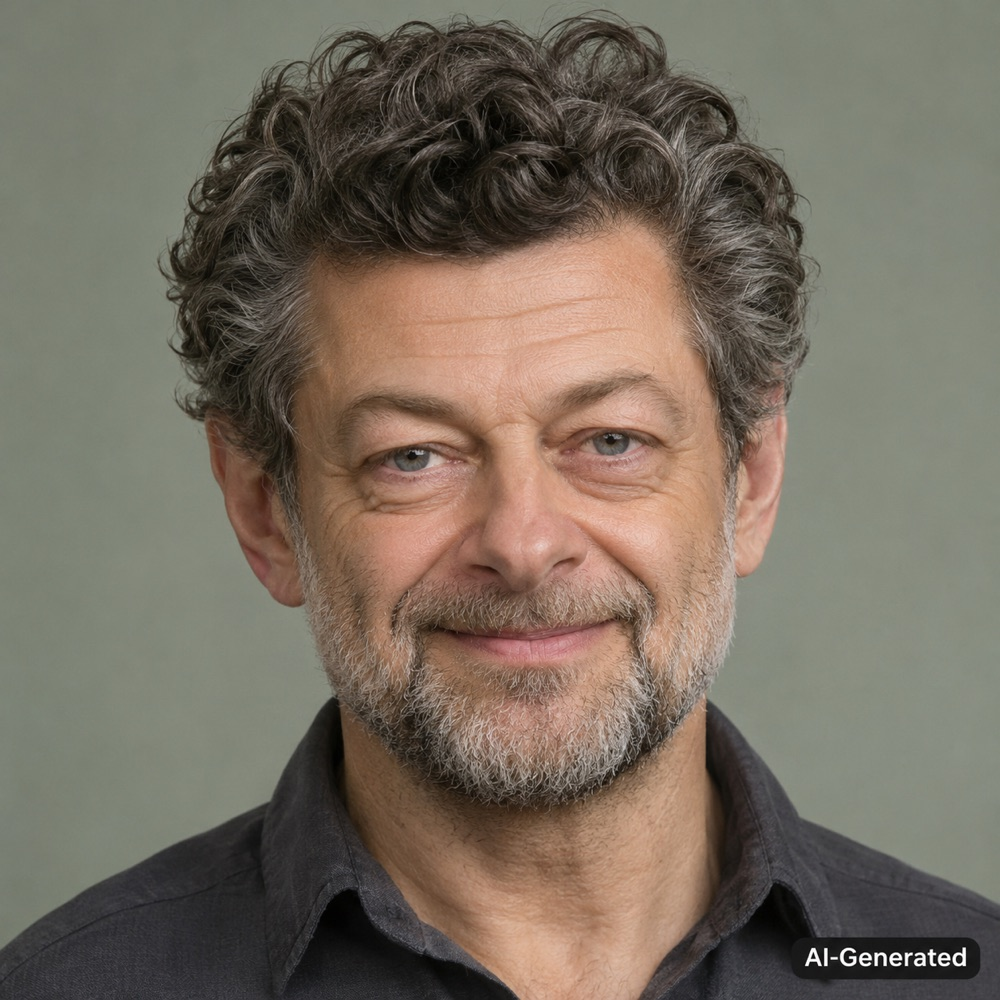
Artwork: Original AI-generated portrait of Andy Serkis, created for Famous Faith; not a photograph. The other AI-generated portraits shown here were also created for Famous Faith. No endorsement is implied.
Film and book titles identify the works discussed. A career credit is not a recommendation that every reader watch or read that work.