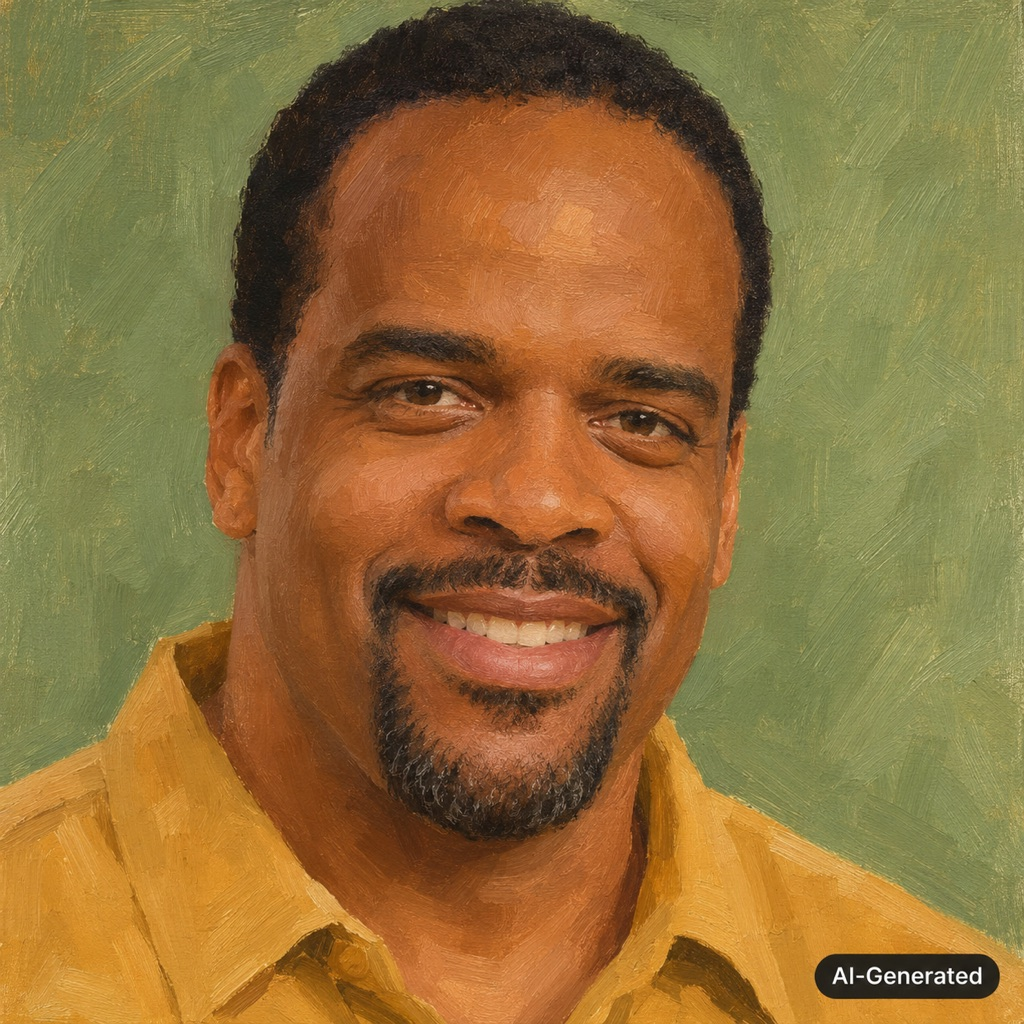
AI-generated painted editorial portrait of Victor Williams; not a photograph.
Victor Williams’s present religious affiliation is not clearly established in the interviews and professional material reviewed for this profile. There is not enough verified evidence here to identify him as a practicing Christian or assign him another definite religion. His role as Deacon Palmer on The King of Queens does not settle the question.
Even the character’s name can mislead a quick search. In the sitcom, Deacon is a person’s name, not evidence that Williams holds a church office. Viewers know the actor as Doug Heffernan’s friend, but friendship on screen and a private confession of faith are very different things.
What has Victor Williams discussed publicly?
In a December 2023 Casting Networks interview, Williams described discovering an interest in acting, studying at NYU, and building a career across comedy and drama. He spoke gratefully about having steady work. Those comments reveal his approach to a demanding profession, rather than supplying a religious label.
The interview also makes clear that his career reaches beyond The King of Queens. Williams discussed his work on Justified: City Primeval and the choices that helped him develop as an actor. A person who plays different kinds of characters should be understood through his own statements, not through whichever role a reader remembers best.
A 2025 Harts & Minds episode with Williams focused on fatherhood, family traditions, and life as a creative parent. Its description highlights ordinary family routines and the challenge of being present for children. Those are meaningful subjects, but a discussion of parenting is not automatically a declaration of Christian faith.
Why does an honest answer leave some things open?
Celebrity biographies sometimes repeat a religion without identifying the original interview or statement behind it. Repetition can make an unsupported label look settled. A responsible profile should ask where the claim came from and whether it actually describes the person’s present beliefs.
We have not found a clear profession of Christian faith in the material cited here. That does not prove Williams has no faith. It tells readers the limit of this profile’s evidence. A person may choose to keep religion private, and privacy should not be treated as a gap we are entitled to fill.
What makes Deacon’s friendship worth considering?
Deacon’s place beside Doug gives the show room to explore loyalty, disagreement, and the influence friends have on one another. Familiar friends can be a comfort, but closeness can also tempt us to excuse a poor decision rather than challenge it. That is a question about the story and our own friendships, not a claim about Williams’s private behavior.
Proverbs 27:6 describes the value of honest correction from a friend. Ephesians 4:15 connects truth with love. The two belong together. Bluntness without care can become cruelty, while affection without honesty can leave someone trapped in a harmful habit. Biblical friendship seeks another person’s good even when the conversation is difficult.
- Be present when a friend struggles.
- Refuse to cover for a dishonest plan.
- Offer correction with patience and humility.
- Accept the same honesty in return.
These habits can strengthen a friendship, but they do not make one person morally superior to another. We all need people who will listen, tell the truth, and remind us that admitting a fault is better than defending it forever.
Does being dependable make someone right with God?
Dependability matters. A parent who shows up, a coworker who keeps a promise, and a friend who listens can make everyday life better. Christians should be grateful for such goodness wherever they see it. The Bible does not teach that people outside the church are unable to love their families or care for neighbors.
It also does not teach that a good reputation cancels sin. Romans 3:23 places everyone under the same diagnosis. Have we told a lie, acted from envy, taken what was not ours, or refused to love a neighbor? Our failures are more than an image problem. They are wrongs before God.
What is the gospel’s answer to that problem?
Jesus Christ, the Son of God, lived the sinless life we have failed to live. He willingly died on the cross for sinners and bore the judgment we deserve. He was buried and rose bodily from the dead. His resurrection is central to the Christian message, not a hopeful detail added to a lesson about kindness.
Ephesians 2:8–9 says salvation is a gift of grace received through faith. We cannot earn it by becoming a better friend or a more patient parent. We are called to turn from sin and rely on Christ’s finished work for forgiveness and eternal life. A changed life follows as a response to mercy.
Williams’s interviews give readers a public account of his craft and family interests. They do not give us a complete account of his religion. We can respect that limit, appreciate his work, and let the question of faith lead us toward an honest examination of our own hope in God.
Explore the King of Queens cast and faith guide.
Sources and image credit
- Casting Networks: Victor Williams interview, December 18, 2023
- Harts & Minds: Victor Williams episode, September 28, 2025
- Paramount Global Content: series and cast
Featured image: AI-generated painted editorial portrait of Victor Williams, created for Famous Faith. This is an illustration, not a photograph or an official publicity image. No endorsement is implied.