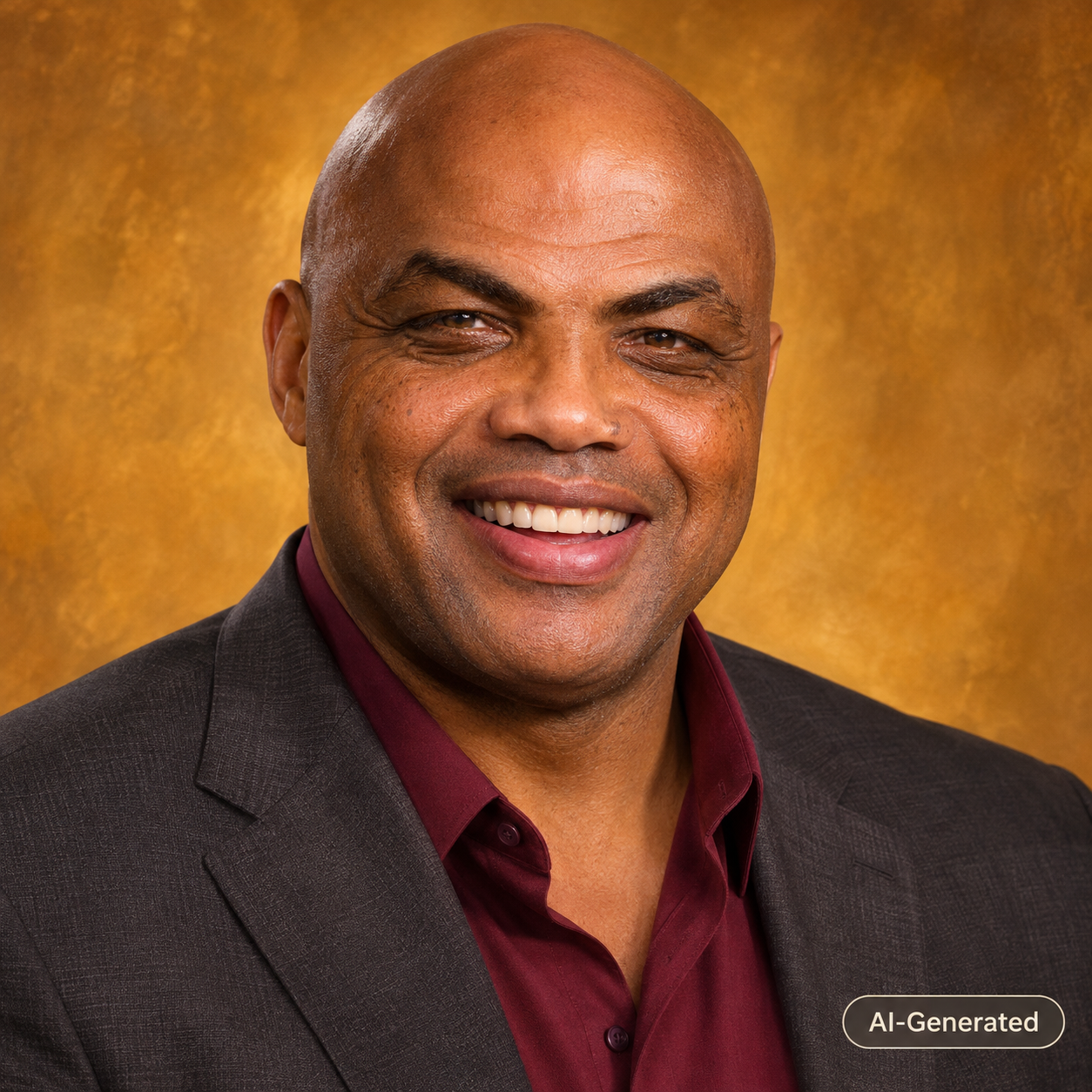
Charles Barkley has spoken about thanking God, but he has also publicly questioned Christianity. In a July 2015 interview with WBRC’s Rick Karle, he said he was not a Christian and was unsure how to describe his beliefs. That dated statement deserves to be heard alongside his expressions of gratitude to God.
It would therefore be misleading to give Barkley a confident Christian label simply because he mentions God. His public comments document both thankfulness and serious uncertainty. They do not establish a settled denomination or give us access to his private convictions today.
Gratitude alongside difficult questions
Barkley became a familiar name through professional basketball and later through sports broadcasting. His blunt way of speaking has also made questions outside basketball part of his public life. When he talks about religion, the same directness is evident.
At a South by Southwest discussion published by Sports Illustrated in April 2015, Barkley recalled thanking God during his playing years with Philadelphia. He said that people had objected to those remarks. While describing himself as far from a religious fanatic, he explained that he was grateful to God for his life.
His WBRC interview that July came during a painful period. His mother had recently died, and he spoke about the murder of nine people at a Charleston church. Asked whether he was a Christian, he answered negatively and expressed confusion about how God could allow such violence.
The context matters. This was a direct statement made amid grief and horror at a particular tragedy. It should neither be hidden nor treated as an unchanging declaration covering every later year. The honest answer is that Barkley has publicly expressed belief-related gratitude and doubt, with an explicit rejection of the Christian label in that 2015 interview.
Does the Bible make room for grief?
A Christian response should begin with compassion. The deaths of loved ones and the killing of worshipers are not occasions for clever slogans. Scripture contains lament, questions, and tears. In John 11, Jesus wept at the grave of His friend Lazarus. He did not treat human sorrow as an inconvenience.
The Bible also calls evil real. Christianity does not require saying that murder becomes good because God exists. God’s holiness means He opposes evil and will judge it. His promise of final justice gives moral seriousness to suffering rather than making the victims disappear into an argument.
That truth raises a personal question for all of us. We rightly condemn violence, but God also sees the wrongdoing we prefer to excuse. Have we lied, stolen, or coveted what another person has? Have we carried hateful anger or entertained lust? Jesus’ teaching reaches the heart, not merely the acts that become headlines.
This is not an accusation aimed at Barkley from a supposedly better position. The writer and reader also stand under God’s law. We are guilty before a holy and just God, and neither success nor a record of charitable deeds can remove that guilt.
Where Christian hope rests
The Christian answer centers on Jesus Christ, God’s divine Son who became human. He lived without sin and voluntarily died on the cross in our place, bearing the full penalty for our sins. He was buried and rose bodily from the dead. Christianity places its hope in that historical victory over sin and death.
Salvation and eternal life are God’s free gift by grace through faith in Jesus Christ. Religious attendance, improved behavior, and good works cannot buy forgiveness. Jesus’ finished work is sufficient; the sinner’s hope is to trust Him rather than offer a personal record as payment.
This good news does not require grieving people to pretend that every question is easy. It points them toward the Savior who entered human suffering and rose again. Barkley’s comments give a reason to discuss faith carefully, while the gospel invites every reader to consider Christ personally.
Sources
Rick Karle’s WBRC interview, July 8, 2015; Richard Deitsch’s Sports Illustrated account of his SXSW conversation with Barkley, April 2015. Bible passages: Exodus 20:13–17; Psalm 13; Matthew 5:21–28; John 11:33–35; Romans 3:23–26; 1 Corinthians 15:3–4; Ephesians 2:8–9.
Featured image: AI-generated portrait of Charles Barkley, created with OpenAI. It is not a photograph.