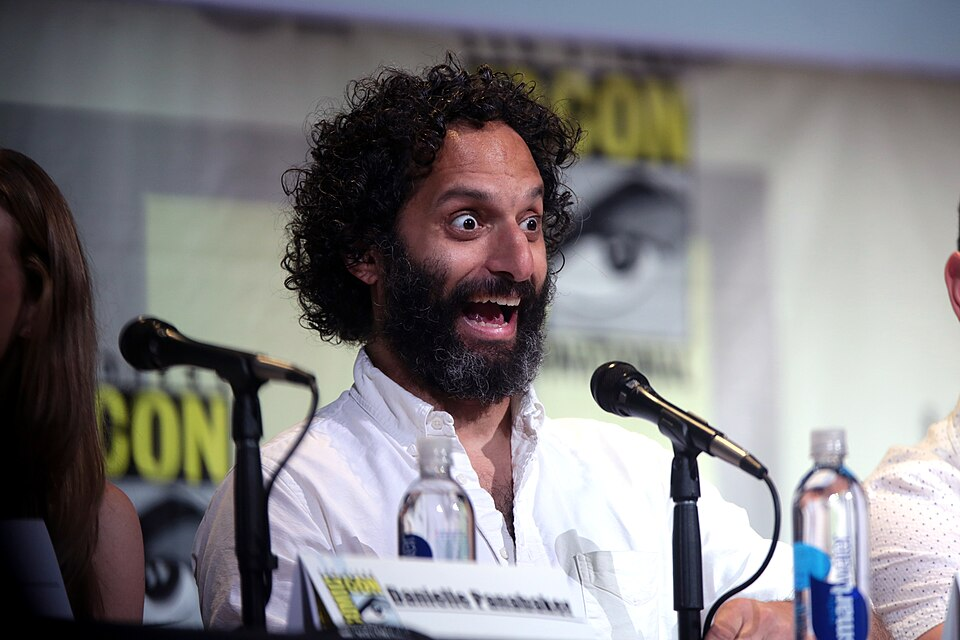
Jason Mantzoukas has studied religion academically and has described a childhood with only occasional Greek Orthodox church attendance. Known as Adrian Pimento on Brooklyn Nine-Nine, he also works in film, voice acting, and podcasts. His public account shows why Greek heritage alone should not be treated as proof of religious practice.
In a March 2025 Doughboys conversation, Mantzoukas said his family had attended a Greek Orthodox church infrequently for a period of time. He described the family as not religious and recalled that the Greek-language services did not connect easily with him and his sister.
A religion degree and an interest in music
A 2026 New York Times profile, republished by eKathimerini, described his degree in religion from Middlebury College and later fellowship study of music in North Africa and the Middle East. The Watson Foundation also identifies him as a former fellow.
Those details show an intellectual and artistic interest in religious life. Studying religion can involve history, texts, symbols, communities, and the ways people understand meaning. It does not automatically make a student an adherent of every tradition studied.
His childhood account and educational background should therefore be held together. He has described limited religious practice in his family and substantial later study. Neither detail, by itself, gives a full account of what he believes today about God or salvation.
Is Jason Mantzoukas a Christian?
The sources reviewed here do not establish a current personal profession of Christian faith. His connection with Greek Orthodox services in childhood should not be turned into a claim of present membership. His account of a nonreligious household also does not give a complete present philosophy of belief.
Pimento’s intense behavior is a fictional performance, not evidence about the actor’s religion. An actor can build a character around experiences, habits, and convictions very different from his own. That distinction matters whenever a role becomes someone’s most recognizable public identity.
A careful answer reports Mantzoukas’s own account and leaves the rest open. Christians can then discuss what the Bible says about knowledge, religious tradition, and personal faith without claiming he endorses those teachings.
Learning about religion can raise good questions
The Bible encourages people to seek wisdom and examine what they hear. Acts 17 describes Paul reasoning with people from different religious and philosophical backgrounds. He paid attention to their setting while explaining the God who made the world and raised Jesus from the dead.
That approach offers a model for thoughtful conversation. Christians need not be afraid of learning what others believe. Careful listening can help us understand a neighbor and explain our own convictions more clearly.
Respect also requires honesty about disagreement. Different religions make different claims about God, human nature, and salvation. We should not pretend those differences disappear simply because the people involved are sincere.
Knowledge and personal trust are different
A person can know a great deal about Christianity without trusting Christ. In John 3, Jesus spoke with Nicodemus, a respected teacher, about the need to be born again. Religious knowledge did not remove the need for a new relationship with God.
This challenges churchgoers as much as scholars. We may understand biblical vocabulary, remember holidays, or admire a faithful grandparent. The important question is whether we have personally responded to Jesus in repentance and faith.
James 2:19 also warns that acknowledging a true fact about God is not the whole of saving faith. Faith involves dependence on the Lord himself. It changes the direction of a person’s life rather than remaining an interesting subject at a comfortable distance.
What Scripture says about our condition
Romans 3:23 says that all have sinned and fall short of God’s glory. God’s commands expose lying, stealing, coveting, idolatry, and failures of love. Jesus addressed sinful anger and lust in the heart as well as outward actions.
That standard reaches every reader, regardless of education or family tradition. We cannot excuse our wrong by pointing to someone worse. God is holy and just, and Romans 6:23 describes death as the wages of sin.
More information alone cannot remove guilt. Neither can an impressive achievement, a charitable gift, or a promise to improve. We need the forgiveness God provides through his Son.
The gospel calls for a response
Jesus Christ, the Son of God, lived without sin and willingly died on the cross for sinners. He bore the punishment we deserve, was buried, and rose bodily from the dead. First Corinthians 15:3–4 places his death for our sins and resurrection at the center of the gospel.
Salvation is God’s gift of grace, received through faith in Christ rather than earned by works (Ephesians 2:8–9). God calls us to repent, turn from sin, and trust Jesus as Lord and Savior. A new life of obedience follows his mercy.
Mantzoukas’s public story includes both cultural connections and serious study. Christians can appreciate his creative work and pray for him. Every reader is also invited to move beyond knowing facts about religion and consider whether they have placed their trust in the risen Savior.
Sources
- Doughboys: March 13, 2025 episode
- Episode transcript: discussion of church attendance near 2:03:49
- New York Times / eKathimerini: education and fellowship study
- Watson Foundation: former fellow Jason Mantzoukas
Portrait: Gage Skidmore, CC BY-SA 2.0, via Wikimedia Commons. Cropped or resized where needed.
