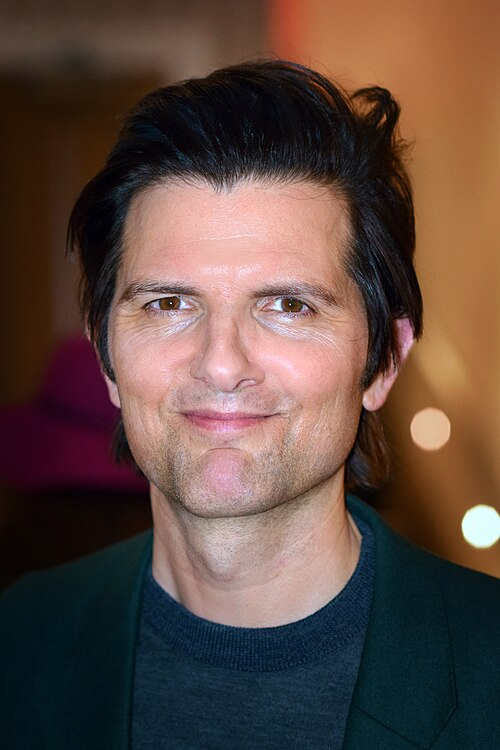
In April 2026, Adam Scott told The Guardian he was “probably closer to agnostic.” That public statement is the clearest answer found for this profile. It does not give us permission to fill in every part of his private spiritual life. Nor should a reader confuse the actor with the professional golfer who shares his name.
The actor behind Ben Wyatt
Scott plays Ben Wyatt on Parks and Recreation. He is also known for Party Down and Severance. Rachel Syme’s December 2024 New Yorker profile describes the long stretch of smaller parts and auditions that preceded those successes. His career makes an interesting starting point for a question many people recognize: Who am I when my work does not prove that I matter?
That question belongs to this article’s Christian reflection. It is not a claim about Scott’s inner struggles or the reason for his religious views. A performer can bring complicated people to life without sharing their convictions. Ben’s loyalty, awkwardness, or choices in a story cannot serve as a statement of the actor’s faith.
What can we say about his religion?
The dated interview linked below should carry more weight than a celebrity database that assigns a religion without explaining its evidence. A religious label also needs careful handling. In ordinary use, agnosticism concerns what someone knows, or thinks can be known, about God. Different people use the term in different ways. We should not attach an entire philosophy to someone on the strength of a short answer.
This review did not establish a clear public profession of Christian faith. That is a limit of the evidence, not a verdict about his heart. Christian reporting should be willing to leave a question open when the record does not answer it. Accuracy is part of loving our neighbor, including a neighbor we know only through a screen.
Can we divide life into separate selves?
Work, family, friendships, and private thoughts can feel like separate rooms. We may present one version of ourselves at the office and another at home. A third version appears online. It is possible to become skilled at managing these versions while avoiding the question of whether they fit together.
The Bible describes a God who sees the whole person. Psalm 139 speaks of God knowing our thoughts and ways. Hebrews 4:13 says that nothing in creation is hidden from him. This can sound frightening, especially when we remember what we would rather keep out of sight. Yet being fully known also means that our deepest need cannot be mistaken for a public relations problem.
We do not need only a better image. We need forgiveness and a changed heart. The same God who sees our good work also sees the envy behind a friendly smile, the dishonest excuse, the lust we feed, and the resentment we protect. None of these charges is aimed at Scott. They are questions that the author and reader must face for ourselves.
God’s law reaches behind the performance
The Ten Commandments call us to worship God, honor his name, tell the truth, remain faithful, and refuse theft and coveting. Jesus explains that God’s commands reach the heart, not just outward behavior (Matthew 5:21–30). Keeping our reputation intact does not make us innocent before a holy and just God.
Romans 3:23 teaches that all have sinned. That includes people with religious confidence and people with doubts. It includes the person writing a Christian article. We cannot cancel guilt by collecting achievements, becoming more likable, or comparing ourselves with someone who seems worse. Good deeds matter, but they cannot make past evil disappear. God’s justice is not fooled by a successful performance.
Jesus offers more than a new role
The gospel announces what God has done for guilty people. Jesus Christ, the eternal Son of God, became truly human. He lived without sin, obeying the Father perfectly in thought, word, and action. He did not merely offer advice about how to live a more meaningful life.
At the cross, Jesus willingly bore the judgment sinners deserve. His death was a sacrifice in our place, not a reward for our improvement. He was buried and rose bodily from the dead. The risen Jesus is Lord, and his victory means that sin and death do not have the final word (1 Corinthians 15:3–4).
Ephesians 2:8–10 explains that salvation is God’s gift, received through faith rather than earned by works. Faith means relying on Christ himself, not trusting that our spiritual interest, church attendance, or moral effort will be enough. Repentance means turning to God with a changed mind about sin and Christ, a change that begins to reshape the way we live. Obedience follows grace; it does not buy grace.
A question for the person watching
We can appreciate Scott’s work without making him a spiritual guide. The more personal question is what we do with Jesus. If you are uncertain, read a Gospel with that uncertainty honestly in view. Consider who Jesus claims to be, why he dies, and what his resurrection would mean. Bring your questions to a trustworthy Christian who will listen and open the Bible with you.
Christian hope is not that we finally create an impressive version of ourselves. It is that the Savior who knows the truth about us can forgive us and make us new.
Sources and image credit
- Adam Scott’s interview with Rich Pelley, The Guardian, April 23, 2026.
- Rachel Syme’s Adam Scott profile, The New Yorker, December 23, 2024.
Portrait: Philip Romano, 2023, via Wikimedia Commons, CC BY-SA 4.0. Resized for display. This Christian commentary does not imply the photographer’s or subject’s endorsement.
