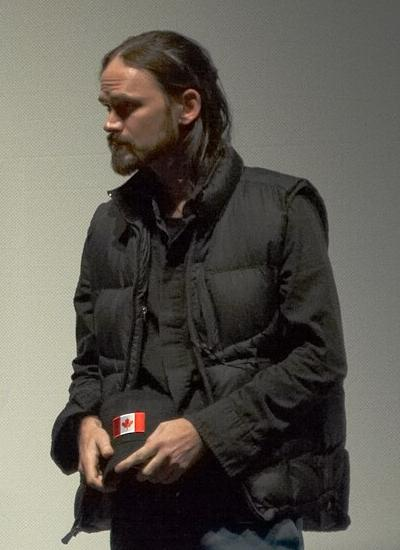
Jeremy Davies is familiar to LOST viewers as Daniel Faraday, the physicist trying to understand the island’s mysteries. His work raises questions about knowledge, choices, and what people can change. It does not establish the actor’s religion. The public material reviewed here does not confirm a current religious affiliation or a clear personal profession of Christian faith.
This profile concerns the American actor who played Faraday and Dickie Bennett on Justified. Public figures can share a name, and a religious biography belonging to someone else would not be evidence about him. The careful answer is that Davies’s own religious identity remains unconfirmed in these sources.
What his acting interview actually tells us
In a 2011 CHUD interview, Davies described his enthusiasm for Justified and writer Elmore Leonard. He said he grew up without television and read extensively. He appreciated strong writing, the rhythm of scenes, and the possibilities that good material gives an actor.
He also spoke about supporting others in a competitive business. After enjoying Justified, he had sent word to its creative team that he admired the work and would be interested if a suitable opportunity arose. He later joined the show as Dickie Bennett.
Those remarks reveal literary interests and a view of professional community. They are not a creed, a conversion story, or a statement about Jesus. Even expressions such as “believer” or “bless you” can occur casually in conversation without establishing a person’s religion. Context matters more than an isolated word.
Faraday’s knowledge is part of a fictional world
On LOST, Faraday can explain things that other characters struggle to grasp. Yet intelligence does not spare him from emotional wounds, limited information, or hard choices. His story gives viewers a way to think about the limits of human understanding. It should not be treated as Davies’s personal philosophy.
A scientist in a drama may speak with certainty because the scene requires it. The actor is communicating the character’s confidence, confusion, or discovery. We cannot infer that the performer accepts every claim in the script. The same rule applies when an actor portrays a criminal, a soldier, or a religious figure.
Davies’s range illustrates that point. A character actor’s work depends on entering lives that differ from his own. Appreciating that range helps us avoid the mistake of treating the most memorable role as a complete account of the person.
Faith is not an excuse to stop thinking
Christians do not need to respond to a fictional physicist by making science and faith enemies. The Bible presents a created world that can be observed and studied. It also teaches that human knowledge is limited. We should be grateful for real discoveries and humble about questions we cannot yet answer.
Acts 17 presents Paul reasoning with his hearers and pointing toward Jesus’ resurrection. Christian faith has an object: the God who acts and speaks, supremely through Christ. It is not merely confidence that our preferred theory will turn out to be true. A sincere conviction can be mistaken, so the truth of what we trust matters.
This is a biblical framework for readers to consider, not a claim that Davies shares it. Keeping those boundaries clear allows a meaningful discussion without assigning beliefs to the actor.
A supportive community still needs moral truth
Davies’s appreciation for encouraging colleagues is a welcome topic in a competitive culture. Romans 12:10 calls Christians to honor others. Another person’s achievement need not be treated as our loss. Gratitude, encouragement, and honest praise can make ordinary work more humane.
Yet belonging to a helpful community does not settle our standing before God. Groups can support us and still excuse our wrongs. Friends can reassure us and still be unable to remove guilt. We need something beyond agreement from people who like us.
God’s law exposes the deeper problem. The Ten Commandments forbid lies, theft, adultery, coveting, and worshiping anything above God. Jesus also addresses anger and lust within the heart. We have all sinned, as Romans 3:23 says. No level of intelligence or creative skill makes us exempt from God’s just judgment.
The good news reaches beyond our limits
We cannot solve guilt as if it were an equation or change the past by wishing we understood it sooner. The Gospel announces God’s provision for people who cannot save themselves. Jesus Christ is his divine Son, who became man and lived a sinless life.
Jesus willingly died on the cross as the substitute for sinners, bearing the judgment we deserve. He was buried and rose bodily from the dead. First Corinthians 15:3–4 places his death, burial, and resurrection at the center of the Christian message. He is a living Savior, not simply an inspiring idea.
Salvation is God’s gift by grace through faith, not works. We are invited to acknowledge our sin and trust Jesus’ finished work for forgiveness and eternal life. We do not earn acceptance by being clever, useful, or impressive.
Davies’s public religious profession remains unconfirmed here. His work can lead us into thoughtful questions, but the Christian answer to our deepest need rests on what Christ has already accomplished.
Sources
CHUD: Jeremy Davies interview about Justified, March 2011.
Jeremy Davies: Official career information.
Scripture: Acts 17:16–34; Romans 12:10; Exodus 20:1–17; Matthew 5:21–30; Romans 3:23; 1 Corinthians 15:3–4; Ephesians 2:8–9.
Photo: jbach, cropped by Wikimedia contributors, via Wikimedia Commons, CC BY-SA 2.0. Existing crop.
