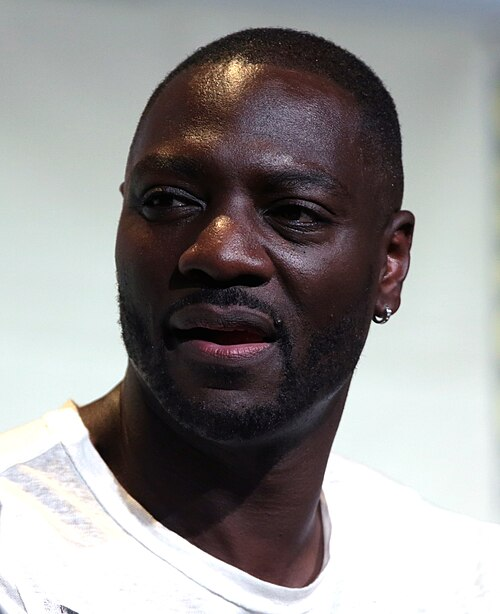
Adewale Akinnuoye-Agbaje has publicly identified as a practitioner of Nichiren Buddhism. In a 2010 CHUD interview, he explicitly named the form of Buddhism he practiced. A June 2026 appearance on Buddhability, an SGI-USA Nichiren Buddhist publication, also discussed his chanting practice. The available evidence therefore supports describing him as Buddhist rather than identifying him as Christian.
That answer comes from his public religious statements, not from his performance as Mr. Eko on LOST. Eko’s priestly clothing, biblical language, and complicated past belong to the character. The actor’s own account points to a different religious commitment.
What he has said about his practice
In the CHUD interview about Faster, Akinnuoye-Agbaje described Nichiren Daishonin Buddhism and emphasized cause and effect. He related that perspective to the film’s questions about revenge, intention, forgiveness, and redemption. He also saw similarities among moral principles in Christianity, Buddhism, and Islam.
The 2026 Buddhability episode presented his reflections on a difficult childhood, finding meaning, and chanting Nam-myoho-renge-kyo. Its published overview described the importance he gave that practice in cultivating happiness. These are public descriptions of his own religious life. They provide stronger evidence than an unsourced celebrity biography or an assumption based on a film role.
We should still be precise about the scope. One person’s explanation of Buddhism does not represent every Buddhist tradition. Nor should we imagine that a short interview exhausts everything he believes. It is enough to report the commitment he has chosen to discuss.
Religious roles and a wide acting career
LOST audiences know Akinnuoye-Agbaje as Mr. Eko, a man whose outward religious role raises hard questions about guilt and identity. In Faster, he played an evangelist. His work also includes Oz and large action productions. Playing a Christian figure can require careful study and conviction within a scene without requiring the performer to identify as Christian.
In his 2010 interview, he discussed seeking the truth of a character and moving beyond familiar types. That professional aim explains why an actor might portray people whose lives differ sharply from his own. Viewers can respect the craft and still keep the distinction between acting and personal faith clear.
The distinction is especially useful when a role becomes iconic. A memorable performance can stay with an audience so strongly that the actor seems inseparable from it. Public religious reporting should resist that shortcut and return to the person’s actual words.
Shared moral concerns do not erase different beliefs
Christians can recognize common concerns in Akinnuoye-Agbaje’s discussion of forgiveness and the consequences of actions. The Bible also teaches that what we do matters. Galatians 6:7 warns that people reap what they sow. Cruel choices damage neighbors and communities; mercy can interrupt a cycle of revenge.
However, similar moral vocabulary does not mean that all religions teach the same answer about God or salvation. Biblical Christianity centers on a personal Creator, human sin against him, and reconciliation through Jesus Christ. Jesus is not simply an example of human potential. He is the divine Son who saves sinners through his death and resurrection.
Likewise, the Christian teaching of grace is more than a favorable result produced by our improved behavior. God gives forgiveness that we cannot earn. That difference should be explained plainly and respectfully, without mocking Buddhist practice or pretending the actor has made a Christian profession.
Guilt cannot be resolved by rewriting the past
Mr. Eko’s story can lead viewers to ask who has the right to name our guilt and whether a new identity can remove it. Scripture directs that question toward God’s judgment. The Ten Commandments forbid lying, stealing, murder, adultery, coveting, and placing other gods before the true God. Jesus also exposes sinful anger and lust within the heart.
These standards apply to all of us. Romans 3:23 says everyone has sinned. We may sincerely wish to become kinder and wiser, yet our future effort cannot make past wrongdoing disappear. God is just. We need more than the confidence that we have grown or that our intentions were understandable.
This is not a verdict on Akinnuoye-Agbaje’s heart or eternal destiny. It is the Bible’s diagnosis of the human condition, including the writer and reader. The law shows why we need a Savior rather than merely another method for improving ourselves.
The Christian message of rescue
Jesus Christ is God’s divine Son, who became man and lived without sin. On the cross, he willingly died as the substitute for sinners, bearing the judgment that our sins deserve. He was buried and rose bodily from the dead. His resurrection gives the Christian hope an objective foundation beyond a feeling of renewal.
Ephesians 2:8–9 teaches that salvation is by grace through faith, not works. We are invited to acknowledge our sin and trust Jesus’ finished work for forgiveness and eternal life. Good works are the fruit of new life, not the payment that secures it.
Akinnuoye-Agbaje’s public account identifies a Buddhist practice. Christians can accurately describe that account, value honest conversation, and clearly explain where the Gospel differs. The invitation of Christ remains a gift of grace for people from every background.
Sources
CHUD: Adewale Akinnuoye-Agbaje interview about Faster, December 2010.
Buddhability/SGI-USA: Adewale Akinnuoye-Agbaje podcast, June 2026.
Scripture: Galatians 6:7; Exodus 20:1–17; Matthew 5:21–30; John 1:1–14; Romans 3:23–26; 1 Corinthians 15:3–4; Ephesians 2:8–10.
Photo: Gage Skidmore, cropped by Mike210381, via Wikimedia Commons, CC BY-SA 2.0. Existing crop, resized.
