Famous Faith · U.S. Presidents
Zachary Taylor
A soldier in office as the slavery crisis deepened.
Zachary Taylor entered the presidency with a military reputation and limited experience in electoral politics. A slaveholding southerner who resisted some demands of slavery’s defenders, he died before the central compromise of 1850 became law.
PRESIDENT 12
The essentials
Zachary Taylor at a glance
- Born
- November 24, 1784
- Died
- July 9, 1850
- Presidency
- March 4, 1849 – July 9, 1850
- Political party
- Whig
- Church background
- Episcopalian
- Spouse
- June 21, 1810, to Margaret Mackall Smith (1788–1852)
- Children
- Six children with Margaret Smith Taylor
- Other work
- Soldier
- Presidential number
- 12
Basic biographical details: [1]. Family and religious qualifications are explained below.
The person behind the office
Life and family
Taylor spent most of his adult life in the Army, moving among posts and commanding forces in conflicts on the frontier and in Mexico. His victories during the Mexican-American War made him a nationally prominent figure. The nickname Old Rough and Ready presented him as a practical soldier rather than a polished politician. His long military service also meant that the consequences of war and expansion were central to his public career before he entered office. [2] The Whigs chose Taylor as their candidate in 1848, hoping his fame could unite a party divided over slavery and other issues. He won the election and became president in March 1849. His public inaugural ceremony was held on March 5, but the constitutional term began on March 4. His administration lasted only until July 1850, leaving a limited record of enacted policy. [3]
Spouse and children
Taylor married Margaret Mackall Smith in 1810. They had six children, and three were alive when he became president. The family endured frequent separations and relocations during his Army career. Their daughter Sarah married Jefferson Davis and died soon afterward; another daughter, Mary Elizabeth, helped perform White House hostess duties. Family connections crossed the lines of the later Civil War, which should not be projected backward as if every earlier relationship already carried its later political meaning. [4]
A public record
Major political accomplishments and decisions
- 01
Built a military reputation before the presidency
Taylor’s battlefield victories in the Mexican-American War made his election possible. These are accomplishments of his military career, not actions he took as president. A careful biography should keep the offices and dates distinct while examining the larger justice of the war in which he served. [2]
- 02
Supported prompt western statehood
Taylor favored California and New Mexico seeking admission as states rather than prolonging the territorial dispute over slavery. His approach upset southern politicians who expected a slaveholding president to favor their sectional demands. His opposition to their preferred settlement complicates a simple regional label. [5]
- 03
Held the Union above secession threats
Taylor resisted efforts to use threats of disunion to control the slavery debate. His death changed the political situation, and the Compromise of 1850 passed under Millard Fillmore. Taylor should not receive credit or blame for signing the laws that his successor approved. [5]
Public evidence and its limits
Faith and documented statements
Taylor’s religious background is identified as Episcopalian. The sources used here provide a firmer basis for reporting that affiliation and his public religious language than for reconstructing a detailed personal theology. Famous Faith does not fill that gap with an invented testimony. [1] In his 1849 inaugural address, Taylor attributed national prosperity to Divine Providence, asked for continued protection, and connected that hope with prudent and just conduct. This is a documented statement of public gratitude and dependence. [6] It should not be read as a promise from God that American policies were righteous. Christians can welcome the acknowledgment of dependence while insisting that rulers remain answerable for what they do to the people under their authority.
Famous Faith’s biblical perspective
Public virtues and serious concerns
The historical actions are sourced. Their evaluation through Scripture expresses Famous Faith’s Christian editorial perspective; it is not a claim to know anyone’s eternal destiny.
Sectional loyalty did not dictate every decision
Taylor’s resistance to some southern demands shows that a president’s background does not predetermine every choice. A willingness to withstand pressure from expected allies can serve the public good. Famous Faith values that possibility of independent judgment while refusing to turn his limited opposition to slavery’s expansion into a claim that he had become an abolitionist.
His ownership of people remains a central wrong
Taylor remained a wealthy enslaver whose family’s plantation interests were supported by forced labor. [4] His defense of the Union and his differences with some proslavery politicians do not remove that responsibility. Famous Faith regards human bondage as incompatible with the dignity of neighbors created in God’s image. A moral account must consider the people whose labor sustained a public figure’s private wealth as well as his words in Washington.
Beyond the familiar name
Interesting facts and useful distinctions
A delayed public inauguration
Taylor took his public oath on March 5, 1849, because the usual date fell on Sunday. A ceremony date and the beginning of a presidential term are not always identical. [6]
The compromise belonged to his successor
Taylor died before the Compromise of 1850 became law. Fillmore’s support for the settlement represented a change in leadership at a critical moment, not merely the completion of Taylor’s own program. [5]
A life in perspective
What this legacy asks of us
Taylor’s presidency was short, but it exposes the inadequacy of easy labels. He was a slaveholder who disappointed some of slavery’s most aggressive defenders, a celebrated soldier whose governing record remained unfinished. A Christian assessment can acknowledge those distinctions while maintaining a clear judgment about the injustice of enslavement.
Our hope rests in Jesus Christ, not a president, party, lodge, or record of public service. Scripture teaches that all have sinned, that Christ died for sins and rose again, and that salvation is God’s gift through faith rather than an achievement we earn (Romans 3:23; 1 Corinthians 15:3–4; Ephesians 2:8–9). His call is to repentance and trust in him.
Sources and image credit
- Miller Center: Overview
- Miller Center: Life Before The Presidency
- Miller Center: Life In Brief
- Miller Center: Family Life
- Miller Center: Domestic Affairs
- Presidential statement: original transcript
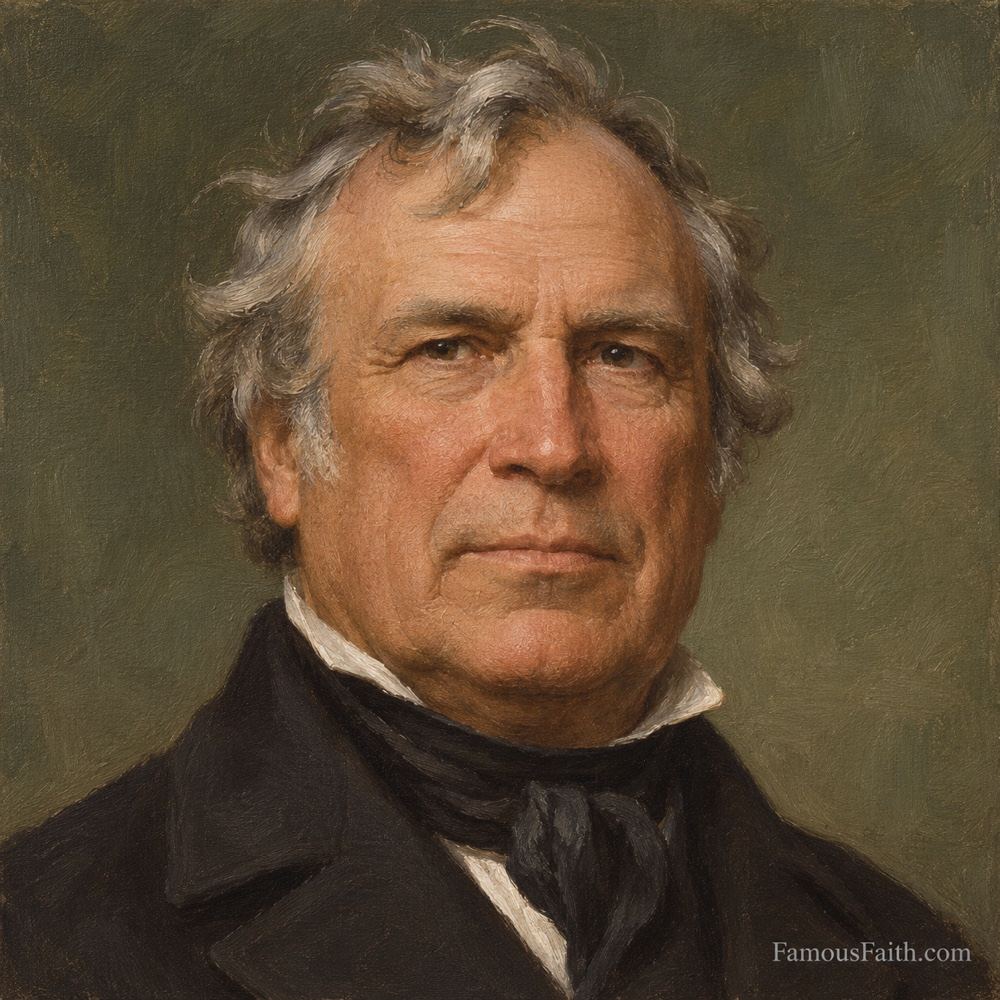
Portrait credit: Original AI-generated painted editorial illustration created for Famous Faith, with a subtle FamousFaith.com watermark. This is an artistic interpretation, not a historical photograph or an authenticated period painting.
Editorial approach: Documented actions and public statements are distinguished from Famous Faith’s biblical assessments. Public profession and church affiliation do not establish the condition of a person’s heart.