Famous Faith · U.S. Presidents
Woodrow Wilson
Presbyterian idealism, world leadership, and racial exclusion.
Woodrow Wilson reshaped federal economic policy and led the United States into World War I. His language of moral purpose and democratic internationalism stands beside segregation, repression of dissent, and a serious failure to extend his ideals consistently to all people.
PRESIDENT 28
The essentials
Woodrow Wilson at a glance
- Born
- December 28, 1856
- Died
- February 3, 1924
- Presidency
- March 4, 1913 – March 4, 1921
- Political party
- Democrat
- Church background
- Presbyterian
- Spouse
- June 24, 1885, to Ellen Louise Axson (1860–1914), December 18, 1915, to Edith Bolling Galt (1872–1961)
- Children
- Three daughters with Ellen: Margaret, Jessie, and Eleanor
- Other work
- Professor, College Administration, Public Official
- Presidential number
- 28
Basic biographical details: [1]. Family and religious qualifications are explained below.
The person behind the office
Life and family
Born Thomas Woodrow Wilson in Virginia, Wilson grew up in a minister’s household during and after the Civil War. He became a scholar of government, a professor, and president of Princeton before entering electoral politics as governor of New Jersey. His academic career gave him an unusual route to the White House, although it did not remove the prejudices and limitations of his upbringing. [2] Elected as a Democrat in 1912 after a Republican split, Wilson pursued a substantial domestic program. He initially kept the country outside the European war, then led it into the conflict in 1917. His campaign for a postwar international order became inseparable from a struggle with the Senate over the peace treaty and the League of Nations. A disabling stroke in 1919 further complicated the final part of his presidency. [3]
Spouse and children
Wilson married Ellen Louise Axson in 1885. Their daughters were Margaret, Jessie, and Eleanor. Ellen died in 1914, during his presidency. He married Edith Bolling Galt in 1915. After his stroke, Edith controlled access to him and helped manage the flow of official business. Her role was consequential, but she did not constitutionally become president; that popular description should not be mistaken for the office she actually held. [4] [3]
A public record
Major political accomplishments and decisions
- 01
Established major economic institutions
Wilson signed the Federal Reserve Act and supported the Federal Trade Commission, the Clayton Antitrust Act, and tariff reform. These measures expanded and reorganized federal responsibilities in banking, competition, and the economy. Their passage involved congressional work as well as presidential leadership. [5]
- 02
Led American participation in World War I
The United States entered the war in 1917 under Wilson. Mobilization contributed to the Allied victory, while the administration also imposed far-reaching wartime controls at home. A complete account includes the human costs and the restrictions on political expression, not only the military outcome. [6] [5]
- 03
Advocated the League of Nations
Wilson’s Fourteen Points and postwar diplomacy promoted a new framework for international relations. He received the Nobel Peace Prize, but the United States did not join the League during his presidency. Advocacy and international influence must be distinguished from the result he failed to secure at home. [6]
Public evidence and its limits
Faith and documented statements
Wilson was a Presbyterian and the son of a Presbyterian minister. Religious language and a sense of moral vocation were visible in his public life. Famous Faith reports that background without assuming that the ideals expressed by a leader were consistently practiced. [1] [2] His 1913 inaugural address spoke of justice and mercy in explicitly religious terms and ended with an appeal for God’s help. The document presents politics as a demanding moral responsibility, not merely a contest for office. [7] That standard makes his exclusions more important to examine, not less. Christian language about democracy or international peace cannot substitute for the equal dignity of neighbors affected by racial discrimination or state repression.
Famous Faith’s biblical perspective
Public virtues and serious concerns
The historical actions are sourced. Their evaluation through Scripture expresses Famous Faith’s Christian editorial perspective; it is not a claim to know anyone’s eternal destiny.
Seeking peace required more than noble language
Wilson’s effort to build institutions for international cooperation addressed a real problem after a catastrophic war. Famous Faith can appreciate the pursuit of peace while questioning whether a particular settlement treated nations and peoples justly. Claims of a moral mission require humility, practical accountability, and willingness to recognize the limits of one’s own judgment.
Segregation contradicted his stated ideals
Wilson’s administration expanded segregation within federal offices and the civil service. [3] Famous Faith regards racial discrimination as a grave failure of impartial justice and neighbor-love. The contradiction is especially serious in a leader who regularly presented policy in moral and religious terms. The administration’s wartime suppression of dissent also demonstrates how appeals to national purpose can be used to silence legitimate criticism. [5]
Beyond the familiar name
Interesting facts and useful distinctions
An academic route to the presidency
Wilson was a university scholar and president before becoming governor and president of the United States. His study of government was a distinctive preparation, although expertise did not make his decisions infallible. [2]
Edith Wilson did not hold the presidency
Her management of access and paperwork after his stroke was politically important. Calling her president, however, confuses informal influence with constitutional authority and can obscure the serious accountability questions created by his incapacity. [4]
A life in perspective
What this legacy asks of us
Wilson’s vision reached far beyond the immediate concerns of his administration, but its universal language was applied unequally. A Christian assessment should examine that gap with particular care. Religious seriousness, intellectual distinction, and a peace prize do not remove responsibility for segregation or the misuse of government power.
Our hope rests in Jesus Christ, not a president, party, lodge, or record of public service. Scripture teaches that all have sinned, that Christ died for sins and rose again, and that salvation is God’s gift through faith rather than an achievement we earn (Romans 3:23; 1 Corinthians 15:3–4; Ephesians 2:8–9). His call is to repentance and trust in him.
Sources and image credit
- Miller Center: Overview
- Miller Center: Life Before The Presidency
- Miller Center: Life In Brief
- Miller Center: Family Life
- Miller Center: Domestic Affairs
- Miller Center: Foreign Affairs
- Presidential statement: original transcript
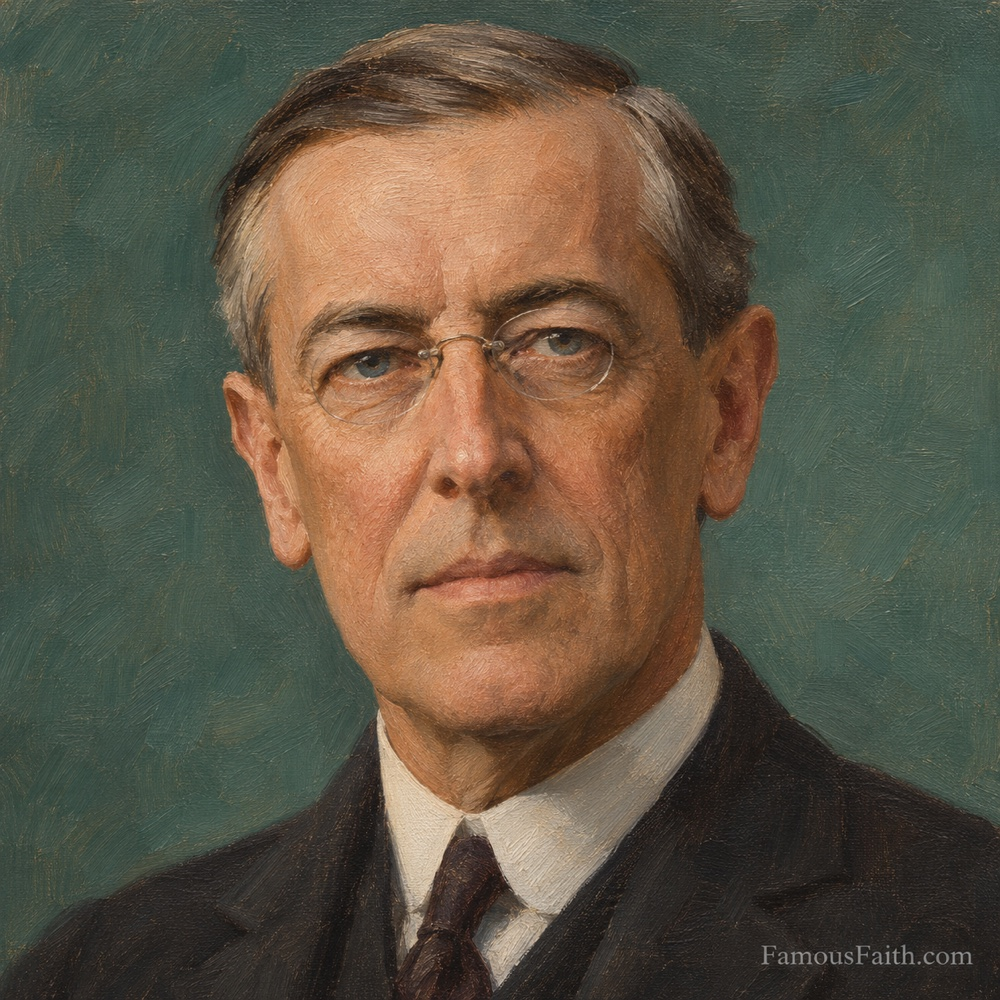
Portrait credit: Original AI-generated painted editorial illustration created for Famous Faith, with a subtle FamousFaith.com watermark. This is an artistic interpretation, not a historical photograph or an authenticated period painting.
Editorial approach: Documented actions and public statements are distinguished from Famous Faith’s biblical assessments. Public profession and church affiliation do not establish the condition of a person’s heart.