Famous Faith · U.S. Presidents
William McKinley
Methodist faith, economic policy, and the moral questions of empire.
William McKinley led the United States through war with Spain and into a new era of overseas power. His Methodist commitments and devoted family life are documented, but they do not remove the need to examine the coercion and suffering associated with American expansion.
PRESIDENT 25
The essentials
William McKinley at a glance
- Born
- January 29, 1843
- Died
- September 14, 1901
- Presidency
- March 4, 1897 – September 14, 1901
- Political party
- Republican
- Church background
- Methodist
- Spouse
- January 25, 1871, to Ida Saxton (1847–1907)
- Children
- Two daughters, Katherine and Ida; both died in childhood
- Other work
- Lawyer
- Presidential number
- 25
- Freemasonry
- Documented member
Basic biographical details: [1]. Family and religious qualifications are explained below.
The person behind the office
Life and family
McKinley grew up in Ohio and served in the Union Army during the Civil War. Afterward he trained as a lawyer and developed a political career with help from fellow veteran Rutherford B. Hayes. He served in Congress and as governor of Ohio, becoming closely associated with protective tariffs and the Republican economic program. His presidential campaign in 1896 also represented a new scale of party organization and fundraising. [2] He defeated William Jennings Bryan and entered office during the recovery from the depression of the 1890s. Economic issues remained important, but war with Spain and the acquisition of overseas possessions transformed his presidency. Reelected in 1900, he was assassinated the following year, bringing Theodore Roosevelt to the White House. His legacy therefore joins domestic economic change with the emergence of a more interventionist international role. [3]
Spouse and children
McKinley married Ida Saxton in 1871. Their daughters Katherine and Ida both died as young children. Ida’s continuing ill health shaped their family life, and McKinley gave close attention to her needs during his public career. They entered the White House without surviving children. The evidence of care within their marriage deserves recognition without being used to make the administration’s wider policies immune from moral criticism. [4] [1]
A public record
Major political accomplishments and decisions
- 01
Advanced tariff and monetary legislation
McKinley supported the Dingley Tariff and the Gold Standard Act. These measures reflected the economic questions that had dominated his rise in the Republican Party. Their consequences should be evaluated as policy choices, rather than presented as evidence that every period of growth resulted solely from a president’s decisions. [5]
- 02
Led the country through the Spanish-American War
The 1898 war ended Spanish rule in Cuba and transferred Puerto Rico, Guam, and the Philippines to the United States. Cuba was not simply annexed as another American territory. The war’s outcomes raised lasting questions about independence, sovereignty, and the purposes of American power. [6]
- 03
Presided over a turn toward overseas expansion
Hawaii was annexed during McKinley’s administration, and American rule in the Philippines met armed resistance. These developments helped establish an overseas empire, not merely a new set of trading relationships. They belong at the center of any assessment of his presidency. [6]
Public evidence and its limits
Faith and documented statements
McKinley was a Methodist whose religious interests began long before his presidency; the Miller Center notes that he had considered the ministry as a young man. This provides a basis for describing a serious religious connection rather than assuming faith from a ceremonial appearance. [3] In his 1901 inaugural address, he invoked Almighty God for guidance and prayed that disputes with other powers could be settled through peaceful arbitration. [7] Famous Faith reports those actual words and intentions without relying on disputed stories about a private divine instruction to annex the Philippines. A claim that a political choice came from God needs stronger evidence than a memorable anecdote. His separate Masonic membership also requires acknowledgment within a profile that takes his Methodist profession seriously.
Famous Faith’s biblical perspective
Public virtues and serious concerns
The historical actions are sourced. Their evaluation through Scripture expresses Famous Faith’s Christian editorial perspective; it is not a claim to know anyone’s eternal destiny.
Care and the pursuit of peaceful settlement
McKinley’s attention to his wife’s needs and his public desire to avoid future wars are aspects of his life worth recognizing. Famous Faith sees fidelity in practical care as morally significant. The desire for peaceful arbitration should also be judged by actions, rather than taken as proof that all the administration’s uses of force were necessary or just.
Empire required an accounting of other peoples’ rights
American control of the Philippines produced a war against a movement seeking independence. [6] Famous Faith rejects the assumption that a powerful nation may decide another people’s future merely because it considers its own institutions or religion superior. Biblical neighbor-love reaches beyond national borders. Christian language about helping or civilizing people cannot excuse coercion, civilian suffering, or the denial of their agency.
Beyond the familiar name
Interesting facts and useful distinctions
A presidential mentor
McKinley’s Civil War service connected him with Rutherford B. Hayes, who became a political mentor. The relationship links two presidencies through a much earlier chapter of military and personal experience. [2]
His successor was already on the ticket
Theodore Roosevelt became vice president after the 1900 election and succeeded McKinley when he died in September 1901. Roosevelt’s later program should not be treated as identical to McKinley’s. [3]
A life in perspective
What this legacy asks of us
McKinley’s religious seriousness and personal kindness do not settle the moral questions of empire. His presidency invites careful distinction between care for those close to a leader and justice toward people placed under national power. A Christian profile should apply its standards in both settings without accepting national success as spiritual validation.
Our hope rests in Jesus Christ, not a president, party, lodge, or record of public service. Scripture teaches that all have sinned, that Christ died for sins and rose again, and that salvation is God’s gift through faith rather than an achievement we earn (Romans 3:23; 1 Corinthians 15:3–4; Ephesians 2:8–9). His call is to repentance and trust in him.
Sources and image credit
- Miller Center: Overview
- Miller Center: Life Before The Presidency
- Miller Center: Life In Brief
- Miller Center: Family Life
- Miller Center: Domestic Affairs
- Miller Center: Foreign Affairs
- Presidential statement: original transcript
- First Kings Masonic District: Masonic Presidents
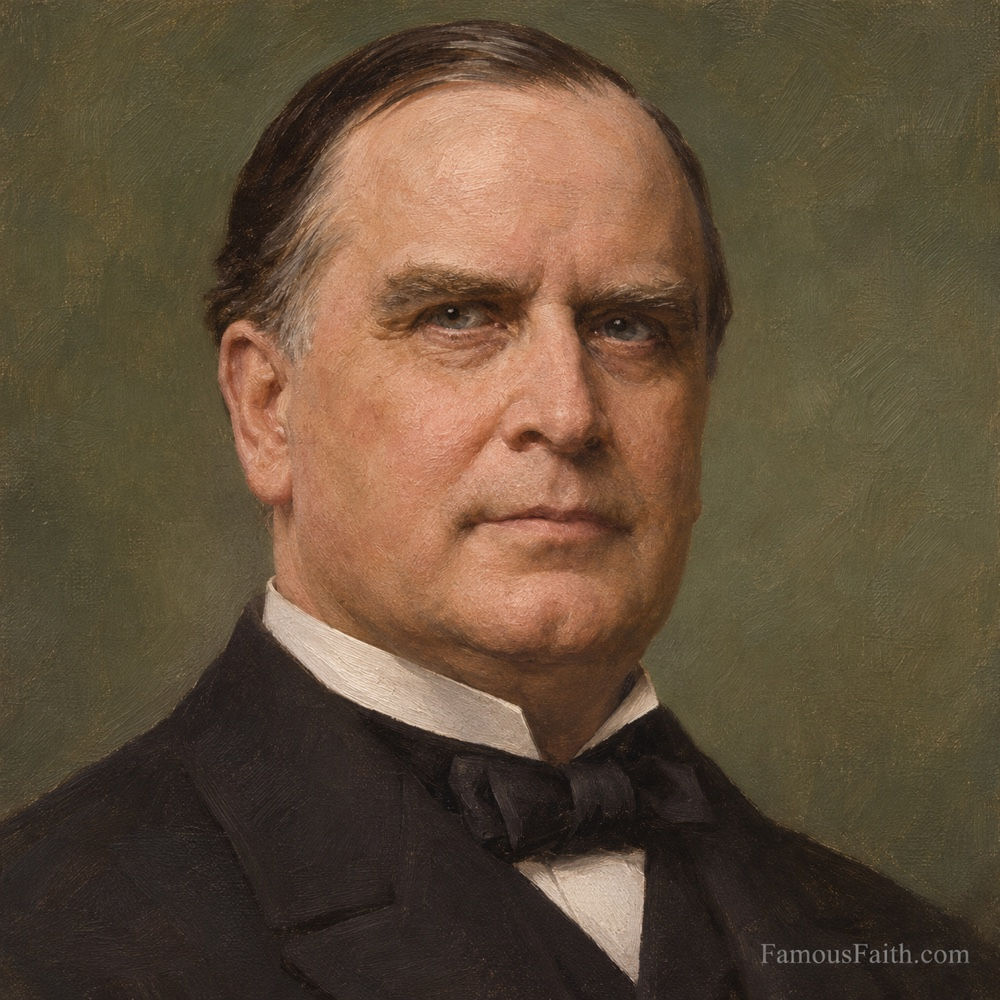
Portrait credit: Original AI-generated painted editorial illustration created for Famous Faith, with a subtle FamousFaith.com watermark. This is an artistic interpretation, not a historical photograph or an authenticated period painting.
Editorial approach: Documented actions and public statements are distinguished from Famous Faith’s biblical assessments. Public profession and church affiliation do not establish the condition of a person’s heart.