Famous Faith · U.S. Presidents
William Henry Harrison
A long career behind the shortest presidency.
William Henry Harrison served only a month as president, but his earlier military and territorial career had already shaped the lives of many people. His story calls for more than the familiar tale of a long inaugural speech and an early death.
PRESIDENT 9
The essentials
William Henry Harrison at a glance
- Born
- February 9, 1773
- Died
- April 4, 1841
- Presidency
- March 4, 1841 – April 4, 1841
- Political party
- Whig
- Church background
- Episcopalian
- Spouse
- November 25, 1795, to Anna Tuthill Symmes (1775–1864)
- Children
- Ten children with Anna Symmes Harrison
- Other work
- Soldier
- Presidential number
- 9
Basic biographical details: [1]. Family and religious qualifications are explained below.
The person behind the office
Life and family
Harrison was born into a prominent Virginia family and pursued a military career rather than the medical future his father had considered for him. He became a soldier, territorial official, legislator, senator, and diplomat. His position in the expanding western republic brought him into repeated conflict with Native nations whose land and independence were threatened by American settlement. [2] His military reputation rested especially on Tippecanoe and the Battle of the Thames. The Whig campaign of 1840 presented him as a plain frontier candidate, although his family background was privileged. He defeated Martin Van Buren and entered office with broad expectations. His death on April 4, 1841, ended the first presidency lost to the death of its incumbent and forced the country to confront an unsettled question of succession. [3]
Spouse and children
Harrison married Anna Tuthill Symmes in 1795. They had ten children, and the family suffered repeated bereavements. Only four of their children were alive when he became president. Anna was not with him in Washington during his brief administration. Their son John Scott Harrison became the father of Benjamin Harrison, the twenty-third president, making the family the only presidential grandfather-and-grandson pair. [4]
A public record
Major political accomplishments and decisions
- 01
Held major territorial and military responsibilities
Before the presidency, Harrison governed Indiana Territory and commanded American forces in conflicts including the War of 1812. These were substantial positions of power, but their consequences for Native peoples must be included when describing the expansion celebrated by his supporters. [2]
- 02
Won the Whigs’ first presidential victory
The election of 1840 brought the Whig coalition into the presidency through a highly organized and symbolic campaign. Its log-cabin imagery and popular celebrations were important developments in political communication, even though they simplified the candidate’s actual upbringing and career. [3]
- 03
Left an incomplete presidential program
Harrison had too little time to establish a substantial presidential legislative record. His inaugural address described principles and intentions, but a plan is not an accomplishment. His death produced a major constitutional precedent through John Tyler’s insistence that the vice president became president in full. [5]
Public evidence and its limits
Faith and documented statements
Harrison’s religious background was Episcopalian. The surviving evidence used here does not support an elaborate account of his private spiritual experience, and Famous Faith will not invent one to fill the gap left by a short presidency. [1] His inaugural address is more informative about his public religious language. He expressed reliance on Almighty Power, described rights as grounded in a common Creator, defended freedom of worship, and connected just treatment of weaker peoples with accountability before God. [6] These statements deserve to be read alongside his career rather than used to exempt it from scrutiny. A theological acknowledgment of human equality is morally demanding precisely when a powerful government deals with people it can dispossess or overrule.
Famous Faith’s biblical perspective
Public virtues and serious concerns
The historical actions are sourced. Their evaluation through Scripture expresses Famous Faith’s Christian editorial perspective; it is not a claim to know anyone’s eternal destiny.
A useful statement about accountability
Harrison’s inaugural language recognizes that political power does not originate in a ruler’s personal superiority. His appeal to a shared Creator and to justice toward weaker peoples can be welcomed as public moral principles. Famous Faith relates that concern to Genesis 1:27 and Micah 6:8 while distinguishing a political address from a complete confession of the gospel.
Territorial expansion involved neighbors with rights
Harrison’s earlier career included pressure for Native land cessions and support for policies accommodating slavery’s expansion. [2] His moral record cannot be confined to the thirty-one days he spent in the White House. Famous Faith rejects a history that treats Indigenous losses as scenery behind American success. Biblical justice asks how treaties, force, and land claims affected the people living under those decisions.
Beyond the familiar name
Interesting facts and useful distinctions
The speech-and-death story is too certain
His doctors recorded pneumonia, but later researchers have proposed other explanations for his fatal illness. A long speech without an overcoat is not proof of a single cause. This profile avoids presenting that familiar causal story as settled fact. [7]
The shortest term still had consequences
Harrison’s death made succession an immediate practical question rather than a hypothetical constitutional debate. John Tyler’s response helped establish a precedent long before the Twenty-fifth Amendment clarified presidential succession. [5]
A life in perspective
What this legacy asks of us
Harrison’s brief administration limits what can honestly be said about his presidential accomplishments. His longer public life, however, provides ample material for moral examination. A careful Christian profile should resist both the entertaining myth and the assumption that an early death leaves nothing consequential to assess.
Our hope rests in Jesus Christ, not a president, party, lodge, or record of public service. Scripture teaches that all have sinned, that Christ died for sins and rose again, and that salvation is God’s gift through faith rather than an achievement we earn (Romans 3:23; 1 Corinthians 15:3–4; Ephesians 2:8–9). His call is to repentance and trust in him.
Sources and image credit
- Miller Center: Overview
- Miller Center: Life Before The Presidency
- Miller Center: Life In Brief
- Miller Center: Family Life
- Miller Center: Impact And Legacy
- Presidential statement: original transcript
- Encyclopedia Virginia: William Henry Harrison
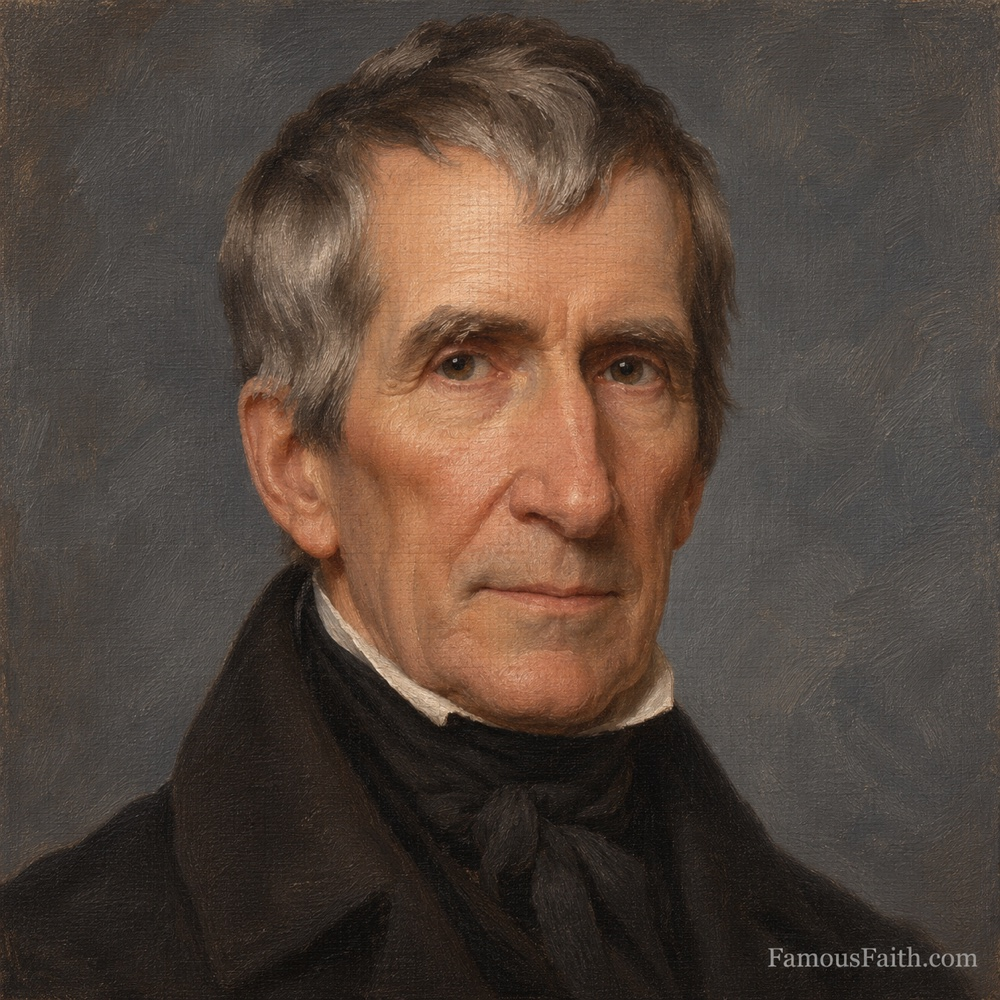
Portrait credit: Original AI-generated painted editorial illustration created for Famous Faith, with a subtle FamousFaith.com watermark. This is an artistic interpretation, not a historical photograph or an authenticated period painting.
Editorial approach: Documented actions and public statements are distinguished from Famous Faith’s biblical assessments. Public profession and church affiliation do not establish the condition of a person’s heart.