Famous Faith · U.S. Presidents
Warren G. Harding
Public reassurance, private infidelity, and the cost of misplaced trust.
Warren G. Harding promised a return to normalcy after war and political conflict. His administration achieved important diplomacy, but corruption among officials and documented marital infidelity expose the distance between an appealing public image and responsible conduct.
PRESIDENT 29
The essentials
Warren G. Harding at a glance
- Born
- November 2, 1865
- Died
- August 2, 1923
- Presidency
- March 4, 1921 – August 2, 1923
- Political party
- Republican
- Church background
- Baptist
- Spouse
- July 8, 1891, to Florence Kling DeWolfe (1860–1924)
- Children
- No children with Florence; fathered Elizabeth with Nan Britton, supported by later DNA evidence
- Other work
- Editor-Publisher
- Presidential number
- 29
- Freemasonry
- Documented member
Basic biographical details: [1]. Family and religious qualifications are explained below.
The person behind the office
Life and family
Harding built his career as a newspaper publisher in Marion, Ohio, and entered Republican politics through state office and the Senate. His agreeable manner and reluctance to alienate factions helped make him a presidential nominee in 1920. He campaigned for a calmer national life after World War I, the controversies of the Wilson administration, and a period of social upheaval. [2] As president, Harding delegated major responsibilities to cabinet officers with widely different abilities and ethics. Some appointments produced serious policy work, while others created opportunities for corruption. He died in August 1923 before the full extent of several scandals became public. The timing is important: later investigations do not mean every fact exposed after his death was known or personally directed by him. [3]
Spouse and children
Harding married Florence Kling DeWolfe in 1891. They had no children together; Florence had a son from an earlier relationship. Harding also had extramarital relationships documented through surviving letters and historical research. [4] A 2015 DNA study supported the identification of Harding as the father of Elizabeth, Nan Britton’s daughter. Older biographical tables that simply list no children therefore need qualification. The distinction is between no children within the marriage and the fuller evidence about his family history. [5]
A public record
Major political accomplishments and decisions
- 01
Supported the Washington Naval Conference
Under Secretary of State Charles Evans Hughes, the administration pursued agreements limiting major naval armaments and addressing Pacific affairs. These treaties represented a significant diplomatic effort to reduce costly competition after the war, though they did not provide a permanent guarantee against future conflict. [6]
- 02
Reorganized aspects of federal budgeting
The Budget and Accounting Act established important machinery for federal financial planning and oversight. Harding also supported tax and tariff policies reflecting Republican priorities. Institutional reforms and the misuse of public office occurred within the same administration and must both be included in its history. [7]
- 03
Left an administration damaged by scandal
Teapot Dome involved corrupt dealings over naval oil reserves by Interior Secretary Albert Fall. Other scandals added to the damage. Harding should not be falsely described as personally convicted of those crimes, but his responsibility for appointments and oversight remains central to evaluating his presidency. [7]
Public evidence and its limits
Faith and documented statements
Harding’s religious affiliation was Baptist. His public vocabulary often joined religious confidence with national purpose. In his 1921 inaugural address, he expressed belief in a divine role in the republic’s founding and offered prayers for peace and shared opportunity. [1] [8] Famous Faith distinguishes those documented statements from a full account of personal Christian doctrine or repentance. Religious optimism about a country can become a substitute for examining its conduct and the conduct of its leaders. Harding’s documented affairs are not made harmless by a church label, and corruption around his administration is not excused by patriotic language. His Masonic membership also requires separate acknowledgment rather than disappearing behind the more familiar Baptist identification.
Famous Faith’s biblical perspective
Public virtues and serious concerns
The historical actions are sourced. Their evaluation through Scripture expresses Famous Faith’s Christian editorial perspective; it is not a claim to know anyone’s eternal destiny.
Efforts to limit war deserve recognition
The naval agreements addressed a genuine danger in international competition. Famous Faith can appreciate the pursuit of peaceful arrangements without assuming that treaty signing alone establishes justice or guarantees future peace. Responsible diplomacy also requires honesty about what an agreement can achieve and the willingness to uphold commitments when they become inconvenient.
Infidelity and careless loyalty were serious failures
Harding’s documented extramarital relationships violated the faithfulness owed within marriage. [4] Famous Faith regards that as a serious moral wrong rather than an entertaining footnote. The scandals of his administration likewise show why personal warmth and loyalty are insufficient safeguards for public responsibility. A leader must be willing to test the conduct of friends and associates, especially when public resources are entrusted to them.
Beyond the familiar name
Interesting facts and useful distinctions
An old family claim gained new evidence
The DNA research published in 2015 changed the evidentiary basis of the Britton paternity question. A careful profile should not repeat an older table as if that later research did not exist. [5]
The scandal timeline matters
Harding died before several investigations fully exposed misconduct by officials. That fact calls for precise attribution of responsibility, without turning incomplete knowledge into either blanket absolution or an invented personal conviction. [3]
A life in perspective
What this legacy asks of us
Harding’s presidency warns against confusing reassurance with trustworthy leadership. Its diplomatic and administrative achievements are real, and so are the failures of fidelity and oversight. A Christian assessment must take both public office and private vows seriously, applying the same standards regardless of a leader’s party or popularity.
Our hope rests in Jesus Christ, not a president, party, lodge, or record of public service. Scripture teaches that all have sinned, that Christ died for sins and rose again, and that salvation is God’s gift through faith rather than an achievement we earn (Romans 3:23; 1 Corinthians 15:3–4; Ephesians 2:8–9). His call is to repentance and trust in him.
Sources and image credit
- Miller Center: Overview
- Miller Center: Life Before The Presidency
- Miller Center: Life In Brief
- Miller Center: Family Life
- American Ancestors: The Harding DNA Study
- Miller Center: Foreign Affairs
- Miller Center: Domestic Affairs
- Presidential statement: original transcript
- First Kings Masonic District: Masonic Presidents
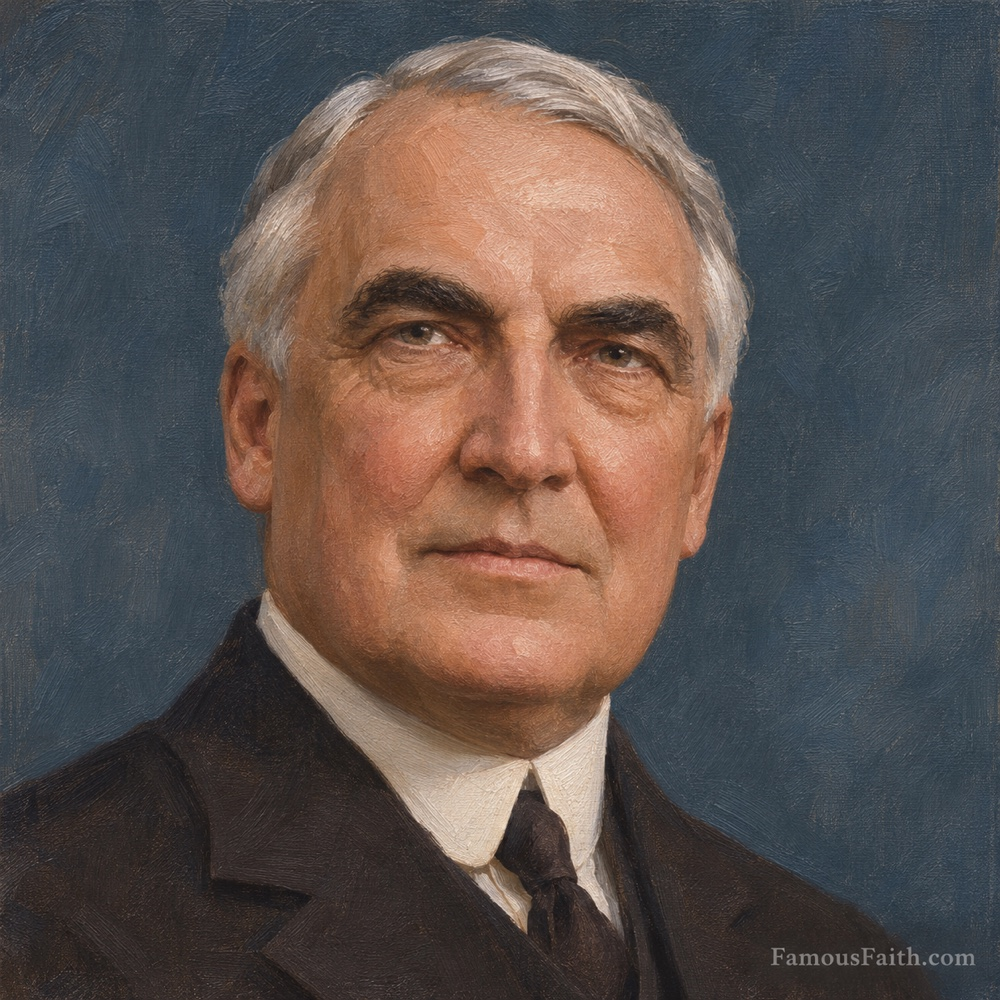
Portrait credit: Original AI-generated painted editorial illustration created for Famous Faith, with a subtle FamousFaith.com watermark. This is an artistic interpretation, not a historical photograph or an authenticated period painting.
Editorial approach: Documented actions and public statements are distinguished from Famous Faith’s biblical assessments. Public profession and church affiliation do not establish the condition of a person’s heart.