Famous Faith · U.S. Presidents
Ulysses S. Grant
Union victory, civil rights, and the responsibility to govern honestly.
Ulysses S. Grant’s reputation extends beyond battlefield command. As president he defended Black citizenship against violent resistance, pursued reconciliation, and struggled with corruption around him. His record also includes Native policies whose religious language did not prevent coercive assimilation.
PRESIDENT 18
The essentials
Ulysses S. Grant at a glance
- Born
- April 27, 1822
- Died
- July 23, 1885
- Presidency
- March 4, 1869 – March 4, 1877
- Political party
- Republican
- Church background
- Methodist association; formal membership should not be assumed
- Spouse
- August 22, 1848, to Julia Boggs Dent (1826–1902)
- Children
- Four: Frederick, Ulysses Jr., Ellen, and Jesse
- Other work
- Soldier
- Presidential number
- 18
Basic biographical details: [1]. Family and religious qualifications are explained below.
The person behind the office
Life and family
Grant attended West Point and served in the Mexican-American War before facing difficult years in civilian life. The Civil War transformed his career. He became the Union’s leading general and accepted Robert E. Lee’s surrender at Appomattox in 1865. His command helped secure the military outcome that made constitutional emancipation enforceable across the former Confederacy. [2] Elected as a Republican in 1868, Grant inherited the unfinished work of Reconstruction. The end of formal slavery did not end violence or efforts to deny Black Americans political rights. His presidency therefore involved a struggle over whether citizenship would receive meaningful protection, alongside the more familiar scandals, financial disputes, and administrative failures. He served two terms and later wrote his memoirs while facing serious illness and financial distress. [3]
Spouse and children
Grant married Julia Boggs Dent in 1848. They had four children: Frederick Dent, Ulysses Jr., Ellen, and Jesse. Their marriage endured military separation, financial hardship, public success, and retirement. Julia’s family came from a slaveholding background, a reminder that the household’s history intersects with the institution Grant’s armies helped destroy. His daughter Ellen, known as Nellie, married at the White House during his presidency. [4]
A public record
Major political accomplishments and decisions
- 01
Defended Reconstruction and Black citizenship
Grant supported federal enforcement against the Ku Klux Klan and other organized efforts to terrorize Black citizens and their allies. His administration used the Enforcement Acts to challenge that violence. The record deserves attention alongside the failures and retreat that later undermined Reconstruction. [5]
- 02
Advanced international arbitration
The Treaty of Washington and the settlement of the Alabama claims helped resolve serious disputes with Britain arising from the Civil War. Arbitration provided a diplomatic alternative to allowing those disputes to become another armed confrontation. [6]
- 03
Presided over an administration damaged by corruption
Scandals involving officials and associates injured public trust. It is important to distinguish corruption by people around Grant from a claim that he personally profited from every scandal. His loyalty to unreliable men nevertheless created a serious failure of supervision and judgment. [5]
Public evidence and its limits
Faith and documented statements
Grant is often associated with Methodism, including through Julia’s religious life. Accounts of his formal church membership and baptism require caution; Famous Faith does not repeat disputed anecdotes as proof of a particular conversion experience. [1] [7] His own 1869 inaugural address provides firmer evidence for a public religious statement: he asked the nation’s prayers to Almighty God for a happy and reunited country. [8] The request shows religious language and an expressed desire for reconciliation, but it is not a detailed explanation of Christian doctrine. We report that distinction while recognizing that religious ideas also shaped policy. The involvement of Christian denominations in his Native policy demonstrates that invoking religion does not by itself establish that a government’s treatment of people is just.
Famous Faith’s biblical perspective
Public virtues and serious concerns
The historical actions are sourced. Their evaluation through Scripture expresses Famous Faith’s Christian editorial perspective; it is not a claim to know anyone’s eternal destiny.
Protecting citizens from racial terror
Grant’s action against organized racist violence is an important moral strength in his presidential record. Famous Faith regards equal protection and the defense of threatened neighbors as consistent with biblical justice. Such work should not be minimized because political opponents later made corruption the only story told about his administration. The safety of people exercising newly secured rights was a real responsibility of government.
Good intentions did not prevent coercive Native policies
Grant sought reform and less corruption in Indian affairs, but his Peace Policy also promoted reservation control and assimilation through religious organizations. The National Park Service describes tensions between protection, territorial expansion, and the destruction of Native ways of life. [9] Famous Faith rejects using Christian identity to excuse coercion or the disregard of treaty obligations. The moral test includes the dignity and freedom of the people whom officials claimed to be helping.
Personal honesty needs accountable administration
A leader can avoid personal enrichment and still fail through misplaced loyalty. The scandals around Grant show why biblical concern for integrity includes scrutiny of appointments and the refusal to shield dishonest allies. Friendship and gratitude should not outrank truth or the public trust.
Beyond the familiar name
Interesting facts and useful distinctions
The general and the president are different chapters
Grant’s military achievement at Appomattox preceded his presidency by four years. His political record should be judged in its own setting rather than treated as an automatic extension of military greatness. [2]
Memoirs written under pressure
In retirement, Grant’s memoirs became an important effort to provide for his family after financial losses. The book also helped preserve his account of the military events for which he was best known. [10]
A life in perspective
What this legacy asks of us
Grant’s story resists a simple verdict of either military hero or failed politician. His defense of Black citizenship deserves renewed attention, while corruption and coercive Native policy require criticism. A Christian assessment should be specific enough to recognize courage without overlooking the obligations that courage elsewhere did not fulfill.
Our hope rests in Jesus Christ, not a president, party, lodge, or record of public service. Scripture teaches that all have sinned, that Christ died for sins and rose again, and that salvation is God’s gift through faith rather than an achievement we earn (Romans 3:23; 1 Corinthians 15:3–4; Ephesians 2:8–9). His call is to repentance and trust in him.
Sources and image credit
- Miller Center: Overview
- Miller Center: Life Before The Presidency
- Miller Center: Life In Brief
- Miller Center: Family Life
- Miller Center: Domestic Affairs
- Miller Center: Foreign Affairs
- PBS American Experience: God in the White House
- Presidential statement: original transcript
- National Park Service: Grant and Federal Indian Policy
- Miller Center: Impact And Legacy
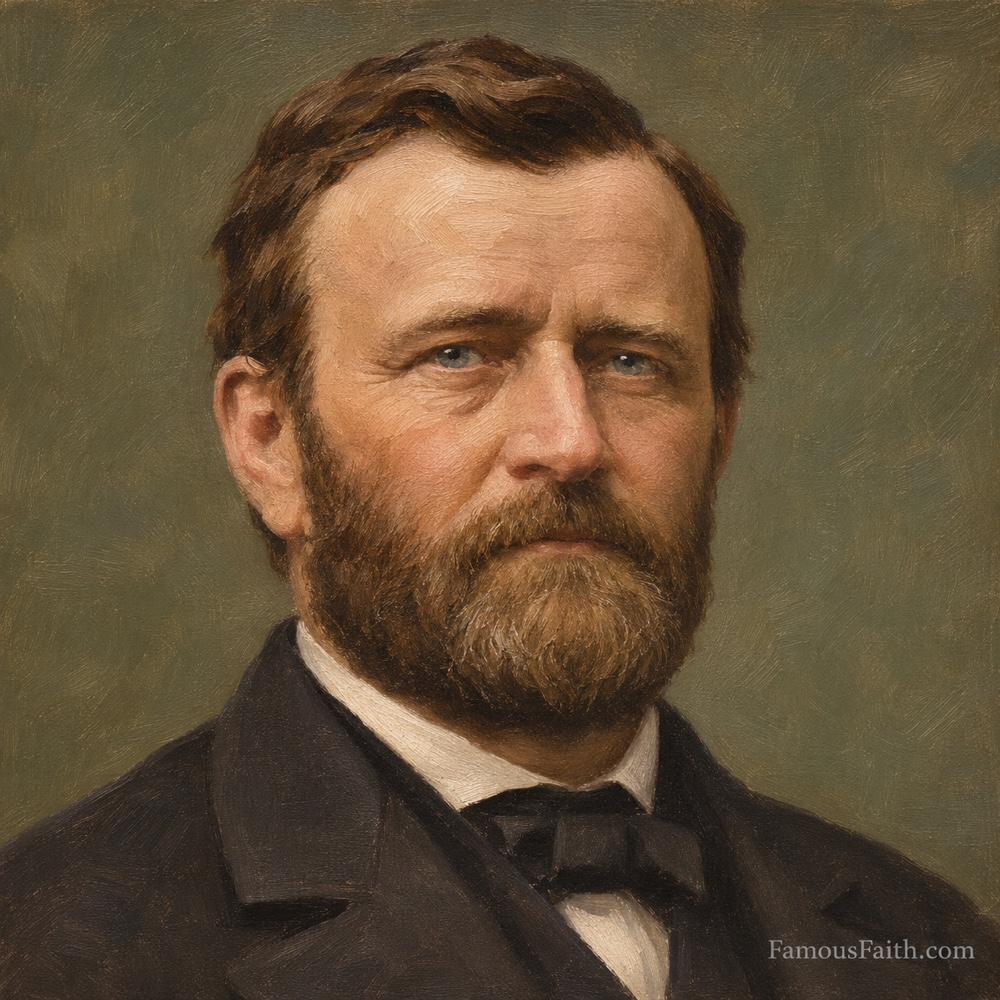
Portrait credit: Original AI-generated painted editorial illustration created for Famous Faith, with a subtle FamousFaith.com watermark. This is an artistic interpretation, not a historical photograph or an authenticated period painting.
Editorial approach: Documented actions and public statements are distinguished from Famous Faith’s biblical assessments. Public profession and church affiliation do not establish the condition of a person’s heart.