Famous Faith · U.S. Presidents
Thomas Jefferson
Religious liberty, the Declaration, and profound contradictions.
Thomas Jefferson gave enduring language to human equality while benefiting from slavery. He defended freedom of conscience, admired Jesus as a moral teacher, and rejected central Christian claims. His profile requires both historical care and a clear biblical assessment.
PRESIDENT 3
The essentials
Thomas Jefferson at a glance
- Born
- April 13, 1743
- Died
- July 4, 1826
- Presidency
- March 4, 1801 – March 4, 1809
- Political party
- Democratic-Republican
- Church background
- No formal affiliation
- Spouse
- January 1, 1772, to Martha Wayles Skelton (1748–1782)
- Children
- Six with Martha; Monticello also identifies him as father of at least six of Sally Hemings’s children
- Other work
- Lawyer, Planter
- Presidential number
- 3
Basic biographical details: [1]. Family and religious qualifications are explained below.
The person behind the office
Life and family
Jefferson grew up in Virginia, studied law, and became a planter and political writer. His strongest public instrument was his pen. In 1776 he drafted the Declaration of Independence, drawing on wider political ideas and working within a congressional process that revised and adopted the document. He later served as Virginia’s governor, minister to France, secretary of state, and vice president before becoming president. [2] His party was the Democratic-Republican Party of the early republic. It was not today’s Republican Party, and its relationship to later party traditions cannot be reduced to a modern label. Jefferson supported a more agrarian republic and feared concentrated power, yet the scale of the Louisiana Purchase tested his own preference for a limited reading of federal authority. [3]
Spouse and children
Jefferson married Martha Wayles Skelton in 1772. They had six children, with Martha and Mary surviving childhood; his wife died in 1782. He did not remarry. His daughters and other women in his extended family sometimes performed public household duties during his presidency. [4] Monticello’s historical research also identifies Jefferson as the father of at least six children born to Sally Hemings, whom he enslaved. That history must be acknowledged within the coercive conditions of slavery rather than presented as an ordinary relationship between equals. [5]
A public record
Major political accomplishments and decisions
- 01
Articulated independence and religious liberty
Jefferson drafted the Declaration and the Virginia Statute for Religious Freedom. The statute opposed government compulsion in matters of belief. His role was consequential, but neither document was a private achievement detached from the legislators, allies, and broader debates that shaped its adoption. [3]
- 02
Completed the Louisiana Purchase
The 1803 purchase from France greatly expanded the territory claimed by the United States. Jefferson also supported the Lewis and Clark expedition. These developments reshaped national geography while carrying enormous implications for Native nations whose lands were treated as objects of negotiation between other governments. [6]
- 03
Faced the limits of economic pressure
The Embargo Act of 1807 sought leverage against violations of American neutral commerce. It also inflicted severe costs on American trade and livelihoods. Understanding Jefferson’s presidency requires examining that failure alongside territorial expansion and the peaceful change of party control in 1801. [7]
Public evidence and its limits
Faith and documented statements
Jefferson’s first inaugural address invoked an overruling Providence and affirmed freedom of religion. His public language was religious, but it did not make him an orthodox Christian. The Miller Center records no formal religious affiliation. [1] [8] Monticello documents his admiration for Jesus’s moral teachings alongside his rejection of Jesus’s divinity, resurrection, and miracles. His privately assembled Gospel extracts reflected that selective approach. [9] Famous Faith regards the resurrection and the identity of Jesus as central to Christianity, not optional additions to an ethical system. First Corinthians 15:14–19 directly connects Christian hope to Christ’s resurrection. Respecting Jefferson’s defense of conscience does not require endorsing his theology.
Famous Faith’s biblical perspective
Public virtues and serious concerns
The historical actions are sourced. Their evaluation through Scripture expresses Famous Faith’s Christian editorial perspective; it is not a claim to know anyone’s eternal destiny.
Freedom of conscience deserves protection
Jefferson’s opposition to compulsory religious support helped protect people from government coercion in belief. Famous Faith sees room to appreciate that protection while continuing to proclaim the truth claims of the gospel. Civil freedom allows Christians to bear witness and allows neighbors to hear and respond without state-imposed conversion. Such liberty is not a declaration that every religion is equally true.
Equality was contradicted by enslavement
Jefferson’s ownership of people and the history of Sally Hemings confront readers with a deep contradiction between his language of rights and his exercise of power. [5] Genesis 1:27 and the command to love one’s neighbor challenge any treatment of human beings as inheritable property. Famous Faith rejects attempts to excuse that injustice by appealing to historical custom or Jefferson’s intellectual achievements. His opposition to some aspects of slavery did not free the people he continued to hold.
Beyond the familiar name
Interesting facts and useful distinctions
The Jefferson Bible needs its proper context
His edited collection of Gospel passages was a private project emphasizing Jesus’s life and moral instruction. It should not be described as a new Bible imposed by the federal government. [9]
One obituary, two founders
Jefferson and John Adams died on the same Independence Day in 1826. Their political rivalry and renewed correspondence are part of the story behind that remarkable coincidence. [2]
A life in perspective
What this legacy asks of us
Jefferson left a vocabulary of rights that later generations could use to challenge exclusions he accepted. His political influence remains immense, but intellectual brilliance does not resolve the moral contradictions of his household or the theological problems of a Christianity without the risen Christ.
Our hope rests in Jesus Christ, not a president, party, lodge, or record of public service. Scripture teaches that all have sinned, that Christ died for sins and rose again, and that salvation is God’s gift through faith rather than an achievement we earn (Romans 3:23; 1 Corinthians 15:3–4; Ephesians 2:8–9). His call is to repentance and trust in him.
Sources and image credit
- Miller Center: Overview
- Miller Center: Life In Brief
- Miller Center: Life Before The Presidency
- Miller Center: Family Life
- Monticello: Brief Biography of Thomas Jefferson
- Miller Center: Foreign Affairs
- Miller Center: Domestic Affairs
- Presidential statement: original transcript
- Monticello: Jefferson’s Religious Beliefs
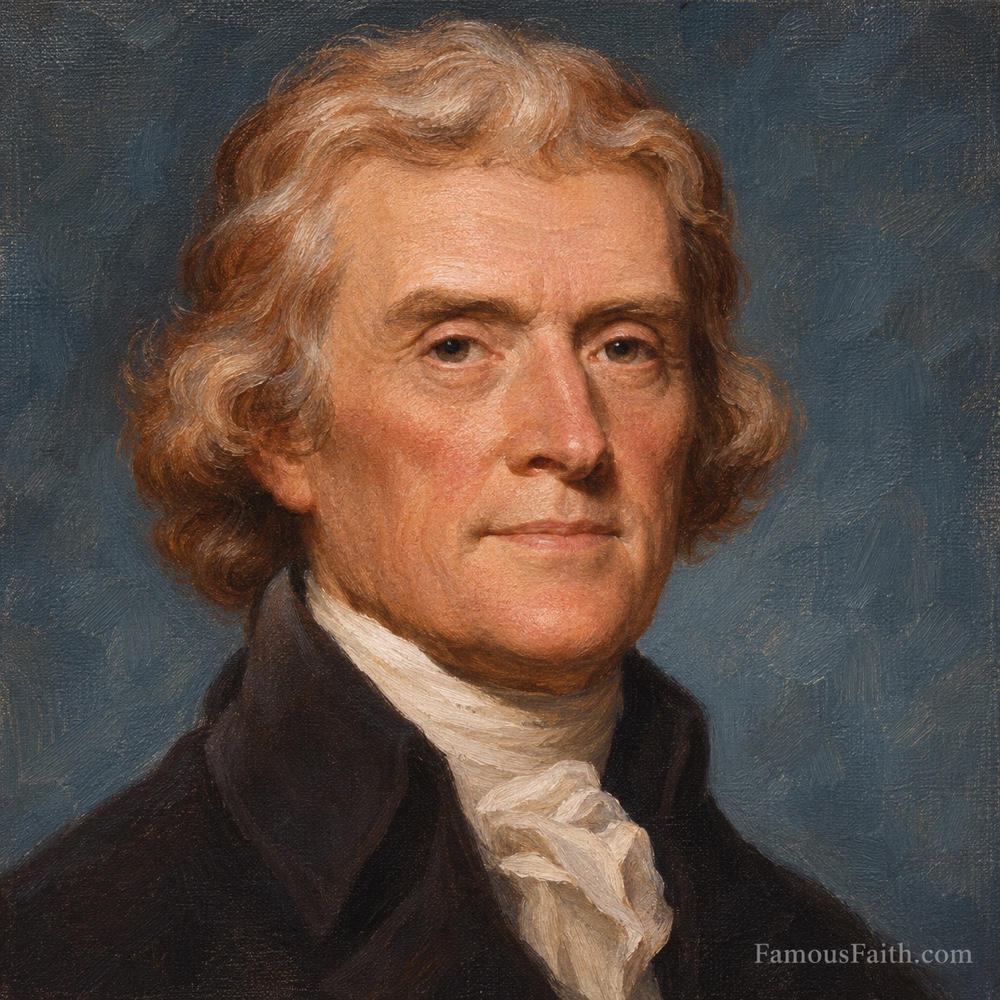
Portrait credit: Original AI-generated painted editorial illustration created for Famous Faith, with a subtle FamousFaith.com watermark. This is an artistic interpretation, not a historical photograph or an authenticated period painting.
Editorial approach: Documented actions and public statements are distinguished from Famous Faith’s biblical assessments. Public profession and church affiliation do not establish the condition of a person’s heart.