Famous Faith · U.S. Presidents
Rutherford B. Hayes
Personal integrity and the unfinished promise of Reconstruction.
Rutherford B. Hayes sought honest administration after one of the most disputed presidential elections in American history. His reputation for personal integrity stands beside a withdrawal of federal protection that left Black southerners increasingly exposed to political violence and disfranchisement.
PRESIDENT 19
The essentials
Rutherford B. Hayes at a glance
- Born
- October 4, 1822
- Died
- January 17, 1893
- Presidency
- March 4, 1877 – March 4, 1881
- Political party
- Republican
- Church background
- Methodist association; personally described belief without formal church membership
- Spouse
- December 30, 1852, to Lucy Ware Webb (1831–1889)
- Children
- Eight children; five survived to adulthood
- Other work
- Lawyer
- Presidential number
- 19
Basic biographical details: [1]. Family and religious qualifications are explained below.
The person behind the office
Life and family
Hayes studied at Kenyon College and Harvard Law School and became a lawyer in Ohio. He served in the Union Army during the Civil War, then entered national and state politics as a Republican congressman and governor. His public reputation emphasized integrity and administrative reform, qualities that made him a plausible candidate after the scandals associated with the Grant years. [2] The election of 1876 produced disputed electoral returns and a prolonged national crisis. An electoral commission and the acceptance of the resulting count brought Hayes to office. The political negotiations and the ending of federal military support for the remaining southern Republican governments should be explained carefully, without pretending that every historical question about a single secret bargain has been settled. His presidency began under a cloud of contested legitimacy. [3]
Spouse and children
Hayes married Lucy Ware Webb in 1852. They had eight children, five of whom survived to adulthood. Lucy was an important partner in family and public life and was associated with temperance and Methodist practice. The household welcomed relatives, friends, and staff into its celebrations. Their decision not to serve alcohol at White House entertainments became a memorable symbol of the administration, although a household rule is not the whole measure of Christian character. [4]
A public record
Major political accomplishments and decisions
- 01
Pressed for civil-service reform
Hayes challenged the expectation that government jobs should function as rewards controlled by party leaders. His disputes with powerful Republican factions helped prepare the ground for later reform, although the major Pendleton legislation was enacted under Chester Arthur rather than during Hayes’s term. [5]
- 02
Removed troops supporting remaining southern governments
Hayes ended the federal military presence protecting the Republican governments in Louisiana and South Carolina. This action is associated with the close of Reconstruction. Promises of fair treatment did not provide adequate protection against the power and violence that increasingly excluded Black citizens. [5]
- 03
Managed labor unrest and financial questions
The Great Railroad Strike of 1877 and disputes over currency confronted the administration with a rapidly industrializing country. Federal intervention during the strike showed the growing power of national institutions in conflicts involving business, workers, public order, and property. [5]
Public evidence and its limits
Faith and documented statements
Hayes’s religion is more complicated than the Methodist label in a summary table. His diaries describe serious engagement with sermons, the Bible, and religious questions while declining formal church membership and a fixed creed. PBS reproduces his account of wanting to do Christian work and his final description of Christian belief as a matter of conscience and purpose. [6] Famous Faith takes that self-description seriously without turning it into a complete doctrinal confession. A desire to act according to the Golden Rule is valuable, but Christianity also makes definite claims about Christ, sin, grace, and redemption. Personal respectability, temperance, and a religious household should therefore be reported as parts of a life rather than treated as a certificate of salvation.
Famous Faith’s biblical perspective
Public virtues and serious concerns
The historical actions are sourced. Their evaluation through Scripture expresses Famous Faith’s Christian editorial perspective; it is not a claim to know anyone’s eternal destiny.
Integrity in appointments matters
Hayes’s resistance to patronage reflects an important concern about stewardship. Government employment and authority should not be treated as private property belonging to a party organization. Famous Faith sees a connection with impartiality and honest administration. A leader’s willingness to disappoint political allies can be valuable when their expectations conflict with the public trust.
Reconciliation left vulnerable citizens insufficiently protected
The ending of federal protection did not produce a just peace for Black southerners. Hayes’s hopes for fair local government were not matched by adequate means to secure it. [5] Famous Faith regards reconciliation among former enemies as incomplete when it leaves threatened neighbors exposed. Biblical peace requires attention to justice, not merely the disappearance of a dispute between powerful political factions.
Beyond the familiar name
Interesting facts and useful distinctions
A disputed beginning, a promised limit
Hayes entered office after an extraordinary electoral dispute and served one term. His later departure honored a limit on his own pursuit of the presidency rather than beginning another campaign for office. [7]
The temperance image needs proportion
The alcohol-free White House became central to Lucy Hayes’s popular reputation. The rule is an interesting household detail, but it should not overshadow questions of civil rights, labor, or the consequences of ending Reconstruction. [4]
A life in perspective
What this legacy asks of us
Hayes’s presidency illustrates the difference between personal virtue and the full consequences of public policy. His concern for honesty deserves recognition. So does the suffering left insufficiently protected by his southern policy. A Christian account should examine both without assuming that a respectable household guarantees a just administration.
Our hope rests in Jesus Christ, not a president, party, lodge, or record of public service. Scripture teaches that all have sinned, that Christ died for sins and rose again, and that salvation is God’s gift through faith rather than an achievement we earn (Romans 3:23; 1 Corinthians 15:3–4; Ephesians 2:8–9). His call is to repentance and trust in him.
Sources and image credit
- Miller Center: Overview
- Miller Center: Life Before The Presidency
- Miller Center: Life In Brief
- Miller Center: Family Life
- Miller Center: Domestic Affairs
- PBS American Experience: Hayes’s Diaries and Religious Views
- Miller Center: Impact And Legacy
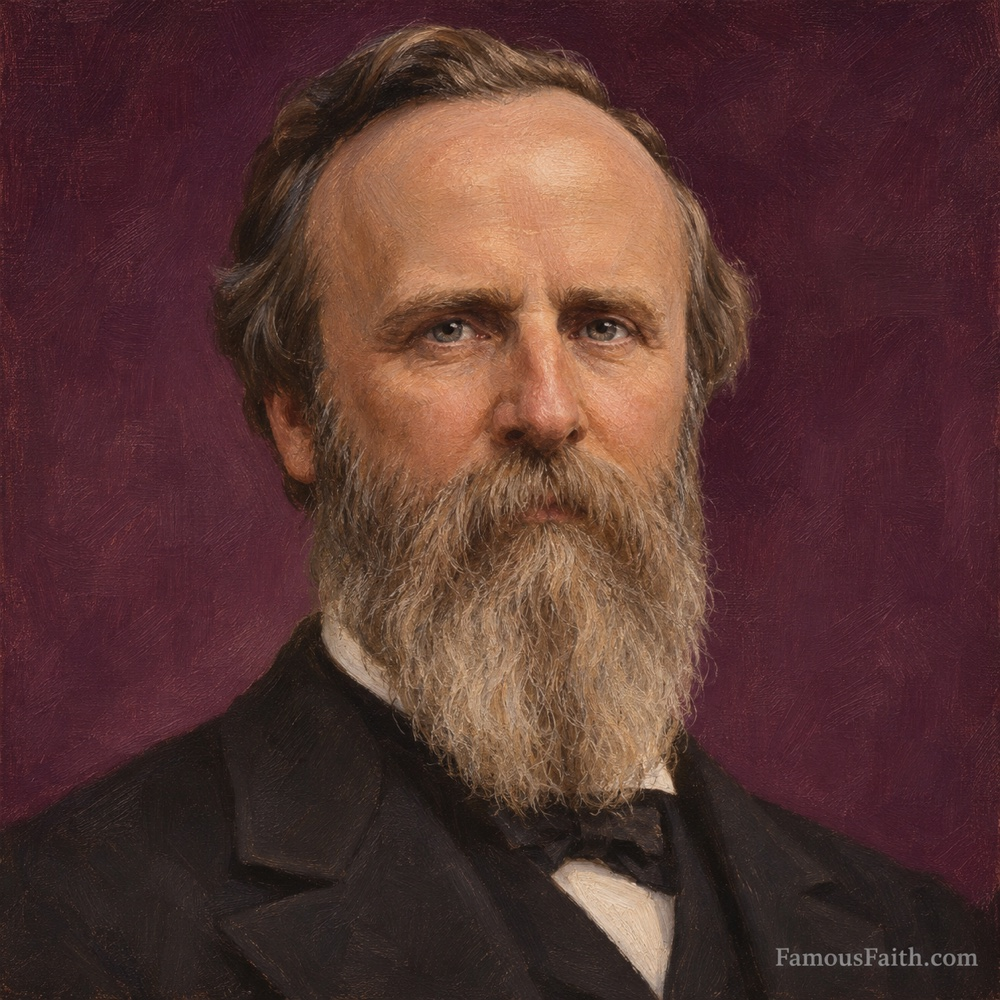
Portrait credit: Original AI-generated painted editorial illustration created for Famous Faith, with a subtle FamousFaith.com watermark. This is an artistic interpretation, not a historical photograph or an authenticated period painting.
Editorial approach: Documented actions and public statements are distinguished from Famous Faith’s biblical assessments. Public profession and church affiliation do not establish the condition of a person’s heart.