Famous Faith · U.S. Presidents
Ronald Reagan
Faith, conservative politics, Cold War diplomacy, and the responsibility to tell the truth.
Ronald Reagan carried an actor’s communication skills into a presidency that reshaped Republican politics. His record includes economic change, negotiations with the Soviet Union, explicit Christian statements, and the Iran–Contra scandal. His honorary Masonic recognition also requires a careful distinction from ordinary lodge membership.
PRESIDENT 40
The essentials
Ronald Reagan at a glance
- Born
- February 6, 1911
- Died
- June 5, 2004
- Presidency
- January 20, 1981 – January 20, 1989
- Political party
- Republican
- Church background
- Disciples of Christ upbringing; see documented Christian statements below
- Spouse
- Jane Wyman (married January 26, 1940; divorce finalized 1949); Nancy Davis (married March 4, 1952)
- Children
- Five, including Christine, whose birth and death were recorded on the same day; four grew to adulthood
- Other work
- Actor, Public Official
- Presidential number
- 40
- Freemasonry
- Honorary Scottish Rite and Shrine recognition; not established as a regular lodge member
Basic biographical details: [1]. Family and religious qualifications are explained below.
The person behind the office
Life and family
Reagan grew up in Illinois, worked in radio, became a Hollywood actor, and served as president of the Screen Actors Guild. He began political life as a Democrat before moving toward conservatism and joining the Republican Party. His mother’s Disciples of Christ background was important in his upbringing. [2] Elected governor of California in 1966, he served two terms before winning the presidency in 1980. His two presidential terms ran from 1981 to 1989. Tax policy, the role of government, military strength, and relations with the Soviet Union were central to his agenda. He left a lasting political coalition as well as controversies that cannot be reduced to either admiration for his speaking ability or hostility toward his party. [3]
Spouse and children
Reagan married actress Jane Wyman in 1940; the Reagan Library dates the final divorce to 1949. [4] They had Maureen, adopted Michael, and had Christine, whose birth and death the Reagan Library records on June 26, 1947. The library notes differing accounts of whether she was stillborn or briefly survived. Reagan married Nancy Davis in 1952, and they had Patricia, known as Patti, and Ronald, known as Ron. A four-child list therefore counts the children who grew up and omits Christine’s brief life. [5]
A public record
Major political accomplishments and decisions
- 01
Changed federal economic policy
Reagan pursued major tax reductions, deregulation, and changes in domestic spending priorities. Economic recovery followed a severe early recession, while deficits and the distribution of gains remained important questions. An account of the period should acknowledge both recovery and the burdens borne unevenly across the population. [6]
- 02
Combined pressure with arms-control diplomacy
He expanded defense spending and confronted Soviet power, but also negotiated with Mikhail Gorbachev. The 1987 Intermediate-Range Nuclear Forces Treaty was an important arms-control achievement. The end of the Cold War involved many governments, peoples, and events; it should not be attributed to one president acting alone. [7]
- 03
Faced the Iran–Contra scandal
Secret arms transactions with Iran and assistance to the Nicaraguan Contras brought serious questions about legality, oversight, and presidential responsibility. In his March 1987 address Reagan acknowledged that the evidence contradicted his earlier assertion about trading arms for hostages. The admission is part of the record, not a reason to omit the wrongdoing. [8]
Public evidence and its limits
Faith and documented statements
In his April 2, 1983, Easter and Passover radio address, Reagan explicitly spoke of the resurrection of Jesus. That supplies a clearer example of his public Christian profession than a generic ceremonial blessing. [9] Famous Faith affirms the centrality of Christ’s resurrection while distinguishing a politician’s public statement from proof about the state of the heart. His language about faith and national purpose should also be read critically: biblical Christianity does not identify the kingdom of God with American strength or with a political movement. Honoring his religious background therefore includes examining the relationship between his stated convictions, actual decisions, and the religious associations described below.
Famous Faith’s biblical perspective
Public virtues and serious concerns
The historical actions are sourced. Their evaluation through Scripture expresses Famous Faith’s Christian editorial perspective; it is not a claim to know anyone’s eternal destiny.
Defending unborn life requires a complete record
Reagan became a prominent opponent of abortion, but as California governor he signed legislation liberalizing the state’s abortion law in 1967 and later called that decision a mistake. [10] Famous Faith supports protecting unborn life and believes a truthful account must include this earlier action rather than making his position appear unchanged throughout his career. Care for mothers, children, and families also belongs in a consistent concern for life.
Political loyalty must not excuse deception
Iran–Contra presents a serious test for Christians who admire Reagan. His acknowledgment that the evidence contradicted his earlier account matters, but accountability requires more than a sympathetic understanding of intentions. [8] Famous Faith believes truthfulness and lawful oversight must apply to leaders we favor as firmly as to their opponents. A Christian profession cannot give an administration permission to conceal wrongdoing.
Beyond the familiar name
Interesting facts and useful distinctions
An earlier party affiliation
Reagan was once a Democrat. His later leadership of the Republican Party should not erase that earlier part of his political development. [2]
Negotiation was part of the Cold War record
His presidency is remembered for confrontational rhetoric, but arms-control negotiations were also a major feature of the second term. Firmness and diplomatic engagement were both parts of the historical record. [7]
A life in perspective
What this legacy asks of us
Reagan’s communication, political influence, and diplomacy made him one of the defining presidents of the late twentieth century. His Christian language deserves accurate reporting, and his administration’s failures deserve equally accurate scrutiny. Famous Faith measures both by standards larger than political success: fidelity to Christ, truthfulness, care for life, and the responsible use of power.
Our hope rests in Jesus Christ, not a president, party, lodge, or record of public service. Scripture teaches that all have sinned, that Christ died for sins and rose again, and that salvation is God’s gift through faith rather than an achievement we earn (Romans 3:23; 1 Corinthians 15:3–4; Ephesians 2:8–9). His call is to repentance and trust in him.
Sources and image credit
- Miller Center: Overview
- Miller Center: Life Before The Presidency
- Miller Center: Life In Brief
- Ronald Reagan Presidential Library: pre-presidential timeline
- Ronald Reagan Presidential Library: Reagan’s family
- Miller Center: Domestic Affairs
- Miller Center: Foreign Affairs
- Reagan’s address on Iran–Contra, March 4, 1987
- Reagan Library: Easter and Passover radio address, April 2, 1983
- TIME: Reagan’s changing position on abortion, with his correspondence
- Kansas City Scottish Rite: Ronald Reagan and honorary recognition
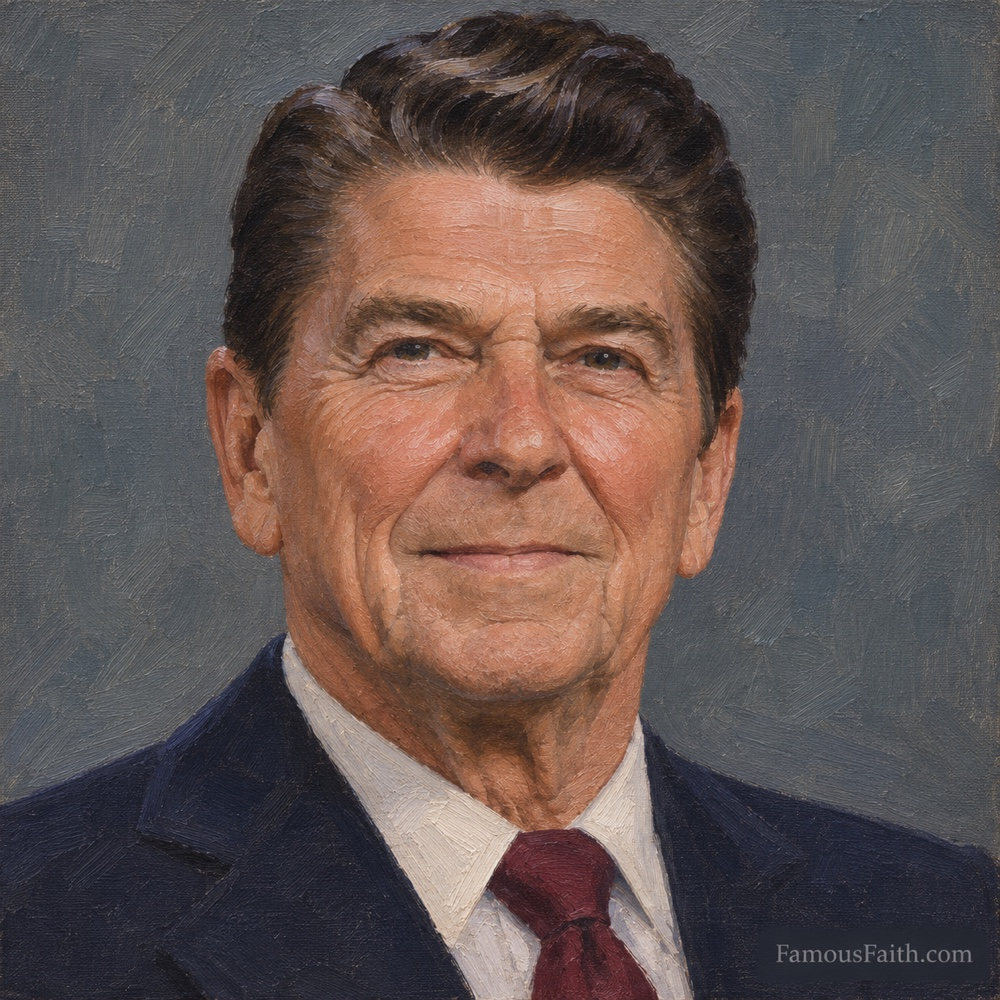
Portrait credit: Original AI-generated painted editorial illustration created for Famous Faith, with a subtle FamousFaith.com watermark. This is an artistic interpretation, not a historical photograph or an authenticated period painting.
Editorial approach: Documented actions and public statements are distinguished from Famous Faith’s biblical assessments. Public profession and church affiliation do not establish the condition of a person’s heart.