Famous Faith · U.S. Presidents
Richard Nixon
Diplomatic breakthroughs and the collapse of public trust.
Richard Nixon achieved major changes in relations with China and the Soviet Union, then resigned amid Watergate. His Quaker background and public appeals to peace stand beside a record of deception and abuse of power that requires an unambiguous moral judgment.
PRESIDENT 37
The essentials
Richard Nixon at a glance
- Born
- January 9, 1913
- Died
- April 22, 1994
- Presidency
- January 20, 1969 – August 9, 1974
- Political party
- Republican
- Church background
- Society of Friends (Quaker)
- Spouse
- June 21, 1940, to Thelma “Patricia” Catherine Ryan (1912–1993)
- Children
- Two daughters: Patricia, known as Tricia, and Julie
- Other work
- Lawyer, Public Official
- Presidential number
- 37
Basic biographical details: [1]. Family and religious qualifications are explained below.
The person behind the office
Life and family
Nixon grew up in California, studied at Whittier College and Duke Law School, and served in the Navy during World War II. His rapid political rise included the House, the Senate, and two terms as Dwight Eisenhower’s vice president. He lost the presidential election of 1960 and a California gubernatorial race before rebuilding his political position and winning the presidency in 1968. [2] His administration combined an unusually active foreign policy with domestic initiatives that do not fit a simple ideological label. Reelected in 1972 by a large electoral margin, he then faced the investigations that exposed Watergate and related abuses. He resigned in August 1974 before a full House impeachment vote. Saying he was removed after conviction would misstate what happened. [3]
Spouse and children
Nixon married Thelma Catherine Ryan, known as Pat, in 1940. Their daughters were Patricia, usually called Tricia, and Julie. Julie married David Eisenhower, Dwight Eisenhower’s grandson, connecting two presidential families. Tricia married Edward Cox at the White House. Pat and the daughters supported Nixon through his political crises, but family devotion does not settle the public questions raised by the actions of his administration. [4]
A public record
Major political accomplishments and decisions
- 01
Opened a new relationship with China
Nixon’s 1972 visit to the People’s Republic of China reshaped international diplomacy. His long record of anticommunism made the change politically striking. The opening was a major development, not a resolution of every disagreement or a guarantee that engagement would produce a particular political future. [5]
- 02
Pursued arms agreements and withdrawal from Vietnam
Nixon’s administration negotiated with the Soviet Union and concluded the first Strategic Arms Limitation agreements. It also reached the Paris Peace Accords concerning Vietnam. American combat withdrawal did not mean the wider war ended during his presidency; the fall of South Vietnam occurred in 1975. [5]
- 03
Established lasting domestic institutions
The Environmental Protection Agency and significant environmental legislation became part of his domestic record. Other initiatives included changes in social assistance and economic policy. These achievements should be described accurately rather than erased by Watergate, while not being used to excuse it. [6]
Public evidence and its limits
Faith and documented statements
Nixon came from the Society of Friends, or Quaker, tradition. His religious background is documented, but the label should not be used to presume that his policies consistently reflected Quaker teaching or biblical Christianity. [1] In his first inaugural address, he spoke of equal dignity before God and committed his office to the pursuit of peace. He also contrasted material abundance with spiritual disorder. [7] Famous Faith takes those public statements seriously enough to test them against conduct. Religious language about dignity and peace cannot make deception, retaliation, or the concealment of wrongdoing acceptable. Neither a church background nor association with prominent religious figures establishes the condition of a person’s heart.
Famous Faith’s biblical perspective
Public virtues and serious concerns
The historical actions are sourced. Their evaluation through Scripture expresses Famous Faith’s Christian editorial perspective; it is not a claim to know anyone’s eternal destiny.
Diplomacy with adversaries can be worthwhile
Nixon’s willingness to negotiate with states he had long opposed helped reduce some dangerous barriers in international relations. Famous Faith can recognize practical peacemaking without imagining that agreement requires approval of an adversary’s ideology. Negotiation still requires truthfulness, regard for human rights, and attention to people affected by decisions made far above them.
Watergate was a grave breach of responsibility
Watergate involved more than the break-in itself: the cover-up and broader abuses of presidential power damaged constitutional government and public trust. [6] Famous Faith regards deceit and the use of authority to protect oneself from accountability as serious moral wrongs. A successful policy or a landslide election cannot authorize a ruler to treat the law as an instrument for personal survival.
Beyond the familiar name
Interesting facts and useful distinctions
Resignation is different from impeachment and conviction
Nixon resigned while facing a rapidly advancing impeachment process. The House Judiciary Committee had approved articles, but the full House had not impeached him and the Senate had not tried or convicted him. [3]
A major political comeback preceded the fall
His earlier defeats did not end his career. The return to presidential victory in 1968 makes his later collapse a particularly striking example of success failing to protect a leader from the consequences of wrongdoing. [2]
A life in perspective
What this legacy asks of us
Nixon’s presidency requires two clear judgments at once: diplomatic and domestic accomplishments were real, and the abuse of office was real. Christian moral assessment should resist using either truth to erase the other. Public trust requires more than competence, and spiritual hope cannot rest on the ability to win, govern, or recover a reputation.
Our hope rests in Jesus Christ, not a president, party, lodge, or record of public service. Scripture teaches that all have sinned, that Christ died for sins and rose again, and that salvation is God’s gift through faith rather than an achievement we earn (Romans 3:23; 1 Corinthians 15:3–4; Ephesians 2:8–9). His call is to repentance and trust in him.
Sources and image credit
- Miller Center: Overview
- Miller Center: Life Before The Presidency
- Miller Center: Life In Brief
- Miller Center: Family Life
- Miller Center: Foreign Affairs
- Miller Center: Domestic Affairs
- Presidential statement: original transcript
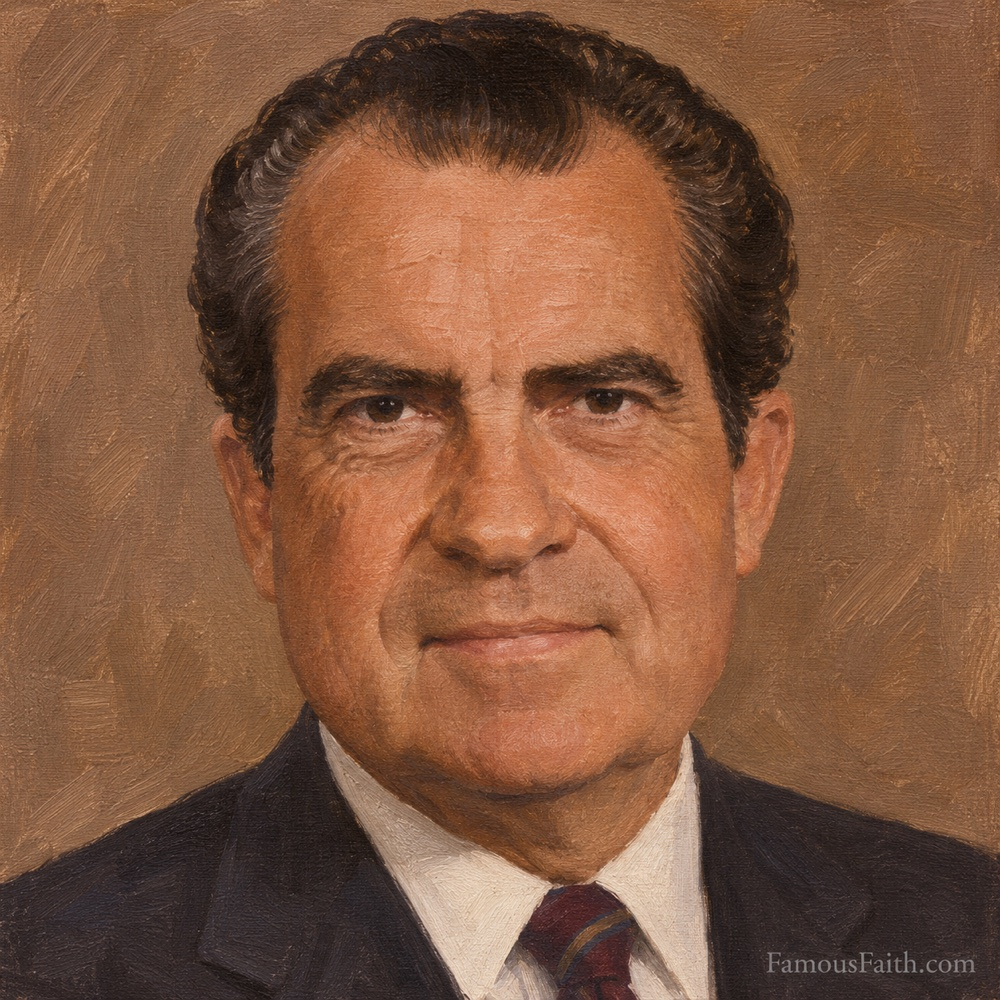
Portrait credit: Original AI-generated painted editorial illustration created for Famous Faith, with a subtle FamousFaith.com watermark. This is an artistic interpretation, not a historical photograph or an authenticated period painting.
Editorial approach: Documented actions and public statements are distinguished from Famous Faith’s biblical assessments. Public profession and church affiliation do not establish the condition of a person’s heart.