Famous Faith · U.S. Presidents
Millard Fillmore
Compromise, conscience, and the price paid by the enslaved.
Millard Fillmore sought to preserve the Union through compromise. His support for the Fugitive Slave Act reveals the moral danger of treating national stability as sufficient justification for forcing vulnerable people back into bondage.
PRESIDENT 13
The essentials
Millard Fillmore at a glance
- Born
- January 7, 1800
- Died
- March 8, 1874
- Presidency
- July 9, 1850 – March 4, 1853
- Political party
- Whig
- Church background
- Unitarian
- Spouse
- February 5, 1826, to Abigail Powers (1798–1853); February 10, 1858, to Caroline Carmichael McIntosh (1813–1881)
- Children
- Two: Millard Powers and Mary Abigail
- Other work
- Lawyer
- Presidential number
- 13
Basic biographical details: [1]. Family and religious qualifications are explained below.
The person behind the office
Life and family
Fillmore rose from a poor family in New York through work, self-education, and legal training. His early experience differed sharply from that of presidents born into established planter families. He became a lawyer, legislator, congressman, and New York comptroller before serving as Zachary Taylor’s vice president. His career reflected both personal determination and the opportunities offered by the developing party system. [2] Taylor’s death brought Fillmore to the presidency in July 1850. The Whig coalition was already divided over slavery, and Fillmore chose to support a legislative settlement that his predecessor had resisted. The resulting compromise briefly reduced immediate sectional pressure while deepening the federal government’s role in enforcing slavery. His pursuit of stability therefore had a direct human cost. [3]
Spouse and children
Fillmore married Abigail Powers in 1826. They had two children, Millard Powers and Mary Abigail. Abigail, formerly his teacher, shared his interest in learning and helped establish a White House library. She died shortly after his presidency ended in 1853; their daughter died the next year. Fillmore married Caroline Carmichael McIntosh in 1858. These losses and later family changes belong to the private life behind a presidency often remembered almost entirely for one compromise. [4] [1]
A public record
Major political accomplishments and decisions
- 01
Supported the Compromise of 1850
Fillmore backed the package that admitted California as a free state, addressed territorial and boundary questions, ended the slave trade in Washington, and strengthened fugitive-slave enforcement. The measures were separate laws with different effects; describing the entire package simply as a victory for freedom would be misleading. [5]
- 02
Pursued expanded trade with Japan
His administration sent the expedition led by Commodore Matthew Perry that pressed Japan to open relations. Perry’s arrival and the subsequent agreement occurred after Fillmore left office. The distinction preserves his role in initiating the mission without assigning later events to his presidency. [6]
- 03
Tried to contain unauthorized expansion abroad
Fillmore’s administration opposed private expeditions aimed at taking Cuba from Spain. These efforts show that a president interested in trade and national influence did not endorse every expansionist project promoted by private American adventurers or slaveholding interests. [6]
Public evidence and its limits
Faith and documented statements
Fillmore was associated with Unitarianism. That historical affiliation should not be silently equated with the Trinitarian beliefs of biblical Christianity. Nor should a denominational label be used to invent a detailed account of personal conversion or private devotion. The sources used here do not establish a complete first-person confession of faith that Famous Faith can responsibly present as such. [1] His presidency is therefore assessed primarily through its documented actions and the religious background that can be verified. Christians should be particularly cautious when moral language about order, law, or national peace becomes detached from the people harmed by enforcement. The question is not whether a public official sounds respectable, but whether the exercise of authority accords with justice and the dignity of neighbors.
Famous Faith’s biblical perspective
Public virtues and serious concerns
The historical actions are sourced. Their evaluation through Scripture expresses Famous Faith’s Christian editorial perspective; it is not a claim to know anyone’s eternal destiny.
Peace is more than the absence of immediate conflict
Preserving the Union was a serious responsibility, and political compromise is not inherently unprincipled. But the biblical pursuit of peace does not authorize a bargain that transfers danger to people excluded from the negotiation. Famous Faith distinguishes practical cooperation from the assumption that a quieter political atmosphere proves a just outcome.
The Fugitive Slave Act demanded wrongful cooperation
Fillmore signed and enforced the Fugitive Slave Act of 1850. It strengthened federal machinery for capturing people claimed as fugitives from slavery and exposed free Black people to grave danger. [5] Famous Faith regards forcing neighbors into human bondage as a profound violation of human dignity. Appeals to legal duty do not remove the moral responsibility of the officials who create and enforce an unjust system.
Beyond the familiar name
Interesting facts and useful distinctions
A White House library
Abigail Fillmore’s interest in books helped establish a library in the presidential household. The detail adds an important dimension to a family usually overshadowed by the politics of slavery. [4]
A later party affiliation
Fillmore later became the presidential candidate of the American, or Know-Nothing, Party in 1856. That campaign belonged to his post-presidential life and should not be confused with the Whig ticket on which he became vice president. [7]
A life in perspective
What this legacy asks of us
Fillmore’s record warns against making stability the highest moral good. The government could postpone sectional conflict while increasing the peril of enslaved and free Black people. A Christian assessment must ask who bore the burden of compromise and whether the nation’s promised peace depended on denying someone else’s freedom.
Our hope rests in Jesus Christ, not a president, party, lodge, or record of public service. Scripture teaches that all have sinned, that Christ died for sins and rose again, and that salvation is God’s gift through faith rather than an achievement we earn (Romans 3:23; 1 Corinthians 15:3–4; Ephesians 2:8–9). His call is to repentance and trust in him.
Sources and image credit
- Miller Center: Overview
- Miller Center: Life Before The Presidency
- Miller Center: Life In Brief
- Miller Center: Family Life
- Miller Center: Domestic Affairs
- Miller Center: Foreign Affairs
- Miller Center: Impact And Legacy
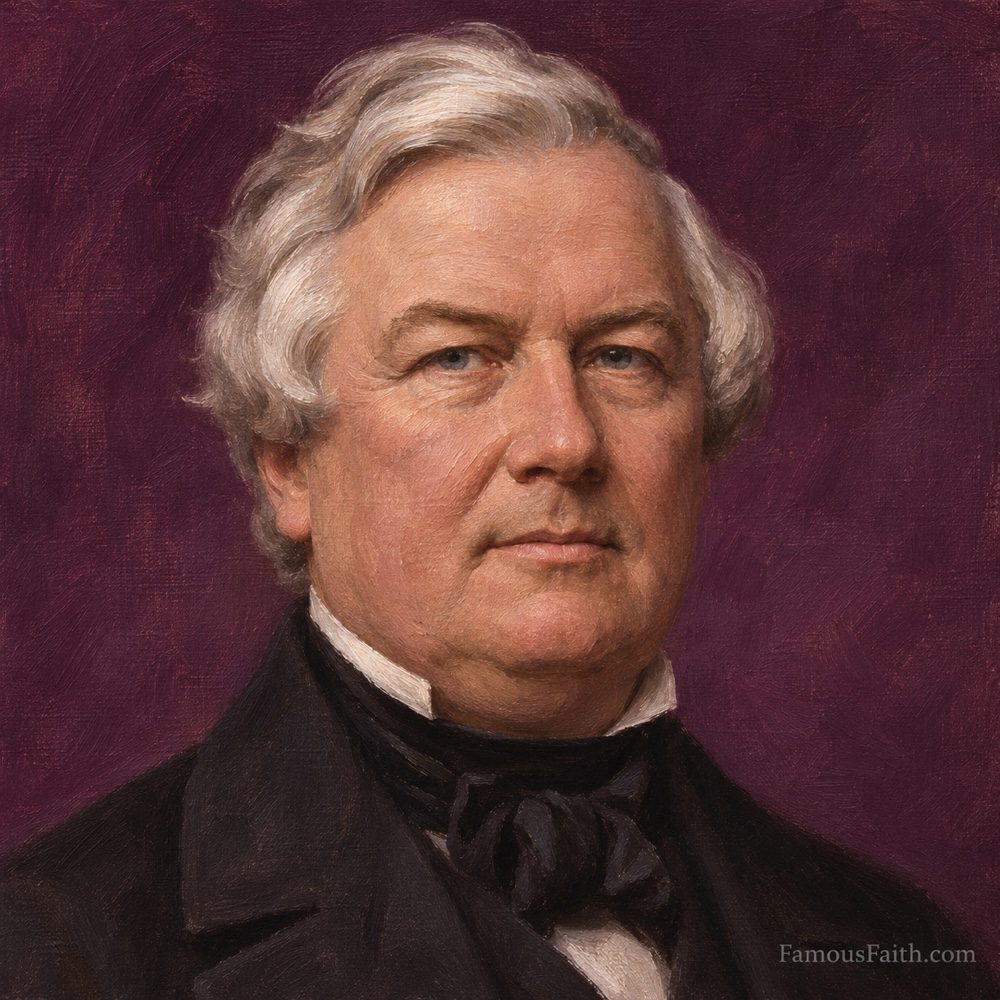
Portrait credit: Original AI-generated painted editorial illustration created for Famous Faith, with a subtle FamousFaith.com watermark. This is an artistic interpretation, not a historical photograph or an authenticated period painting.
Editorial approach: Documented actions and public statements are distinguished from Famous Faith’s biblical assessments. Public profession and church affiliation do not establish the condition of a person’s heart.