Famous Faith · U.S. Presidents
Martin Van Buren
Political organization, economic crisis, and the burden of succession.
Martin Van Buren helped organize a durable national party, then inherited a presidency overwhelmed by economic collapse. His record also includes responsibility for the Cherokee removal and a later change in his position on the expansion of slavery.
PRESIDENT 8
The essentials
Martin Van Buren at a glance
- Born
- December 5, 1782
- Died
- July 24, 1862
- Presidency
- March 4, 1837 – March 4, 1841
- Political party
- Democrat
- Church background
- Dutch Reformed
- Spouse
- February 21, 1807, to Hannah Hoes (1783–1819)
- Children
- Five sons; four survived childhood
- Other work
- Lawyer
- Presidential number
- 8
Basic biographical details: [1]. Family and religious qualifications are explained below.
The person behind the office
Life and family
Van Buren was born in Kinderhook, New York, into a Dutch-speaking community. He trained as a lawyer and built a career through New York politics before entering national office. He served as a senator, governor, secretary of state, and vice president. His ability to organize supporters, negotiate rivalries, and understand party machinery made him one of the most skilled political operators of his generation. [2] As an ally of Andrew Jackson, he helped build the Democratic Party and became Jackson’s chosen successor. His election in 1836 seemed to promise continuity. Instead, a financial crisis erupted shortly after he took office. A presidency intended to consolidate a political system became a struggle to respond to conditions that neither party organization nor personal skill could readily control. [3]
Spouse and children
Van Buren married Hannah Hoes in 1807. They had five sons, one of whom died in infancy. Hannah died in 1819, long before his presidency, and he did not remarry. His surviving sons remained important to his public and private life. His son Abraham served as his presidential secretary, and Abraham’s wife, Angelica Singleton Van Buren, undertook White House hostess duties during part of the administration. [4]
A public record
Major political accomplishments and decisions
- 01
Helped build a national party organization
Van Buren argued for disciplined political parties that could organize interests and sustain electoral competition. His work in New York and in Jackson’s coalition shaped the emerging Democratic Party. The achievement concerned institutions and strategy; it was not evidence that all interests represented by that coalition were just. [2]
- 02
Established an independent treasury system
After the Panic of 1837, Van Buren sought to separate federal funds from private banking arrangements. Congress enacted the Independent Treasury in 1840. The measure was a significant institutional response, but it did not quickly end unemployment, business failures, or the suffering of families facing the depression. [5]
- 03
Avoided some opportunities for foreign escalation
Van Buren handled tensions involving Britain and the Canadian border and postponed annexing Texas. His decisions reflected concern about conflict and the sectional consequences of expansion. Restraint in these areas belongs in the record beside the military force his administration continued to use against Native peoples. [6]
Public evidence and its limits
Faith and documented statements
Van Buren came from the Dutch Reformed tradition. That church background is well documented, but it should not become a substitute for evidence about his complete personal theology. A president’s denomination does not authorize Famous Faith to pronounce on the condition of his soul. [1] In his 1837 inaugural address, he expressed hope in the sustaining support of Providence and prayed for the country’s welfare and peace. His closing language echoed the biblical imagery of pleasant ways and peaceful paths. The address is a public religious statement, not a detailed explanation of salvation through Christ. [7] We can report its gratitude and dependence accurately while continuing to ask whether the policies of the administration treated vulnerable neighbors with the justice its religious language implied.
Famous Faith’s biblical perspective
Public virtues and serious concerns
The historical actions are sourced. Their evaluation through Scripture expresses Famous Faith’s Christian editorial perspective; it is not a claim to know anyone’s eternal destiny.
Institutional answers should be judged by their effects
The independent treasury addressed a real question about stewardship of public money. Christians can reasonably debate the design of financial institutions without treating a party program as Scripture. Famous Faith’s concern is that assessments of competence also include honesty, the burdens borne by ordinary households, and the temptation to protect political advantage while suffering continues.
Removal was his administration’s responsibility too
Van Buren oversaw the forced Cherokee removal known as the Trail of Tears and continued war against the Seminoles. He also worked to preserve the support of slaveholding interests. [3] Famous Faith regards forced displacement, racial bondage, and the disregard of human suffering as serious violations of biblical neighbor-love. Calling him merely the inheritor of Jackson’s policies would obscure the authority he himself exercised while president.
Beyond the familiar name
Interesting facts and useful distinctions
Born after independence
Van Buren was the first president born after the Declaration of Independence. His Dutch-speaking upbringing also distinguishes him from the more familiar image of the early Virginia presidents. [2]
A later political change
In 1848 he ran as the Free Soil presidential candidate, opposing slavery’s expansion into the territories. That later position should be dated honestly rather than used to erase the choices of his Democratic presidency. [8]
A life in perspective
What this legacy asks of us
Van Buren’s career combines real institutional skill with policies that caused profound harm. His later opposition to slavery’s expansion adds complexity, but does not retroactively transform his presidency. A Christian account should allow for change while refusing to make political ability or a later improvement an excuse for earlier injustice.
Our hope rests in Jesus Christ, not a president, party, lodge, or record of public service. Scripture teaches that all have sinned, that Christ died for sins and rose again, and that salvation is God’s gift through faith rather than an achievement we earn (Romans 3:23; 1 Corinthians 15:3–4; Ephesians 2:8–9). His call is to repentance and trust in him.
Sources and image credit
- Miller Center: Overview
- Miller Center: Life Before The Presidency
- Miller Center: Life In Brief
- Miller Center: Family Life
- Miller Center: Domestic Affairs
- Miller Center: Foreign Affairs
- Presidential statement: original transcript
- Miller Center: Impact And Legacy
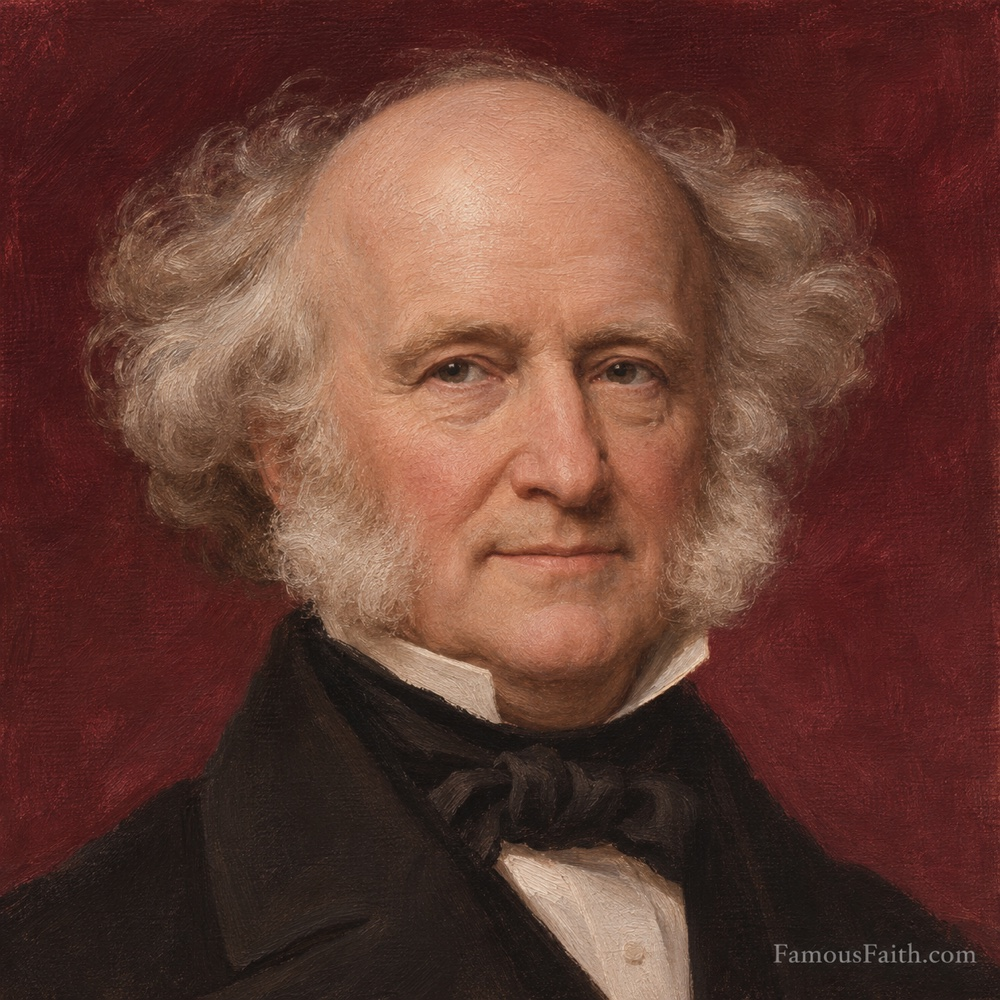
Portrait credit: Original AI-generated painted editorial illustration created for Famous Faith, with a subtle FamousFaith.com watermark. This is an artistic interpretation, not a historical photograph or an authenticated period painting.
Editorial approach: Documented actions and public statements are distinguished from Famous Faith’s biblical assessments. Public profession and church affiliation do not establish the condition of a person’s heart.