Famous Faith · U.S. Presidents
Lyndon B. Johnson
Civil-rights breakthroughs and the devastation of Vietnam.
Lyndon B. Johnson used extraordinary legislative skill to expand civil rights and social protection. The same presidency escalated the Vietnam War at enormous human cost. His religious language and limited Masonic initiation must be reported with the same precision as those contrasting political records.
PRESIDENT 36
The essentials
Lyndon B. Johnson at a glance
- Born
- August 27, 1908
- Died
- January 22, 1973
- Presidency
- November 22, 1963 – January 20, 1969
- Political party
- Democrat
- Church background
- Disciples of Christ
- Spouse
- November 17, 1934, to Claudia Alta “Lady Bird” Taylor (1912–2007)
- Children
- Two daughters: Lynda Bird and Luci Baines
- Other work
- Teacher, Public Official
- Presidential number
- 36
- Freemasonry
- Entered Apprentice only; did not advance
Basic biographical details: [1]. Family and religious qualifications are explained below.
The person behind the office
Life and family
Johnson grew up in Texas, trained as a teacher, and entered politics through congressional work and the New Deal. He served in the House and Senate, becoming a powerful Senate majority leader. His understanding of legislators’ interests, fears, and ambitions gave him unusual ability to build majorities and pressure opponents. That skill was central to the legislation associated with his presidency. [2] He became John Kennedy’s vice president in 1961 and succeeded him after the assassination in November 1963. A decisive electoral victory in 1964 gave him a mandate for the Great Society. At the same time, the growing war in Vietnam consumed resources, damaged credibility, and fractured the political coalition on which his domestic ambitions depended. He did not seek another term in 1968. [3]
Spouse and children
Johnson married Claudia Alta Taylor, known as Lady Bird, in 1934. Their daughters were Lynda Bird and Luci Baines. Lady Bird was an important political partner with business experience and a public role of her own. Both daughters married during his presidency, one at the White House. The family’s ranch served as a refuge and a working political setting, but the household remained subject to the pressures of war and a demanding presidential personality. [4]
A public record
Major political accomplishments and decisions
- 01
Secured landmark civil-rights legislation
Johnson signed the Civil Rights Act of 1964 and the Voting Rights Act of 1965. Congressional coalitions and the courage of the civil-rights movement were essential. Presidential leadership mattered, but the achievement must not erase the people whose organizing and sacrifice made action unavoidable. [5]
- 02
Expanded health and social programs
Medicare, Medicaid, education measures, and the War on Poverty changed the federal government’s role in daily life. Supporters and critics have debated their design and results, but the scope of the legislative program is clear. Compassionate intention and practical effectiveness remain distinct questions. [5]
- 03
Escalated American involvement in Vietnam
Johnson dramatically increased American troop levels and bombing. The war caused enormous loss of life and growing public opposition. It was not a conflict he inherited without choices: the decisions to expand and sustain it formed a central part of his own presidential responsibility. [6]
Public evidence and its limits
Faith and documented statements
Johnson’s religious background was the Disciples of Christ. In his 1965 inaugural address, he spoke of an oath taken before God and warned that the country had no promise from God that its greatness would endure. Those are documented expressions of public religious conviction and national accountability. [1] [7] Famous Faith welcomes the rejection of an automatic divine guarantee for national success. Such language does not prove a complete doctrinal confession or remove the duty to examine policy. His Masonic connection also requires a specific distinction: he received the first degree but did not become a Fellowcraft or Master Mason. A Christian assessment should be firm about spiritual concerns without inflating the historical record.
Famous Faith’s biblical perspective
Public virtues and serious concerns
The historical actions are sourced. Their evaluation through Scripture expresses Famous Faith’s Christian editorial perspective; it is not a claim to know anyone’s eternal destiny.
Equal rights required law and protection
The civil-rights and voting legislation addressed entrenched injustice. Famous Faith regards the protection of neighbors from racial exclusion as consistent with biblical impartiality and human dignity. Its achievement involved a broad movement, but Johnson’s willingness to spend political capital on it deserves acknowledgment. Neither party history nor his other failures should erase that contribution.
War required truthfulness and regard for human life
The escalation in Vietnam produced catastrophic suffering and a widening gap between official assurances and the war’s reality. [6] Famous Faith believes national prestige and a leader’s fear of political defeat are inadequate measures of whether to continue a war. Christian responsibility requires honesty, attention to civilian lives, and a willingness to reconsider policies whose costs fall heavily on others.
Beyond the familiar name
Interesting facts and useful distinctions
A law is not the work of one person
The Great Society depended on congressional action, movement pressure, and administrative work. Johnson’s legislative skill was substantial, but the people seeking civil rights were participants in the achievement rather than passive recipients of a president’s generosity. [5]
One Johnson is not the other
Lyndon Johnson was the thirty-sixth president. Andrew Johnson, the seventeenth, governed a century earlier and opposed important Reconstruction protections. Their records should not be merged merely because they share a surname.
A life in perspective
What this legacy asks of us
Johnson’s presidency contains both extraordinary advances in civil rights and profound failures in war. A Christian account must be able to recognize both. The same concern for the dignity of a neighbor that welcomes protection at home should also ask difficult questions about the lives placed at risk abroad.
Our hope rests in Jesus Christ, not a president, party, lodge, or record of public service. Scripture teaches that all have sinned, that Christ died for sins and rose again, and that salvation is God’s gift through faith rather than an achievement we earn (Romans 3:23; 1 Corinthians 15:3–4; Ephesians 2:8–9). His call is to repentance and trust in him.
Sources and image credit
- Miller Center: Overview
- Miller Center: Life Before The Presidency
- Miller Center: Life In Brief
- Miller Center: Family Life
- Miller Center: Domestic Affairs
- Miller Center: Foreign Affairs
- Presidential statement: original transcript
- Johnson City Lodge No. 561: Lodge History
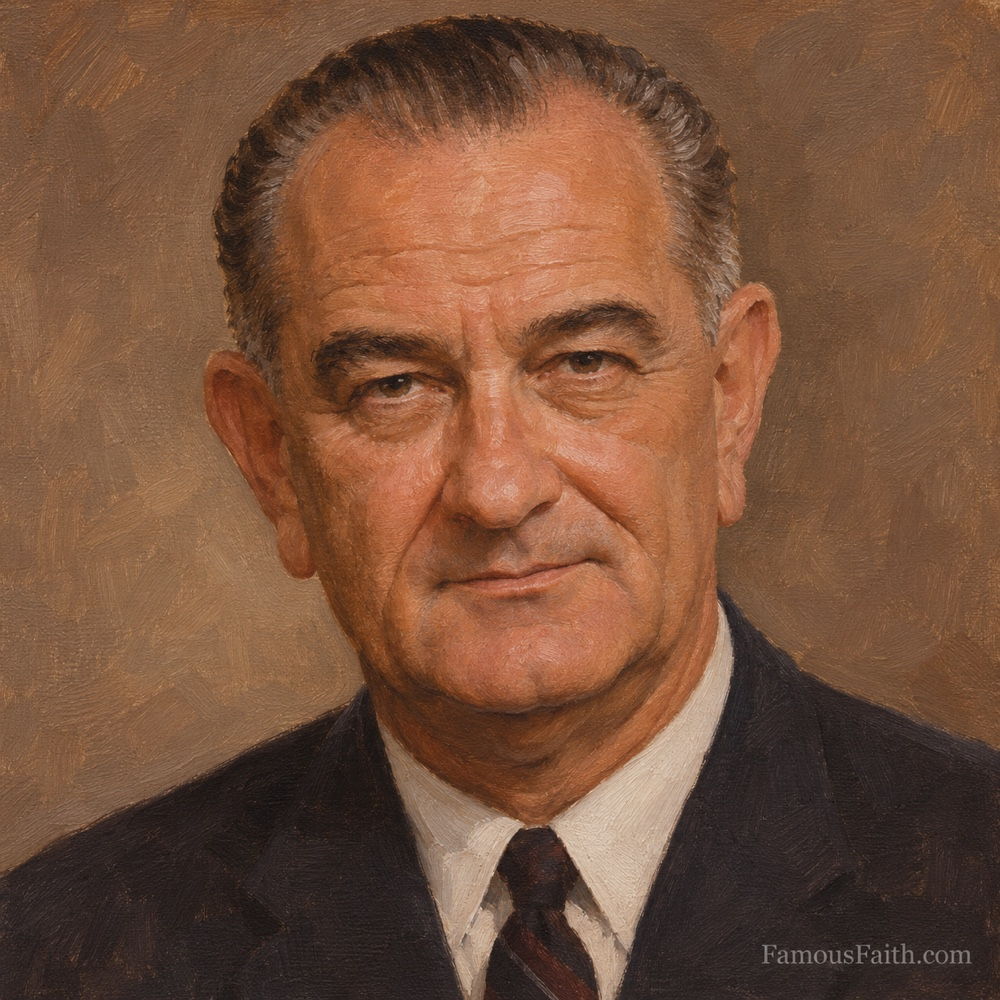
Portrait credit: Original AI-generated painted editorial illustration created for Famous Faith, with a subtle FamousFaith.com watermark. This is an artistic interpretation, not a historical photograph or an authenticated period painting.
Editorial approach: Documented actions and public statements are distinguished from Famous Faith’s biblical assessments. Public profession and church affiliation do not establish the condition of a person’s heart.