Famous Faith · U.S. Presidents
John Tyler
Succession, political isolation, and a consequential defense of slavery.
John Tyler established that a vice president could succeed to the presidency in full. His insistence on executive independence shaped the office, while his support for slavery, territorial expansion, and eventually the Confederacy requires a sober moral assessment.
PRESIDENT 10
The essentials
John Tyler at a glance
- Born
- March 29, 1790
- Died
- January 18, 1862
- Presidency
- April 4, 1841 – March 4, 1845
- Political party
- Elected vice president as a Whig; expelled from the party as president
- Church background
- Episcopalian
- Spouse
- March 29, 1813, to Letitia Christian (1790–1842); June 26, 1844, to Julia Gardiner (1820–1889)
- Children
- Fifteen children: eight with Letitia and seven with Julia
- Other work
- Lawyer
- Presidential number
- 10
Basic biographical details: [1]. Family and religious qualifications are explained below.
The person behind the office
Life and family
Tyler grew up within Virginia’s planter elite, studied at William and Mary, trained as a lawyer, and entered state politics. He later served in Congress, as governor of Virginia, and in the Senate. His distrust of concentrated federal power shaped a long political career, although his own actions as president demonstrated how much authority the executive office could exercise. [2] The Whigs selected him as William Henry Harrison’s running mate in 1840. When Harrison died in April 1841, Tyler insisted that he became president rather than merely an acting officer. Conflict soon developed with Whig leaders over banking and other policies. His party expelled him, most of his cabinet resigned, and his administration continued without a dependable national party behind it. [3]
Spouse and children
Tyler married Letitia Christian in 1813, and they had eight children. Letitia died during his presidency in 1842. He married Julia Gardiner in 1844; they had seven children. The total of fifteen includes a child who died in infancy, a detail that explains why shorter family accounts sometimes give a different number. A large household and persistent financial pressure formed part of a private life often obscured by his unusual political position. [1] [4]
A public record
Major political accomplishments and decisions
- 01
Established a decisive succession precedent
Tyler asserted the full powers and title of president after Harrison’s death. That response became an important precedent for later successions. It should be distinguished from the later constitutional language of the Twenty-fifth Amendment, which did not exist during his administration. [5]
- 02
Helped resolve a dispute with Britain
The Webster-Ashburton Treaty of 1842 settled the disputed northeastern boundary and addressed other issues between the United States and Britain. Secretary of State Daniel Webster’s diplomacy was essential. Tyler’s isolation at home did not prevent the administration from conducting consequential foreign negotiations. [6]
- 03
Advanced the annexation of Texas
Tyler signed the congressional resolution offering annexation near the end of his term. Texas entered the Union under James K. Polk later in 1845. The distinction matters: Tyler advanced the process, but statehood itself occurred after he left office. Slavery and the risk of conflict with Mexico were central to the controversy. [6]
Public evidence and its limits
Faith and documented statements
Tyler’s church background was Episcopalian. The sources used here do not provide a sufficient basis for an elaborate account of his personal conversion, sacramental practice, or complete doctrinal commitments. Famous Faith therefore reports the affiliation without converting it into an assurance about his spiritual condition. [1] In his April 1841 address on assuming office, Tyler described Harrison’s death in the language of Providence, promised prayer for guidance, and acknowledged dependence on the Being who had made him. The statement is a documented religious expression at a moment of constitutional uncertainty. [7] A public promise to seek divine guidance still leaves the moral character of particular decisions open to examination. The Bible does not authorize Christians to treat a leader’s religious language as a substitute for justice.
Famous Faith’s biblical perspective
Public virtues and serious concerns
The historical actions are sourced. Their evaluation through Scripture expresses Famous Faith’s Christian editorial perspective; it is not a claim to know anyone’s eternal destiny.
Continuity of government can protect the public
Tyler’s handling of succession helped prevent an immediate struggle over who could exercise executive authority. Orderly institutions can protect people from conflict and uncertainty. Famous Faith can appreciate that contribution while asking whether the powers thereby secured were used honestly, impartially, and in service of neighbors rather than personal vindication.
States’ rights did not justify slavery or secession
Tyler’s political commitments included the defense of slaveholding interests. In his later life he sided with secession and the Confederacy. [2] [5] Famous Faith rejects the use of constitutional arguments or regional loyalty to make human bondage morally acceptable. Genesis 1:27 grounds dignity in God’s image, not state boundaries or the legal status assigned by a slaveholding society. His succession precedent does not cancel that grave failure.
Beyond the familiar name
Interesting facts and useful distinctions
A president without his elected party
Tyler’s expulsion from the Whigs made him an unusual president governing without the party that had placed him on its ticket. The episode shows that a shared election victory need not imply a shared governing program. [8]
Two marriages, a very large family
Tyler married Julia Gardiner while president and continued having children long after leaving office. His fifteen children make his family exceptional in presidential history. [1]
A life in perspective
What this legacy asks of us
Tyler’s career illustrates why institutional importance and moral admiration are different judgments. He helped clarify the presidency’s continuity while supporting a social order built on enslavement. A Christian account should tell both parts of the story and refuse to let a successful constitutional precedent become a blanket endorsement of the man.
Our hope rests in Jesus Christ, not a president, party, lodge, or record of public service. Scripture teaches that all have sinned, that Christ died for sins and rose again, and that salvation is God’s gift through faith rather than an achievement we earn (Romans 3:23; 1 Corinthians 15:3–4; Ephesians 2:8–9). His call is to repentance and trust in him.
Sources and image credit
- Miller Center: Overview
- Miller Center: Life Before The Presidency
- Miller Center: Life In Brief
- Miller Center: Family Life
- Miller Center: Impact And Legacy
- Miller Center: Foreign Affairs
- Presidential statement: original transcript
- Miller Center: Domestic Affairs
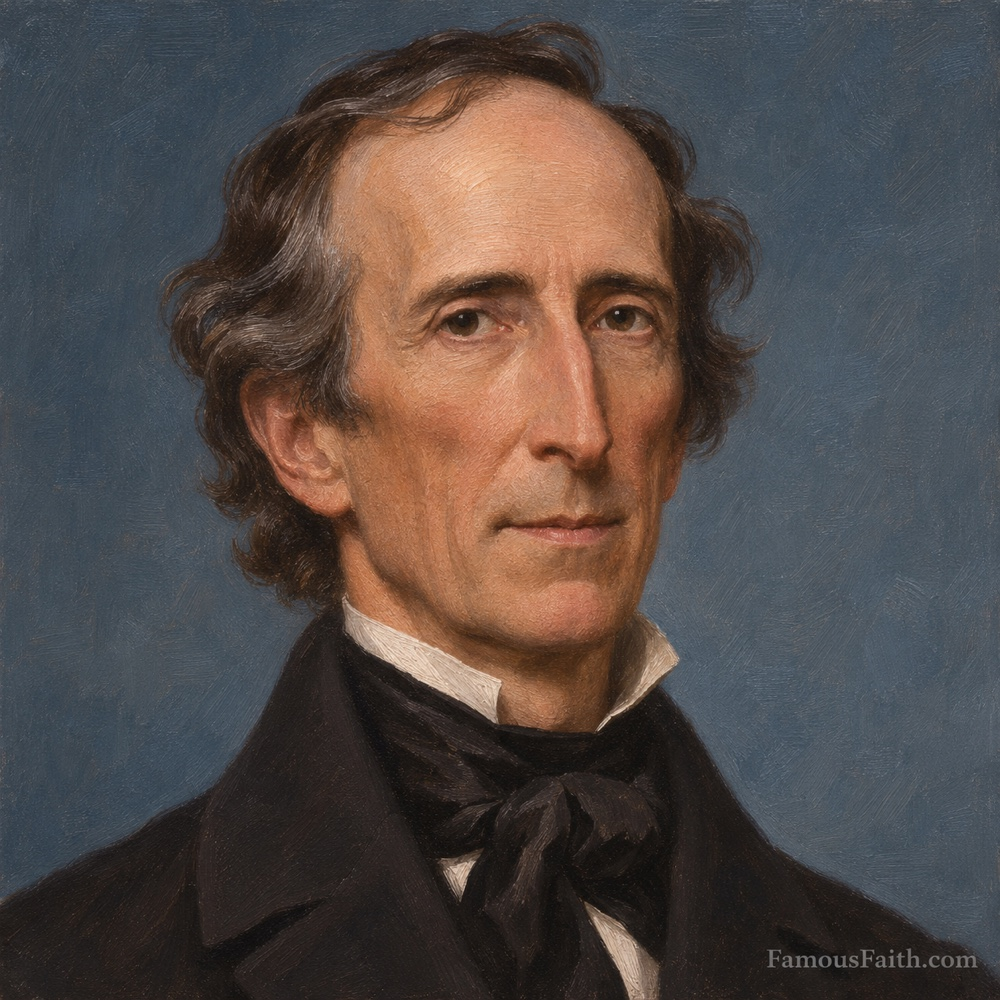
Portrait credit: Original AI-generated painted editorial illustration created for Famous Faith, with a subtle FamousFaith.com watermark. This is an artistic interpretation, not a historical photograph or an authenticated period painting.
Editorial approach: Documented actions and public statements are distinguished from Famous Faith’s biblical assessments. Public profession and church affiliation do not establish the condition of a person’s heart.