Famous Faith · U.S. Presidents
John Quincy Adams
A lifetime of diplomacy, Scripture, and resistance to slavery.
John Quincy Adams’s presidency was only one chapter in an exceptionally long public life. His diplomatic achievements and later opposition to slavery deserve attention alongside a religious outlook that combined regular Bible reading with Unitarian convictions.
PRESIDENT 6
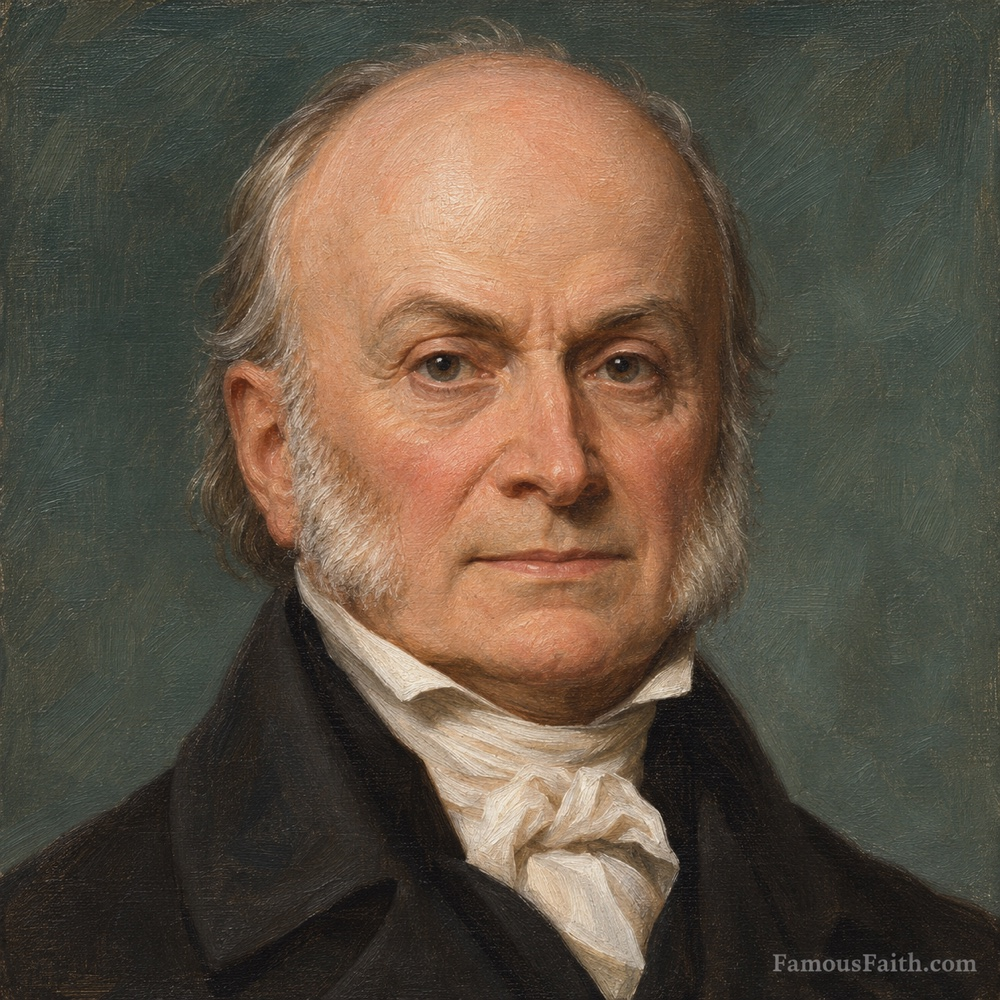
The essentials
John Quincy Adams at a glance
- Born
- July 11, 1767
- Died
- February 23, 1848
- Presidency
- March 4, 1825 – March 4, 1829
- Political party
- Democratic-Republican / National Republican as president; earlier Federalist, later Whig
- Church background
- Unitarian
- Spouse
- July 26, 1797, to Louisa Catherine Johnson (1775–1852)
- Children
- Four: George, John, Charles Francis, and Louisa Catherine
- Other work
- Lawyer, Senator, Diplomat
- Presidential number
- 6
Basic biographical details: [1]. Family and religious qualifications are explained below.
The person behind the office
Life and family
Adams entered the world of diplomacy as a boy accompanying his father, John Adams, to Europe. He learned languages, observed courts and governments, studied at Harvard, and developed a career as a diplomat, senator, and secretary of state. His experience in international affairs was extensive before he became president. [2] As James Monroe’s secretary of state, he helped negotiate the acquisition of Florida and shape the policy later known as the Monroe Doctrine. He won the presidency after the election of 1824 went to the House of Representatives because no candidate had an electoral majority. Andrew Jackson’s supporters condemned the outcome as a corrupt bargain, an accusation that should be identified as a political charge rather than repeated as an established agreement. His administration then struggled against organized opposition. [3]
Spouse and children
Adams married Louisa Catherine Johnson in 1797. Their four children were George Washington, John, Charles Francis, and Louisa Catherine. Their daughter died in infancy, and only Charles Francis outlived both parents. Family relationships could be strained by Adams’s demanding habits and public commitments. Louisa brought her own international experience and political intelligence to a household that cannot be understood solely through the president’s diaries. [4]
A public record
Major political accomplishments and decisions
- 01
Helped define American diplomacy
As secretary of state, Adams negotiated the Adams-Onís Treaty with Spain and played a major part in developing the Monroe Doctrine. Those achievements preceded his presidency and should be dated accordingly. They helped establish borders and articulate an independent American position toward European power. [2]
- 02
Proposed a broad national development program
As president, he supported transportation improvements, education, and scientific advancement. His ambitions for national development were wider than the measures a hostile political environment allowed him to enact. A fair account distinguishes proposals, legislative results, and ideas whose influence developed later. [5]
- 03
Challenged the suppression of antislavery petitions
After leaving the White House, Adams served in the House of Representatives. He became an important opponent of the gag rule restricting consideration of antislavery petitions. This post-presidential work, rather than a major emancipation measure during his presidency, established much of his later reputation. [3]
Public evidence and its limits
Faith and documented statements
Adams read the Bible regularly and attended church. The Miller Center describes his joining the Unitarian branch of the Congregational tradition while also questioning doctrines including Christ’s divinity. These details make it misleading either to call him indifferent to Scripture or to present him as an uncomplicated example of orthodox evangelical belief. [4] In his 1825 inaugural address, he used the biblical image of the watchman laboring in vain without God’s protection and committed his country’s future to Providence. The address documents his use of Scripture in public life. [6] Famous Faith welcomes serious attention to the Bible while insisting that Jesus’s identity cannot be reduced to that of an admirable teacher. John 1:1–14 and the resurrection testimony of 1 Corinthians 15 belong to the substance of the Christian faith.
Famous Faith’s biblical perspective
Public virtues and serious concerns
The historical actions are sourced. Their evaluation through Scripture expresses Famous Faith’s Christian editorial perspective; it is not a claim to know anyone’s eternal destiny.
Persistence against silencing the vulnerable
Adams’s struggle over antislavery petitions illustrates how procedural rules can conceal a moral issue. Protecting the ability to present those petitions challenged an institution invested in avoiding the subject. [3] Famous Faith sees an appropriate connection with Proverbs 31:8–9 and its call to speak for those denied a voice. The principle requires courage when the people seeking justice have little political power.
Learning and piety require theological discernment
Adams’s disciplined reading, education, and church attendance are worth describing accurately. They do not settle disagreements over the nature of Christ or become a substitute for the gospel. We also resist treating his later moral courage as evidence that every earlier diplomatic or political decision was just. A life can show important growth without becoming a flawless religious example.
Beyond the familiar name
Interesting facts and useful distinctions
A president who returned to the House
Adams’s long congressional career followed his single presidential term. Leaving the highest office did not end his public service or his ability to influence national debates. [3]
Diaries and daily discipline
His habits included early rising, Bible reading, exercise, and keeping a diary. The records are valuable evidence, but neither a demanding routine nor a religious vocabulary reveals everything about a person’s spiritual condition. [4]
A life in perspective
What this legacy asks of us
John Quincy Adams is a reminder that a presidency need not contain the most significant moral work of a public life. His later persistence against slavery deserves recognition. His theological convictions also deserve accurate description, so that admiration for his courage does not require readers to endorse every belief he held.
Our hope rests in Jesus Christ, not a president, party, lodge, or record of public service. Scripture teaches that all have sinned, that Christ died for sins and rose again, and that salvation is God’s gift through faith rather than an achievement we earn (Romans 3:23; 1 Corinthians 15:3–4; Ephesians 2:8–9). His call is to repentance and trust in him.
Sources and image credit
- Miller Center: Overview
- Miller Center: Life Before The Presidency
- Miller Center: Life In Brief
- Miller Center: Family Life
- Miller Center: Domestic Affairs
- Presidential statement: original transcript
Portrait credit: Original AI-generated painted editorial illustration created for Famous Faith, with a subtle FamousFaith.com watermark. This is an artistic interpretation, not a historical photograph or an authenticated period painting.
Editorial approach: Documented actions and public statements are distinguished from Famous Faith’s biblical assessments. Public profession and church affiliation do not establish the condition of a person’s heart.