Famous Faith · U.S. Presidents
John F. Kennedy
Catholic identity, Cold War restraint, and a divided private legacy.
John F. Kennedy became the first Roman Catholic president and led during some of the Cold War’s most dangerous confrontations. His calls to service and religious liberty deserve attention alongside failed intervention, an unfinished civil-rights program, and marital infidelity.
PRESIDENT 35
The essentials
John F. Kennedy at a glance
- Born
- May 29, 1917
- Died
- November 22, 1963
- Presidency
- January 20, 1961 – November 22, 1963
- Political party
- Democrat
- Church background
- Roman Catholic
- Spouse
- September 12, 1953 to Jacqueline Lee Bouvier (1929–1994)
- Children
- Caroline, John Jr., Patrick, and a stillborn daughter; Patrick died in infancy
- Other work
- Author, U.S. Navy Officer, Journalist, Public Official
- Presidential number
- 35
Basic biographical details: [1]. Family and religious qualifications are explained below.
The person behind the office
Life and family
Kennedy grew up in a wealthy Irish Catholic family, studied at Harvard, and served in the Navy during World War II. He later became a congressman and senator from Massachusetts. His background combined unusual privilege, serious health challenges, wartime experience, and a family deeply invested in political advancement. His election as a Democrat in 1960 brought a younger generation’s public image to the White House. [2] Kennedy’s presidency lasted less than three years. The Bay of Pigs invasion failed, the Berlin confrontation intensified, and the Cuban missile crisis brought the danger of nuclear war close to immediate reality. At home, his administration advanced proposals whose most important legislative results often came after his death. His assassination in November 1963 should not cause intentions and later achievements to merge into a single idealized record. [3]
Spouse and children
Kennedy married Jacqueline Lee Bouvier in 1953. Their family included a stillborn daughter, Caroline, John Jr., and Patrick, who died shortly after birth in 1963. These losses are part of the household’s history as surely as the familiar images of young children in the White House. [4] [5] Historical scholarship also documents Kennedy’s extramarital relationships. Famous Faith regards marital betrayal as a serious wrong and does not treat charm, public service, or a religious identity as a reason to trivialize it. [6]
A public record
Major political accomplishments and decisions
- 01
Helped avoid nuclear war in the Cuban missile crisis
Kennedy combined pressure with negotiation during the 1962 confrontation over Soviet missiles in Cuba. The settlement avoided immediate war. Recognition of that restraint should not erase the miscalculations and earlier policies that helped produce the dangerous setting. [7]
- 02
Advanced service and the space program
The Peace Corps and the commitment to a crewed lunar landing became major symbols of his administration. The moon landing itself occurred in 1969, under Nixon, after years of work across administrations. Kennedy set an important national objective rather than personally completing the mission. [8]
- 03
Moved toward stronger civil-rights legislation
Kennedy eventually proposed a major civil-rights bill and used federal authority during integration crises. The Civil Rights Act became law under Lyndon Johnson in 1964. His role deserves recognition without assigning him the signature or congressional coalition that came after his death. [8]
Public evidence and its limits
Faith and documented statements
Kennedy was Roman Catholic. During the 1960 campaign, he addressed Protestant ministers in Houston about religious liberty, opposition to religious tests, and the independence of presidential decisions from clerical direction. The speech is a documented statement about his faith’s relationship to public office, not a complete explanation of Christian doctrine. [9] In his inaugural address, Kennedy described human rights as coming from God rather than the generosity of the state. [10] Famous Faith can recognize that grounding of dignity while examining whether his own conduct honored it. A Christian profile should avoid both anti-Catholic prejudice and the assumption that a church identity proves faithfulness in personal or political life.
Famous Faith’s biblical perspective
Public virtues and serious concerns
The historical actions are sourced. Their evaluation through Scripture expresses Famous Faith’s Christian editorial perspective; it is not a claim to know anyone’s eternal destiny.
Restraint and the dignity of conscience
Kennedy’s willingness to negotiate during the missile crisis and his rejection of religious exclusion deserve recognition. Famous Faith regards the pursuit of peace and the protection of conscience as serious moral responsibilities. Protecting religious liberty does not require saying that every theology is equally true, and seeking peace does not eliminate the need for prudent protection of the public.
Service did not excuse betrayal or intervention’s costs
The failed Bay of Pigs operation and the expansion of American involvement in Vietnam require scrutiny of judgment and the effects on other peoples. [7] His marital infidelity also contradicted the faithfulness owed within marriage. [6] Famous Faith applies the same moral standard to an admired president that it would apply to a political opponent: achievements do not make private vows or the lives of foreign neighbors unimportant.
Beyond the familiar name
Interesting facts and useful distinctions
First Catholic president
Kennedy’s election was a major event in American religious and political history. The opposition he faced over Catholic identity is part of the context of his Houston address. [9]
Youngest elected, not youngest to serve
Kennedy was the youngest person elected president. Theodore Roosevelt was younger when he assumed the office after McKinley’s death, a different distinction that is often confused with Kennedy’s. [3]
A life in perspective
What this legacy asks of us
Kennedy’s assassination strengthened the appeal of an unfinished presidency. Christian discernment requires more than affection for its image. His service, religious-liberty arguments, and restraint in crisis deserve recognition, while the failures of policy and fidelity must remain visible. Hope for a nation cannot depend on the glamour of its leaders.
Our hope rests in Jesus Christ, not a president, party, lodge, or record of public service. Scripture teaches that all have sinned, that Christ died for sins and rose again, and that salvation is God’s gift through faith rather than an achievement we earn (Romans 3:23; 1 Corinthians 15:3–4; Ephesians 2:8–9). His call is to repentance and trust in him.
Sources and image credit
- Miller Center: Overview
- Miller Center: Life Before The Presidency
- Miller Center: Life In Brief
- Miller Center: Family Life
- TIME: Jacqueline Kennedy’s Family and Public Life
- Cambridge University Press: Kennedy Historical Study, Sample
- Miller Center: Foreign Affairs
- Miller Center: Domestic Affairs
- Kennedy: Address to the Greater Houston Ministerial Association
- Presidential statement: original transcript
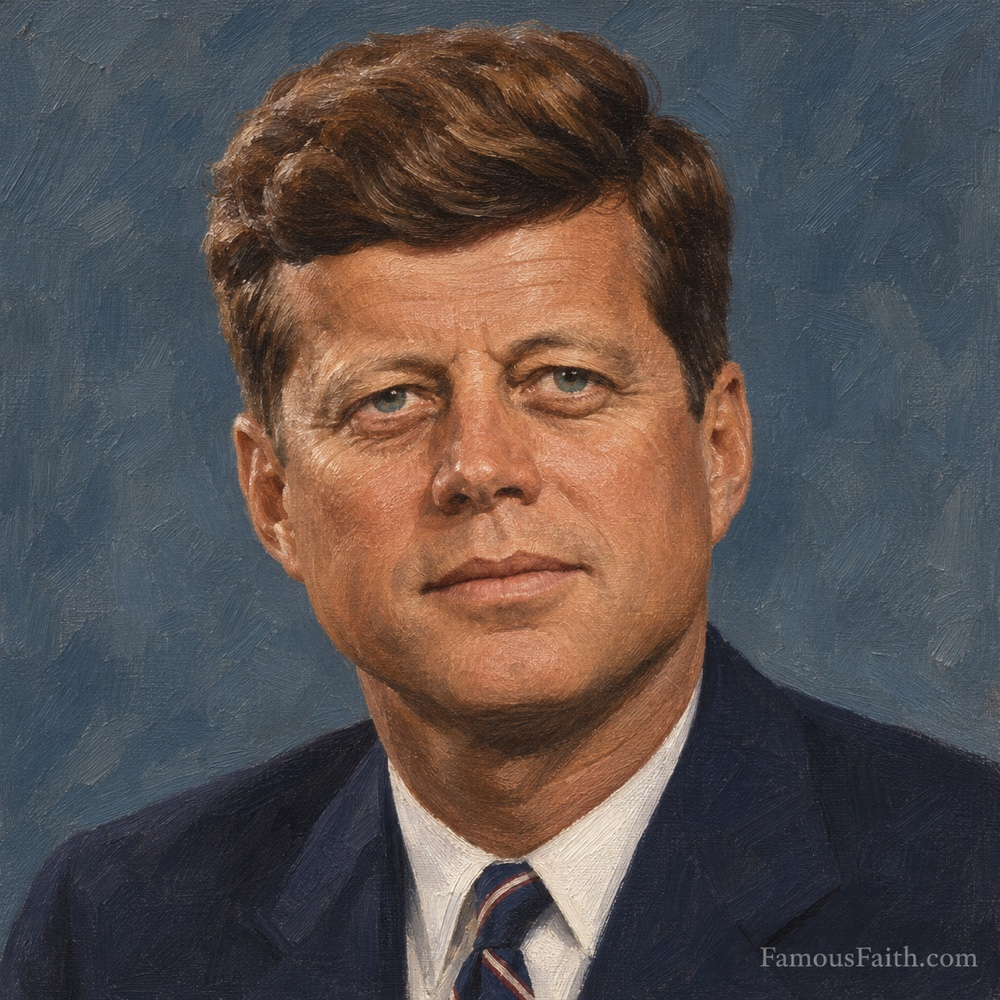
Portrait credit: Original AI-generated painted editorial illustration created for Famous Faith, with a subtle FamousFaith.com watermark. This is an artistic interpretation, not a historical photograph or an authenticated period painting.
Editorial approach: Documented actions and public statements are distinguished from Famous Faith’s biblical assessments. Public profession and church affiliation do not establish the condition of a person’s heart.