Famous Faith · U.S. Presidents
James Monroe
An expanding republic and the limits of good feelings.
James Monroe brought revolutionary service and diplomatic experience to the presidency. His administration shaped American borders and foreign policy, but the Era of Good Feelings also concealed divisions over slavery, economic hardship, and the treatment of Native peoples.
PRESIDENT 5
The essentials
James Monroe at a glance
- Born
- April 28, 1758
- Died
- July 4, 1831
- Presidency
- March 4, 1817 – March 4, 1825
- Political party
- Democratic-Republican
- Church background
- Episcopalian
- Spouse
- February 16, 1786, to Elizabeth Kortright (1768–1830)
- Children
- Three: Eliza, James Spence, and Maria Hester; James died in infancy
- Other work
- Lawyer
- Presidential number
- 5
- Freemasonry
- Documented affiliation
Basic biographical details: [1]. Family and religious qualifications are explained below.
The person behind the office
Life and family
Monroe left his studies at William and Mary to serve in the Revolution and was wounded at the Battle of Trenton. He later trained in law and built a long public career as a legislator, senator, governor, diplomat, and cabinet secretary. These experiences made him much more than the name attached to a foreign-policy doctrine. He worked with several of the leaders who had founded the new republic. [2] Before becoming president, Monroe helped negotiate the Louisiana Purchase and served as secretary of state under James Madison. During part of the War of 1812 he also carried responsibilities as secretary of war. He entered the presidency in 1817 as a Democratic-Republican, at a time when the older Federalist opposition had weakened substantially. [3]
Spouse and children
Monroe married Elizabeth Kortright in 1786. They had three children: Eliza Kortright, James Spence, and Maria Hester. Their son died in infancy. The family often accompanied Monroe on diplomatic assignments, and their daughters received serious attention to education. During Elizabeth’s periods of ill health, Eliza helped with White House hosting. Those family arrangements are part of the story behind the formal image of the fifth president. [4]
A public record
Major political accomplishments and decisions
- 01
Helped settle important boundaries
Monroe’s administration worked with Britain on the Rush-Bagot agreement and the Convention of 1818. These arrangements limited naval forces on the Great Lakes and settled part of the northern boundary. Negotiation reduced some sources of conflict left by the War of 1812. [5]
- 02
Acquired Florida through the Adams-Onís Treaty
Secretary of State John Quincy Adams negotiated the 1819 treaty under Monroe. Spain transferred Florida, and the two governments addressed competing territorial claims. The diplomatic achievement belonged to an administration operating amid military pressure and conflict with Native communities, not a peaceful transaction without human costs. [5]
- 03
Announced the Monroe Doctrine
Monroe’s 1823 message warned against new European colonization and interference in the Americas. The statement later became a major reference point in American diplomacy. Its later uses should not all be attributed to Monroe’s original intentions or treated as a timeless endorsement of every American intervention. [5]
Public evidence and its limits
Faith and documented statements
The Miller Center identifies Monroe’s religious affiliation as Episcopalian. The surviving public evidence does not justify a confident account of all his private theological convictions. Famous Faith therefore distinguishes his background from a detailed confession of Christian doctrine. [1] In his first inaugural address in 1817, Monroe referred to a gracious Providence and ended with prayers to the Almighty for continued protection. Those statements show public acknowledgment of divine help. They do not establish that national prosperity was proof of God’s approval of every policy, or that an inaugural prayer resolves questions about personal saving faith. Christians should read the words honestly without adding a testimony Monroe did not leave in that address. [6]
Famous Faith’s biblical perspective
Public virtues and serious concerns
The historical actions are sourced. Their evaluation through Scripture expresses Famous Faith’s Christian editorial perspective; it is not a claim to know anyone’s eternal destiny.
Diplomacy and peaceful settlements
The administration’s negotiated agreements with Britain show the value of settling disputes before they become new wars. Famous Faith sees a connection with the biblical pursuit of peace and the responsibility to protect the lives of neighbors. This appreciation does not turn territorial enlargement itself into a biblical virtue or settle the justice of every claim made by the expanding United States.
Slavery remained embedded in the political settlement
Monroe signed the Missouri Compromise, which managed sectional conflict while permitting Missouri’s admission as a slave state. He also belonged to the slaveholding Virginia political world. [7] [2] The appearance of national harmony could therefore rest on the continued bondage of other people. Famous Faith rejects measuring good government solely by whether powerful factions stop fighting. Justice for those excluded from the bargain matters under Genesis 1:27 and the command to love one’s neighbor.
Beyond the familiar name
Interesting facts and useful distinctions
Good feelings did not mean universal well-being
The familiar era label grew from Monroe’s warmly received 1817 tour. The Panic of 1819 and the Missouri controversy show why the phrase cannot stand for the experience of everyone living in the country. [7]
Another Fourth of July death
Monroe died on July 4, 1831. Adams and Jefferson had died on the same date five years earlier, making the anniversary a striking part of early presidential memory. [1]
A life in perspective
What this legacy asks of us
Monroe’s presidency helped define the republic’s outward position while leaving deep internal injustices unresolved. A responsible profile can recognize diplomatic skill and public service without presenting national expansion, a church label, or a famous name as evidence of spiritual faithfulness.
Our hope rests in Jesus Christ, not a president, party, lodge, or record of public service. Scripture teaches that all have sinned, that Christ died for sins and rose again, and that salvation is God’s gift through faith rather than an achievement we earn (Romans 3:23; 1 Corinthians 15:3–4; Ephesians 2:8–9). His call is to repentance and trust in him.
Sources and image credit
- Miller Center: Overview
- Miller Center: Life Before The Presidency
- Miller Center: Life In Brief
- Miller Center: Family Life
- Miller Center: Foreign Affairs
- Presidential statement: original transcript
- Miller Center: Domestic Affairs
- James Monroe Museum: Freemasonry & Monroe
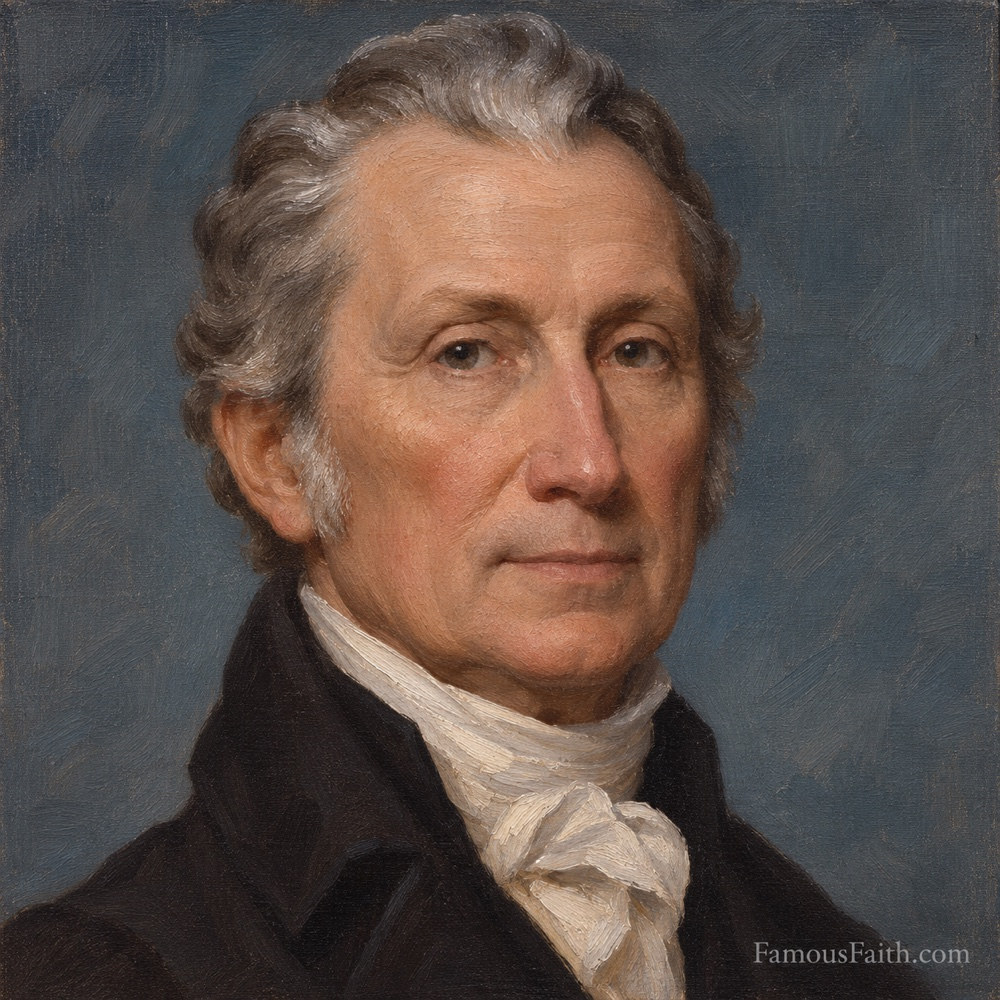
Portrait credit: Original AI-generated painted editorial illustration created for Famous Faith, with a subtle FamousFaith.com watermark. This is an artistic interpretation, not a historical photograph or an authenticated period painting.
Editorial approach: Documented actions and public statements are distinguished from Famous Faith’s biblical assessments. Public profession and church affiliation do not establish the condition of a person’s heart.